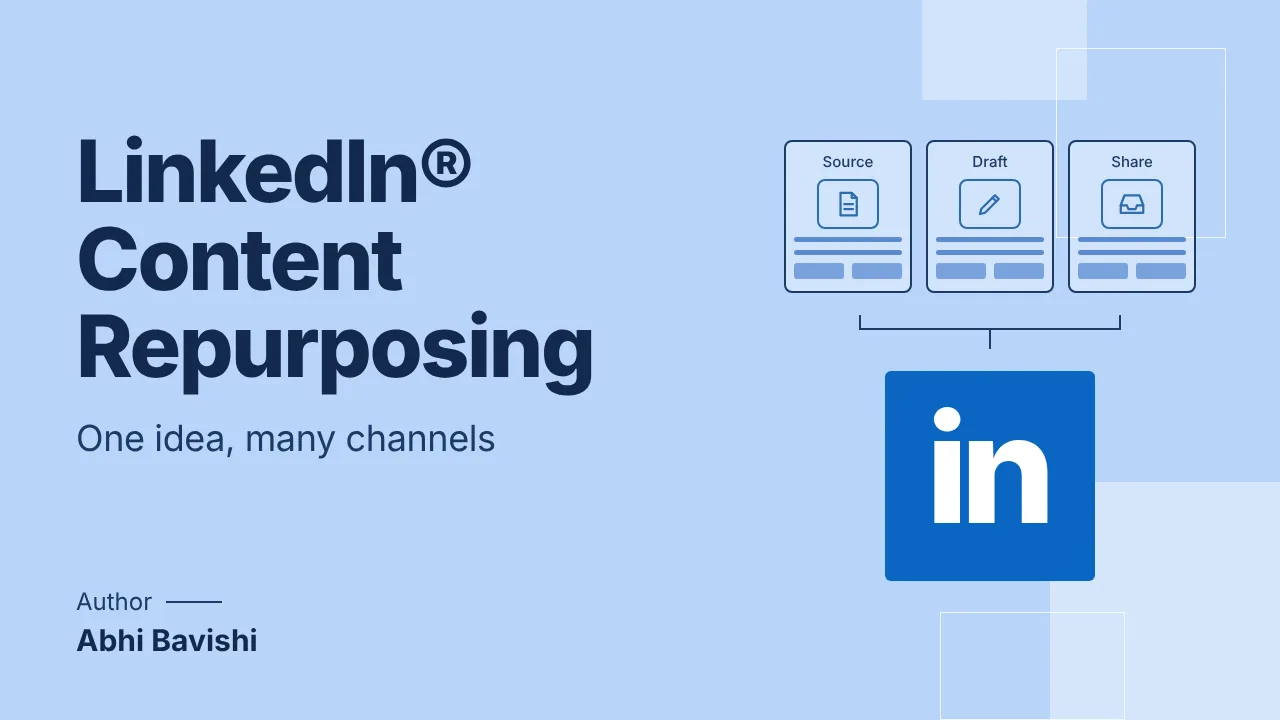
Content repurposing turns one useful source into distinct pieces for LinkedIn®, a blog, YouTube and a newsletter. Give each version its own reader task, adapt the explanation to the format, carry the evidence, attribution and limitations with it, and publish only the versions you can maintain and correct.
Key takeaways
- Pull complete claims and examples out of the source; squeezing a whole article into every format leaves each version thin.
- Keep a source record, so evidence, permissions and corrections travel with each version.
- Give each channel a different reader job, such as explanation, demonstration, discussion or follow-up.
- Check transcripts, captions, links and commercial disclosures in every version, because conversion can change meaning.
- Measure each version's job and its production effort before adding another channel.
What is content repurposing, and when is it useful?
Content repurposing is adapting an existing idea or source into a new format for a specific reader task. Each new version works on its own and keeps the original meaning; identical text pasted everywhere, or a summary of every section crammed into one paragraph, does neither.
A blog can explain a method in depth. A LinkedIn® post can teach one decision from that method and invite a focused discussion. A YouTube video can demonstrate the method visually. A newsletter can connect it to a current reader question and provide a next step. The idea stays the same while the explanation changes with the task.
Repurposing pays off when the material deserves more than one presentation. A detailed guide, a recorded demonstration or an informed discussion can contain several independently useful lessons. A thin announcement may hold only one, and then one version is enough.
Each version also costs something: review, distribution and maintenance, and a correction in the source may need to reach several destinations. Start with the channels your audience actually uses and the formats you can produce well, and add channels only when the first ones are working.
Google's people-first content guidance emphasizes helpfulness, originality and clear evidence for web content. Apply that standard to the blog or resource at the center of the workflow. Repeating an idea across channels guarantees no ranking, AI citation or feed visibility, so judge every version by whether it helps its own reader.
How do you choose a source worth adapting?
Choose a source with a clear reader problem, credible evidence and enough substance to support distinct explanations. Update it first if anything in it is out of date, or repurposing spreads its weaknesses faster.
Read the source and identify the answer it gives. Then mark the examples, steps, tradeoffs and questions that can stand alone. A section title is often only a label: “Month-end process” is a label; “name who resolves each uncategorized transaction before you close the month” is a usable claim.
Check the rights and permissions. Your own article may contain a customer quote, a licensed image or a third-party chart that cannot move freely into every other format. Record who owns each element and what reuse is allowed. The LinkedIn® User Agreement addresses content rights and copying, and attribution and permission are separate things: credit the source, and also confirm you are allowed to reuse it.
Check dates and scope. A product demonstration may show an old interface. A policy explanation may refer to a version that has since changed. A case study may describe one customer's situation. Update the source, or state the limitation explicitly, before producing a shorter version.
Finally, choose the audience for each destination. The same person may use a blog for detailed reference and a newsletter for a timely reminder, while the video reaches a different level of expertise. Adapt the context for each and keep the underlying claim at the same strength.
If you need a focused publishing plan first, our content strategy framework helps decide which versions deserve a place. Repurposing then serves that plan, and the plan decides which channels get filled.
What belongs in a source record?
A source record connects every derivative to the evidence and permissions behind it. Keep it small enough to use while drafting, so you can trace a claim, correct an error and find every version that needs an update.
| Field | What to record | Why it matters |
|---|---|---|
| Source identity | Title, URL or file, author, and version date | Identifies the material being adapted |
| Core claim | The specific statement the version will teach | Prevents an unfocused summary |
| Evidence | Primary source, observation, or demonstration | Keeps support attached to the claim |
| Limitation | Conditions where the claim may not apply | Prevents stronger claims in shorter formats |
| Rights | Ownership, license, and approval details | Avoids assuming permission transfers |
| Destinations | Planned posts, article, video, and email | Supports coordinated updates |
| Owner | Person responsible for review and correction | Prevents orphaned versions |
Mark illustrative material clearly in the record and in the published version. A fictional example used to teach a process must never turn into a customer story when a model rewrites it. Keep the line between “this could happen” and “this happened” visible in every version.
Keep quotations separate from paraphrases. If you shorten a quote, check that the edit keeps its meaning and its qualification. A paraphrase goes outside quotation marks. A transcript can contain errors, so verify attributed language against the recording.
Attach disclosure requirements to the relevant claim. The FTC's social-media endorsement guidance explains that material relationships should be disclosed with endorsements and that video disclosures should appear in the video, not only in its description. Each version carries its own disclosure, because the person watching a clip never sees the original blog.
How do you turn a blog into a useful LinkedIn® post?
Choose one complete idea from the blog and rebuild it for a reader who meets the subject in a feed. Include enough context to understand the problem, one useful example or step, and a fitting next action.
- Write the direct answer in one or two sentences.
- Add the minimum context that keeps it accurate, including any condition on who it applies to.
- Add one example or step the reader can use today.
- Add the next action, and the link if the blog adds depth.
- Read it as someone who will never open the blog, then as someone who will.
Keep the conditions in the opening. If the source says the method applies to small businesses that keep their own books, the post says so too, even if a broader opening would sound punchier. A shorter version stays a conditional recommendation.
For example, an illustrative source might be a bookkeeping firm's guide to the month-end close for small businesses. The post could explain why each uncategorized transaction needs a named owner, using a fictional ledger line as the example. Payroll, tax planning, software selection and reporting can each become separate posts if they have enough value.
Link the fuller guide when it helps the reader continue, and choose a placement that makes the resource easy to find. The official Share documentation lists URL sharing as a publishing capability; test placement on your own posts against the outcome you care about.
Someone who never reads the blog should still get a useful explanation and understand its limits. Someone who does open it should find the promised detail; a post that promises a checklist and links to a sales page breaks that promise.
How do you adapt the same idea for YouTube?
Use video when showing the action makes the explanation clearer. A demonstration, an on-screen comparison or a narrated diagram justifies the format; a blog read aloud usually serves the viewer less well than the original text.
Build the script around the viewer's task, in this order:
- Problem: [the situation the viewer is in, in one sentence]
- Demonstration: [the action, shown on screen while you describe it]
- Explanation: [why each step matters]
- Limitation: [when the method fits and when it does not, said out loud]
- Next step: [what to try, and where the full guide is]
If the interface contains private information, use a prepared example with fictional data and label it on screen, so viewers never mistake it for a real customer account.
Keep the spoken claim aligned with the source. Scripts become more conversational, and conversation can turn a qualified statement into a certainty. Listen for “always”, “every team” or “this will fix”, and replace them with the actual scope and evidence.
Create accurate captions. YouTube's caption documentation explains upload, synchronization and manual-entry options. Check names, technical terms and timing in any automatic output, and include meaningful non-speech information so viewers can follow without audio.
Use the description to link the source and supporting resources, and keep essential qualifications and commercial disclosures in the video itself, where every viewer encounters them.
If the idea needs no visual demonstration and recording adds substantial effort, skip the video. A good text explanation is complete on its own.
How should the newsletter version differ?
A newsletter gives subscribers a reason to read even if they saw the social post: added context, a useful follow-up, an answer to a reader question, or a connection to earlier material. A bare list of links gives them very little.
Open with the reader's situation, explain why this idea belongs in the current issue, then give a useful takeaway before the link. If the newsletter is a digest, state the selection logic: these pieces help solve one particular problem.
A simple issue template:
- Subject line: [the specific thing inside, described accurately]
- Opening: [the reader's situation this week]
- Takeaway: [one usable idea, complete in the email]
- New material: [the exception, follow-up or question this issue adds]
- Link: [the source, with what it adds]
- Disclosure: [any commercial relationship, stated in the email itself]
An illustrative month-end newsletter might focus on the exception: who answers for a transaction when the person who made the purchase is away? It can reference the original guide, summarize the ownership principle and add a short backup checklist, so the subscriber gets something the post did not contain.
Keep the subject line accurate to the contents: an opinion is described as an opinion, a demonstration as a demonstration. Put any commercial disclosure in the email itself, because a forwarded issue travels without your website around it.
For commercial email, the FTC's CAN-SPAM compliance guide describes requirements including accurate routing and subject information, an opt-out mechanism and other obligations. Which rules apply depends on the communication and the jurisdiction. Send email only to people who subscribed, since following you on a social platform is a different relationship.
What does one source become across four channels?
One source becomes four versions with four different reader jobs, all carrying the same claim and limitation. In this illustrative worked example, the source is an original blog from a hypothetical bookkeeping firm explaining a month-end checklist for small businesses. It reports no measured client outcome, so none of the versions claims the method saved time or money.
The core claim is: “Before closing the month, list every uncategorized transaction, name who will resolve each one, and set the date by which they will answer.” The limitation is that a business close to a tax filing deadline should follow its accountant's schedule. The source record marks the example ledger as fictional.
| Destination | Reader job | Completed angle | Evidence carried forward |
|---|---|---|---|
| Blog | Understand and implement the method | Explain the checklist, exceptions and review process | Full reasoning and clearly labeled examples |
| LinkedIn® post | Recognize one common failure | Show why an uncategorized transaction is a question nobody owns yet | A concise fictional ledger example and the limitation |
| YouTube | See the process performed | Walk through resolving three lines on a sample ledger | Fictional data, current interface, spoken caveat |
| Newsletter | Handle a practical exception | Explain who answers when the person who made the purchase is away | The source link and an additional exception checklist |
The social draft might read: “An uncategorized transaction is a question nobody has been asked yet. Before closing the month, list each one and name who will answer it. In this fictional example, ‘card payment, unknown vendor’ becomes ‘the office manager confirms by Friday whether this was the design software renewal.’ That habit suits an ordinary month-end; when a tax filing deadline is close, follow your accountant's schedule.”
The video script begins with the vague ledger line, shows the revision, and explains why the question and its owner are separate fields. The newsletter adds the backup question and links to the full guide. The blog remains the detailed reference, and each version gives value without requiring the others.
After drafting, review all four versions side by side:
- The claim is the same strength everywhere: “suits an ordinary month-end” has nowhere become “the only correct way to close the books”.
- The fictional label appears wherever the example ledger does.
- Every link opens and leads to the promised detail.
- Every disclosure sits inside the version a reader actually receives.
What changes when the source is a video or conversation?
Start from a transcript and use it as a working draft; return to the recording for every important claim and quotation. Transcription can mishear names, drop punctuation and merge statements in misleading ways.
If the source is one of your own public LinkedIn® videos, the free LinkedIn® video downloader saves it as an MP4 you can transcribe or cut into clips. Use it only for videos you own or have permission to reuse.
Pull complete explanations instead of isolated dramatic lines. A sentence can sound decisive only because the speaker stated the limitation a minute later, so carry that limitation into the new version. If a clip needs a lot of missing context to be fair, choose a different passage or add an introduction.
For a guest conversation, check permission for the intended reuse. Agreeing to a full interview may leave open questions about promotional clips, quotations or editing. Keep the speaker's meaning, and show them endorsing your product only when that is accurate and authorized.
When turning a video into a blog, add structure and verification: define terms, supply links, check steps and remove conversational repetition. A raw transcript is source material for a guide. Keep disagreements that matter to the reasoning, instead of smoothing them into a false consensus.
When expanding a popular social post, use the questions it drew as research prompts. Find evidence for the broader explanation and separate the author's original observation from later additions. Popularity shows interest; the facts still need checking.
How do you sequence publication and maintain corrections?
Sequence by dependency and audience need: publish and check whatever another version links to first. If a social post promises a detailed guide, the guide goes live before the post. If a discussion is meant to gather questions before a longer explanation, say so, and link only to finished resources.
Pick the spacing for editorial reasons. A launch may justify coordinated publication, while an educational series may benefit from spacing that gives readers time to use each piece. The interval is your choice; no platform interval is required.
Keep a version map in the source record. When a correction is needed:
- Find the claim in the source record and list every version that relies on it.
- Correct the source first.
- Correct each destination where readers can still find the old version.
- For video, choose between an accessible on-screen note and replacement; a materially wrong spoken claim usually needs more than a description update.
- Log the date and the change in the source record.
Choose the fix by the error and the format, and put the reader's likely understanding first. An update to the blog alone never reaches someone watching an older video.
Accessibility belongs in maintenance too. The W3C image guidance explains that complex visual information should also be available in text. If a chart changes, update its explanation and text alternative. If a transcript changes, check that the captions still match the recording or the revised media.
How do you measure whether repurposing is worth the work?
Measure the job you gave each version and the effort it took. A video may help explain a process, a social post may generate relevant questions, and a newsletter may bring returning readers to a resource; compare each against its own job, since raw counts across formats measure different behavior.
Use consistent link labels when sending people to your site. Google Analytics campaign URL documentation explains how UTM parameters identify campaign information. A shared naming convention can tell versions apart without putting personal data into URLs. Tracking shows recorded visits; conversations and word of mouth sit outside it.
Record production and maintenance time. If a video takes substantial effort and adds little reader value, stop making that version. If a newsletter follow-up answers recurring questions efficiently, keep it even with less public visibility. The workflow serves the business, and no channel is a permanent obligation.
Use writing assistance for drafting from approved material, then compare the result with the source. Reepl is an AI writing platform that puts your social media on autopilot in your own voice: it finds what to post about, drafts your posts, and keeps your calendar full, and you decide how much it does without asking. In repurposing, your review protects meaning, evidence and permission across versions.
Start with one substantial source and two destinations you can maintain. Complete the source record, draft distinct reader tasks and check the versions side by side. Our founder post ideas guide can help keep the derivatives aligned with recurring audience needs. Add a format when it earns its production and review cost.
Make room for better writing
Build a writing routine with your voice and your review controls.