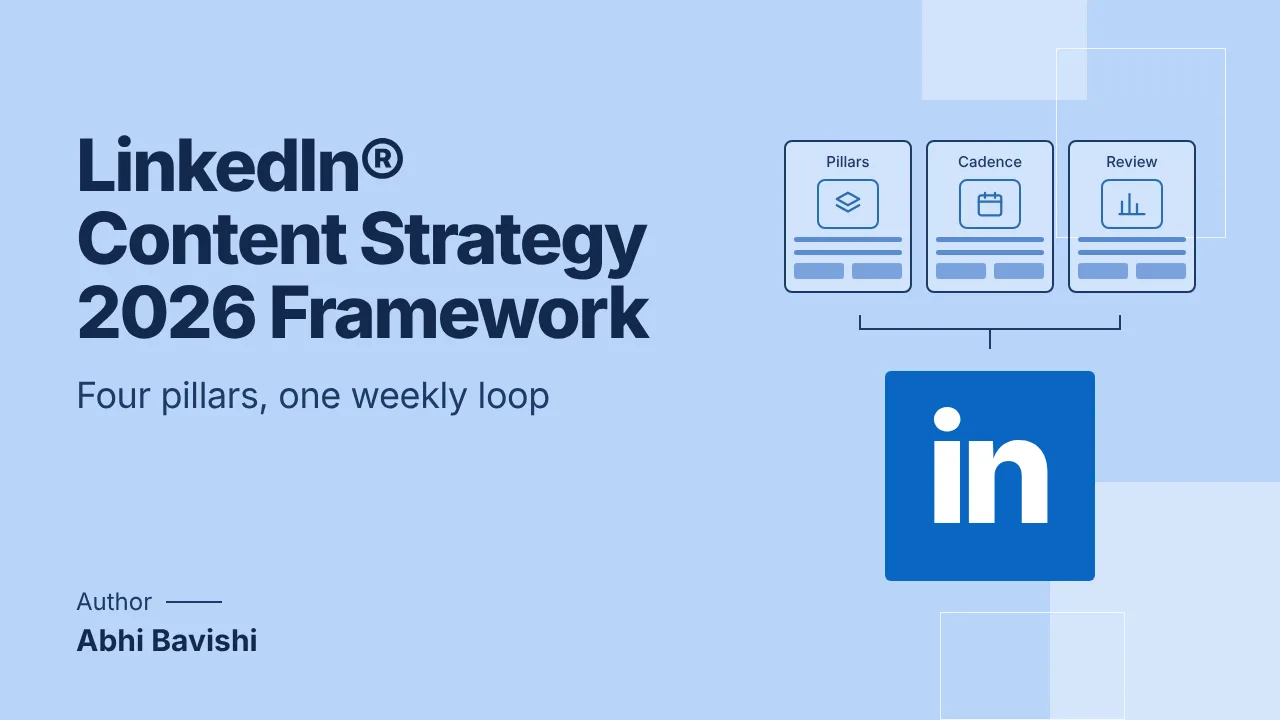
A LinkedIn® content strategy is five decisions written down: who the reader is, what business job the posts serve, which few subjects you will cover, what publishing process you can sustain, and how you will review the results. Write those on one page first, then fill the calendar from it.
Key takeaways
- Define one primary audience and one business job before you choose formats or frequency.
- Start each post from a reader question and the evidence you have; an empty calendar slot is a poor brief.
- Give drafting, factual review, approval, publishing and replies each a named owner, even when one person holds every role.
- Measure exposure, relevant response and business outcome as three separate layers, and record the effort each post took.
- Keep a small experiment backlog and a written stop rule, so the strategy improves without growing endlessly.
What decisions belong in a LinkedIn® content strategy?
A content strategy decides whom you serve, what you help them understand, how you produce the material and how you judge the work. A content strategy is that set of choices; a calendar only records when items are due, so it cannot tell you why a post deserves to exist.
Start with the business job. A consultant may want qualified inquiries, a founder may want customer discovery, and a recruiter may want relevant candidates to understand an opportunity. Those goals produce different subjects and different next steps. “Grow engagement” only becomes a goal once you say what the engagement is supposed to support.
Define the audience by situation. “A startup founder hiring a first engineering manager without a written process” suggests useful questions. “Professionals aged thirty to fifty” tells you nothing about what to write. The decision the reader faces is the bridge between their attention and your expertise.
Then define the promise: what a person can expect to learn from your posts over time. Make it credible, specific and connected to work you can support. A good promise leaves room for posts that neither sell the product nor tell a dramatic personal story.
The platform's profile guidance recommends presenting your professional experience and interests accurately. Make the profile match the strategy, so a reader who liked a post can see straight away how it connects to your work.
Finally, define the cost you can sustain. Include research, writing, approval, publishing, replies and review. A plan that budgets only for drafting hides most of the work, so choose a manageable process first and the cadence second.
Put all five decisions on one page. Copy this and fill in the brackets:
- Reader: [role] who is [situation] and needs to decide [decision].
- Business job: [qualified inquiries, discovery calls, candidate interest, resource use].
- Promise: “Follow these posts to learn how to [specific capability].”
- Subjects: [two to four recurring themes tied to the reader's decisions].
- Capacity: [hours per week] across research, writing, review, replies and review of results.
- Review: [date of the first review] and [the one outcome it will judge].
How do you create an audience and outcome brief?
Write a short brief that could guide a writer without a meeting. It names the reader, their situation, the problem, their current alternatives, the understanding you want them to reach and the next action that fits.
For example, an illustrative fractional HR consultant might write this brief:
Before (weak): “Post three times a week about leadership and hiring to grow engagement.” It names a frequency and a vague topic, and nothing in it helps you judge a draft.
After (illustrative brief): “We write for startup founders hiring their first managers without a written interview process. They currently rely on gut feel and borrowed question lists. We want them to understand how a scorecard written before the first interview changes the hiring decision. The next action is to try our scorecard template or ask a specific question about their process.”
Add what the strategy will leave out. This consultant will skip broad entrepreneurship stories written only for reach, will publish client details only with permission, and will present no hiring outcome she has not measured. Those boundaries settle the argument when a draft is attractive but off-brief.
Choose one primary outcome and a few supporting observations. Here the primary outcome is qualified conversations about hiring process design. Supporting observations include relevant questions, template downloads and profile inquiries. Only the primary outcome counts as the business result.
Keep assumptions visible and test them in real conversations. The consultant may believe founders look for hiring methods on LinkedIn®, so she asks clients where they learn about the problem and what material they found useful. If the channel turns out to be a poor match for their habits, the distribution plan changes, and the writing is judged separately.
Our solo founder guide applies this brief to a small weekly routine. Larger teams need the same clarity plus explicit ownership of each stage; more contributors still need one shared answer to who the post is for.
How do you build an evidence-backed idea pipeline?
Capture reader questions and source material before you draft. An idea pipeline is a short queue of potential explanations with enough context to judge whether each is worth publishing. Keep it filtered; an archive of every interesting link is a reading list, not a pipeline.
Record five fields for each idea, so every draft starts from a defensible claim:
- Reader question: [the exact question, ideally in the reader's words]
- Proposed answer: [one sentence]
- Source: [your own decision, public documentation, a permitted client account]
- Evidence status: [checked, needs checking, missing]
- Permission status: [own material, permitted, needs permission]
When evidence is missing, the next action is research or dropping the idea. Use several source types. Your own decisions can support tradeoff posts. Public documentation can support explainers. Permitted customer accounts can support case studies. Clearly labeled fictional scenarios can teach a process, and they stay labeled as fiction, never as a customer result.
Google's people-first content guidance emphasizes usefulness, clear sourcing and evidence of experience for web content. Apply it to the linked guide or source article. It describes Google Search, which is a separate system from the LinkedIn® feed.
Group ideas into a few recurring themes tied to reader decisions. The founder post ideas guide provides a brief for each theme. A pillar organizes the pipeline; if a story only fits a pillar by stretching the facts, leave the pillar empty that week.
Prioritize by usefulness, available proof, timeliness and effort. A well-supported answer to a current customer question usually deserves attention before a broad trend essay. If a timely topic needs more checking than you can give it, skip it.
Which format should each idea use?
Choose the format after you know the explanation. Text suits a concise argument, a diagram clarifies relationships, a demonstration shows a sequence, and a longer article holds nuance. The right format depends on the reader's task and on your production capacity.
| Reader's task | Suitable starting format | What to check |
|---|---|---|
| Understand one tradeoff | Text post with an example | The opposing case is represented fairly |
| Follow a sequence | Steps, diagram, or demonstration | The order and prerequisites are clear |
| Evaluate evidence | Article or detailed case study | Sources, scope, and limitations remain visible |
| Compare options | Table or structured explanation | The criteria match the reader's decision |
| Learn from a decision | Founder account with a practical lesson | The experience is accurate and relevant |
Keep the condition that makes a complex explanation true, even in a short format. A short post can introduce one part and link to a fuller guide, and it still delivers a useful idea on its own.
Use accessible media. The W3C image decision tree explains how text alternatives should communicate the meaning or function of an image, with complex information also available in text. Apply that to charts and diagrams, and put every critical instruction in the post text as well as in the visual.
Avoid format mimicry. A carousel copied from a popular account may look familiar while adding little to your reader's decision. A plain explanation with a concrete example often teaches more. Choose by comprehension and capacity, then review the results.
The platform's dwell-time engineering article describes how passive consumption is modeled with attention to differences among content types; make each post as long as its idea needs and no longer.
How do you set up a sustainable production workflow?
Give each post a clear path from idea to publication, with six states: source-ready, drafting, review, approved, scheduled and published. Named states stop a rough idea from being mistaken for an approved commitment.
Assign an owner to each transition. In a solo business one person holds every role, and naming the stages still helps. In a team, the writer should know who checks factual claims and who can approve publication. An editor approving style may have no authority over a product promise or a customer disclosure, so name both approvers.
Use a short publication checklist and keep it tied to consequences:
- Claims: each one matches its source.
- Links: each one opens and delivers what the post promises.
- Permission: any client, colleague or customer detail is cleared.
- Voice: it reads like the named author.
- Destination and timing: right account, right date, right time zone.
- Next step: one, and it matches the business job.
Add stricter checks for sensitive subjects such as hiring, finance, customer results or launch dates.
Build a minimum-capacity version. When client work expands, publish fewer posts and keep the factual check and meaningful replies. The factual check is the least visible step, which is exactly why it gets cut first; protect it. A smaller volume of accurate work is easier to maintain than a queue that needs repeated corrections.
Name a pause owner. Product delays, incidents or changed facts can make scheduled material inappropriate, and someone should be able to stop the queue without rebuilding the approval chain.
LinkedIn®'s Professional Community Policies require authentic information and address spam and artificial engagement, so keep them inside the workflow. The strategy produces useful posts and real conversations; arrangements designed to manufacture reactions break those policies.
What does a complete strategy example look like?
A complete strategy fits on one page and connects reader, subjects, posts, profile and review. Take the illustrative fractional HR consultant from the brief above. Her business wants qualified conversations about hiring process design. She has a public scorecard template and her own notes on the method she uses, but no published study of client outcomes.
The strategy chooses three recurring subjects: scorecards, interview structure and offer decisions. She will publish a manageable set of posts during a defined planning cycle, leaving room for follow-up questions. The cadence is a capacity choice.
The first post explains why a scorecard comes before the job post. It uses a fictional example and links to the template. The second discusses when a scorecard is too rigid, for example for a first hire whose role will change quickly, so the first recommendation does not read as universal. The third walks through her own process and states which decisions stay with the founder.
Her profile names the same problem and points to the template, so a reader understands the offer without decoding a job title. The commercial next step is a conversation about fit, offered when a person expresses relevant interest, and left off the replies where it would feel pushy.
Her review records template downloads, relevant questions, inquiries and the time spent producing each post. If a post attracts broad praise but no useful response from founders who are hiring, she notes that. If a narrow post prompts one qualified conversation, she judges it against the business job, whatever its impressions.
The plan can fail: the audience may be inactive on the channel, the problem may matter less than she thinks, or the offer may be unclear. She writes each of those down as a question for the first review, and keeps the volume steady while she finds out.
How should you measure a LinkedIn® content strategy?
Measure in three layers: exposure, relevant response and business outcome. Exposure says whether content was displayed. Relevant response says whether the intended audience engaged meaningfully. Business outcome says what happened that matters to the objective you chose.
For exposure, use consistent definitions and observation windows, and compare each post with others at the same age. Keep format and topic visible in the record so differences stay out of one blended average. Mark unusual events such as a conference mention or a major reshare.
For relevant response, read the questions and conversations, and count only what you can observe. A profile visit may indicate curiosity, and it says nothing yet about buying intent. A comment from someone outside the audience can be interesting while leaving the primary objective untouched.
For business outcomes, ask people how they found you and what influenced the inquiry, and treat the answer as useful but partial evidence. A person may have seen several posts, heard from a referral and read a product page. Spread the credit across what they tell you, instead of handing it all to the last visible click.
If you link to your own site, Google Analytics campaign URL guidance explains how UTM parameters identify campaign information. Use consistent labels for source, medium and campaign, and keep personal information out of them. Campaign tracking helps compare visits; it sees only visits, and conversations happen elsewhere.
Include effort. A strategy that produces useful conversations with manageable work can beat one that produces more attention at an unsustainable cost. Record research and reply time as well as drafting time, and use the review to allocate your next period of effort.
How do you run experiments without chasing every tactic?
Keep a small backlog of questions tied to decisions you can change, and test one at a time. “Does a complete example lead to better implementation questions?” is a useful question. “How do we beat the algorithm?” is too broad to test.
Change one thing and compare reasonably similar posts. Ordinary organic publishing is not a controlled laboratory, because audiences and competing content vary from week to week. Use what you learn to improve your own decisions, and keep the conclusions about your own account.
Write the hypothesis and the success criterion before publishing. Fill this in:
- Question: [one decision you could change]
- Change: [the single variable, for example a full worked example versus a short tip]
- Comparison: [two to four similar posts on the same subject]
- Success looks like: [the observation that would change your decision]
- Review on: [date]
If the purpose is resource use, measure relevant visits and the questions that follow. If the purpose is comprehension, look at the misunderstandings in the replies. If the result is unclear, say so, keep the more reader-friendly option, and gather more information.
Keep every variation accurate. A more dramatic claim may attract attention, but an unsupported premise is off the table as a test. A shorter post may be easier to read, as long as it keeps the limitation that makes the recommendation true.
Stop an experiment when the decision is clear enough for the stakes, when its cost exceeds the value of learning, or when the comparison is too confounded to read. You need enough evidence to choose a simpler workflow, and the honesty to say what the observations leave open.
When should you change or stop the strategy?
Change the strategy when evidence challenges an underlying assumption; a single quiet post is not enough on its own. The audience may be wrong, the problem may be poorly framed, the offer may lack fit, or the workload may be unsustainable, and each needs a different adjustment.
| What you see | Likely assumption at fault | Adjustment |
|---|---|---|
| The wrong people respond | Reader or subjects | Revisit the reader brief and the recurring subjects |
| The right people read but misunderstand the offer | Profile or next step | Revise the profile and the call to action |
| The material is useful but takes too long | Capacity | Simplify the format or repurpose existing work |
| Little relevant activity after a coherent test | Channel fit | Consider another distribution route |
A pause can be a rational decision. Customer delivery, product reliability or direct research may deserve more attention at a particular stage. Keep the source notes and what you learned so you can resume without starting from nothing. Consistency matters when it serves the reader; a calendar kept full only as a test of personal discipline serves nobody.
Reepl is an AI writing platform that puts your social media on autopilot in your own voice: it finds what to post about, drafts your posts, and keeps your calendar full, and you decide how much it does without asking. It can support the drafting and planning work, while the audience choice, evidence and business judgment stay with you.
Your next step is to write the one-page strategy, choose one useful source and produce one post with a clear purpose. Set the review date before you publish. A workable strategy makes the next decision easier and the results easier to read, even when the answer is to do less.
Make room for better writing
Build a writing routine with your voice and your review controls.