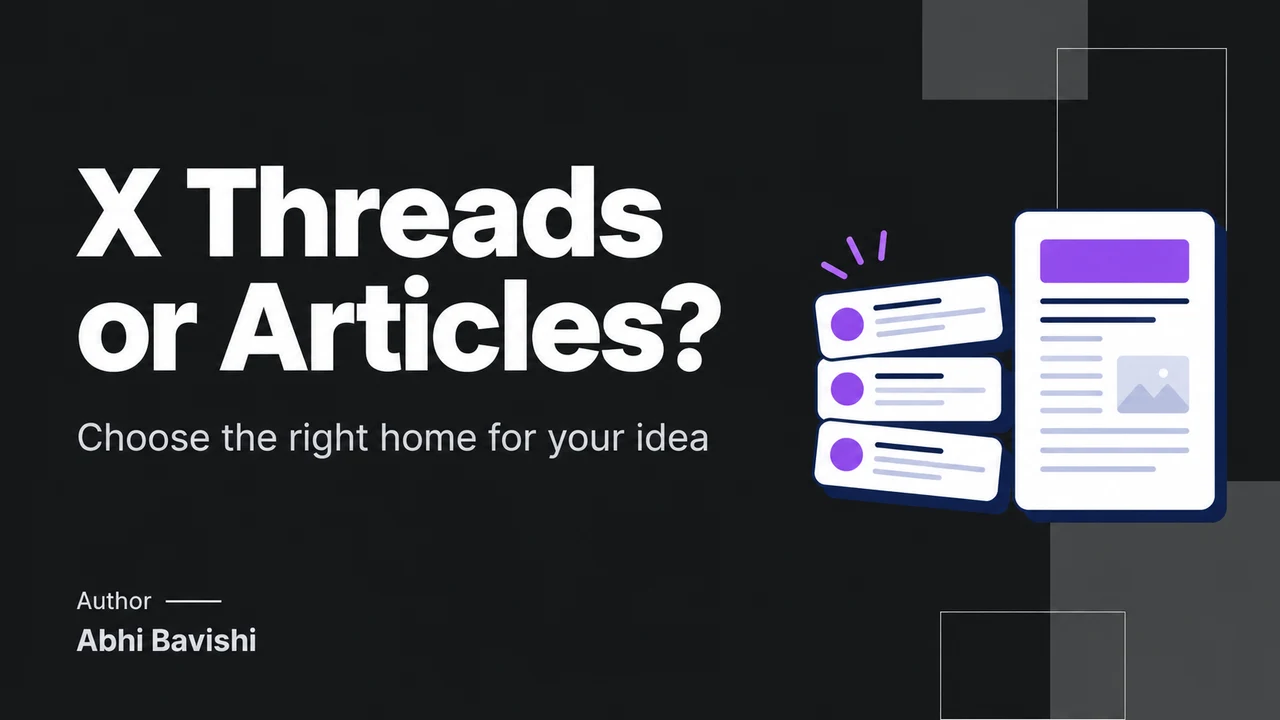
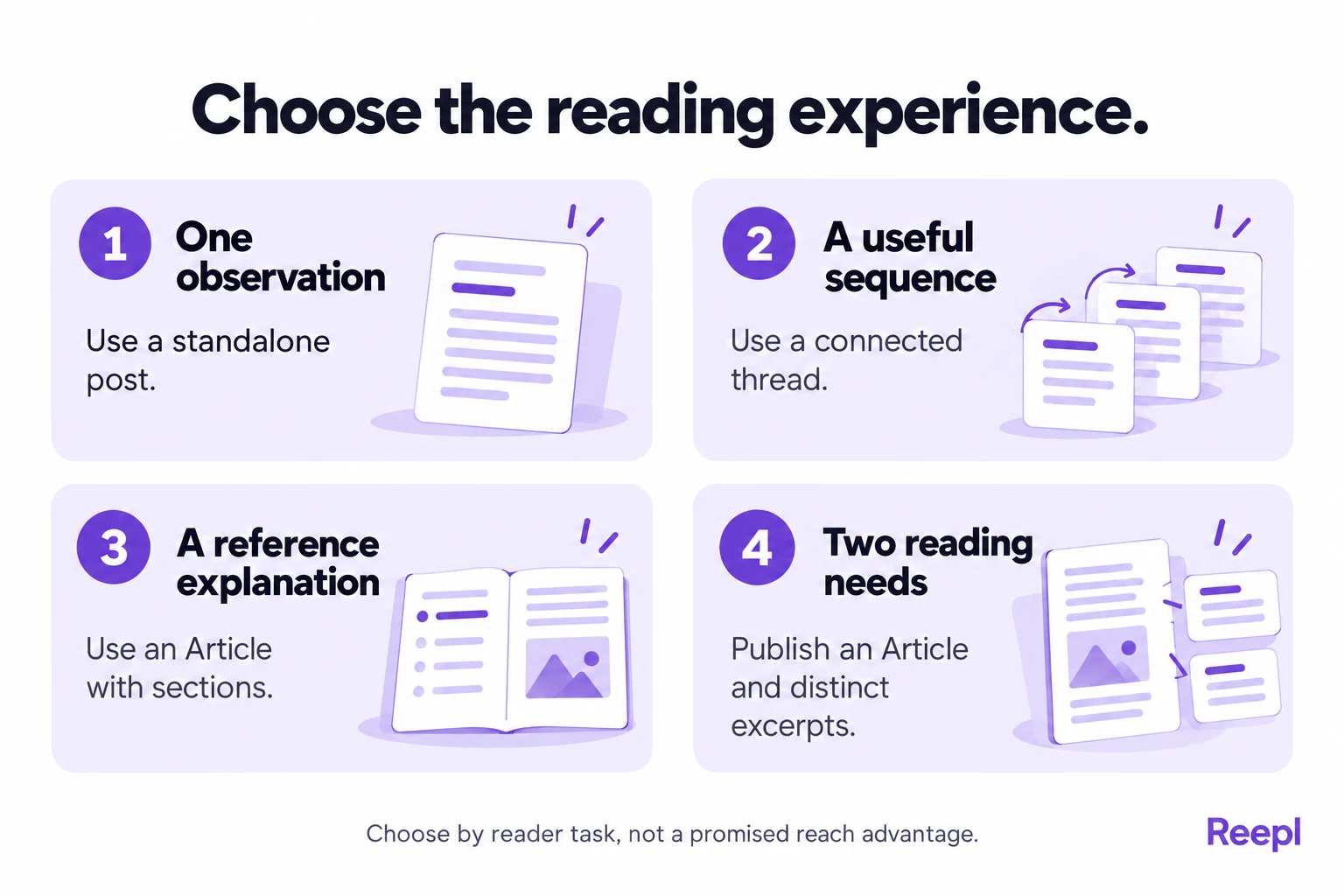
Choose an X thread when the order of steps matters and each post makes sense on its own. Choose an X Article when the reader needs a structured reference with headings, examples and stated limits. Draft both only when they serve different reader tasks, and confirm Article access in the account that will publish.
Key takeaways
- A thread works when each post adds one step to a connected argument and still makes sense if a reader meets it alone.
- An Article suits an explanation that needs headings, examples, tables or stated limits that a reader will scan or revisit.
- X's Article help page, checked in October 2026, lists Premium among eligible subscriptions, so Articles are not limited to Premium+.
- A thread can teach one method from an Article and link to the full reference without repeating every paragraph.
- Judge each format against the reader action you planned before publishing, such as a detailed question or a template request, and log it per post.
What is the practical difference between a thread and an Article?
An X thread is a series of connected posts from one person. An X Article is a long-form publishing format with richer structure. The useful distinction is how readers find and follow your explanation. Word count matters less than shape: a sequence of steps, or a reference to revisit.
According to X's thread documentation, you can connect posts and add further posts after publishing. A reader may discover one segment before seeing the beginning. Each segment therefore needs enough context to make sense outside your carefully planned sequence.
X's Article documentation, checked in October 2026, describes headings, lists, formatting and embedded media. Those features suit a reference explanation that readers might scan, revisit or share with someone facing the same problem.
A thread about choosing an onboarding metric can walk through a decision. An Article about redesigning onboarding can explain the original situation, competing options, implementation details and limitations. Both can discuss the same work while asking different amounts of attention from the reader.
| Decision | Thread | Article |
|---|---|---|
| Main reading task | Follow a sequence | Explore a structured explanation |
| Context | Must survive individual segments | Can develop across sections |
| Visual evidence | Attached to relevant posts | Embedded within a longer argument |
| Useful ending | A takeaway or next step | A complete reference and next step |
| Maintenance | Check connected posts | Check the full document and its links |
Start by writing the reader's task in one sentence. “Help a founder identify the first onboarding event to inspect” is specific enough to guide the format. “Build authority” describes your ambition and leaves the reader out.
Fill in this four-line format brief before you draft:
- Reader: [role, and the situation they are in]
- Task: [what they should be able to do after reading]
- Shape: [a sequence of steps, or a reference to scan and revisit]
- Format: [thread if the steps stand alone; Article if the reader needs headings, examples or stated limits]
When should you choose a thread instead of an Article?
Choose a thread when the order matters and the parts remain useful on their own. A short diagnostic sequence, a worked process or a series of evidence-backed observations often fits. Stop adding segments when the argument is complete.
For example, a founder could explain how to inspect a confusing signup flow: define the expected action, observe the first obstacle, compare wording, test a revision, then review what remains unresolved. The sequence gives readers a method they can apply without opening another page.
A thread becomes harder to follow when essential definitions are several posts away. If a claim requires extensive caveats, multiple tables or a long account of the research method, an Article may preserve the meaning more effectively.
X says threads with two or three posts generally appear connected in timelines, while longer threads may be truncated behind an option to show the thread. Treat that as a documented presentation pattern and put your most useful point in the first two or three posts.
Write the opening post as a useful promise. “Here is the signup check we would run before rewriting every screen” gives a concrete task. A vague invitation to read a long thread asks for attention before explaining why the sequence deserves it.
Read each segment without the previous one. Replace unclear references such as “this changed everything” with the actual change. Keep transitions, and name the subject again in any post that might appear alone in a feed.
A short standalone post may still be the best choice. If the whole lesson is one observation and a supporting example, splitting it into several fragments adds work for the reader. Format should follow the substance available today.
When does an Article earn the extra reading time?
An Article earns its length when the reader needs depth to make a decision. Use sections to separate the problem, evidence, method and limitations. Each extra section should make the explanation easier to inspect. If a section adds no reasoning, cut it.
A good candidate is a detailed account of a product decision with competing constraints. Readers may want the conclusion immediately, then the reasoning, then an example relevant to their own situation. Headings let those readers choose their level of detail.
Place the answer near the beginning. A reader evaluating whether to change an onboarding flow should not need to read a founder's entire company history first. Keep background that changes the decision and remove background that only explains how the writing project began.
Treat visuals as evidence. A simplified flow diagram can show a sequence that is awkward to describe repeatedly. Explain what the diagram establishes in nearby text, and identify fictional numbers or illustrative screens so they cannot be mistaken for customer results.
For images shared in accompanying posts, X's image-description guidance explains how alternative text makes important visual information accessible. Describe the meaningful relationship or observation. “Chart” alone tells a reader almost nothing about the point you intended to communicate.
The longer format also creates maintenance work. Product steps, policy links and screenshots can become outdated. Add a review reminder when the explanation depends on changing behavior, and keep the source material available so you can correct the argument consistently.
Before choosing an Article, sketch its headings. If several headings repeat the same takeaway, shorten the piece or publish a thread. Extra space is useful when it carries additional reasoning, not when it hides that the argument has already finished.
Who can publish X Articles, and what should you verify?
Article eligibility depends on the X account and subscription. The official Article help page, checked in October 2026, includes Premium, Premium+, specified X Subscription plans, and eligible business and organization subscriptions. Older advice limiting Articles to Premium+ is incomplete.
Check eligibility in the account you intend to publish from before assigning a deadline. Check this account even if another account you run has a subscription. If the publishing option is unavailable, verify the current account and X's latest guidance before changing your whole content plan.
Also distinguish publishing from updating. X says editing a published Article unpublishes it while you make changes, after which you can republish. That matters when other posts or external pages are already directing readers to the Article.
Prepare corrections in advance when possible. Record the original claim, replacement wording and supporting source before opening the edit flow. After republishing, inspect the destination again and check the posts you use to distribute it.
If you connect a writing service, review the requested account permissions. X explains third-party access and revocation; an app's available actions depend on the permissions you grant, and the account's platform requirements still apply.
Use the native publishing flow when it is sufficient for your needs. A separate writing platform becomes useful when you need drafting and scheduling around a broader editorial process. Choose it for that work. Article eligibility still comes from the X account and its subscription.
How can a thread and an Article work together?
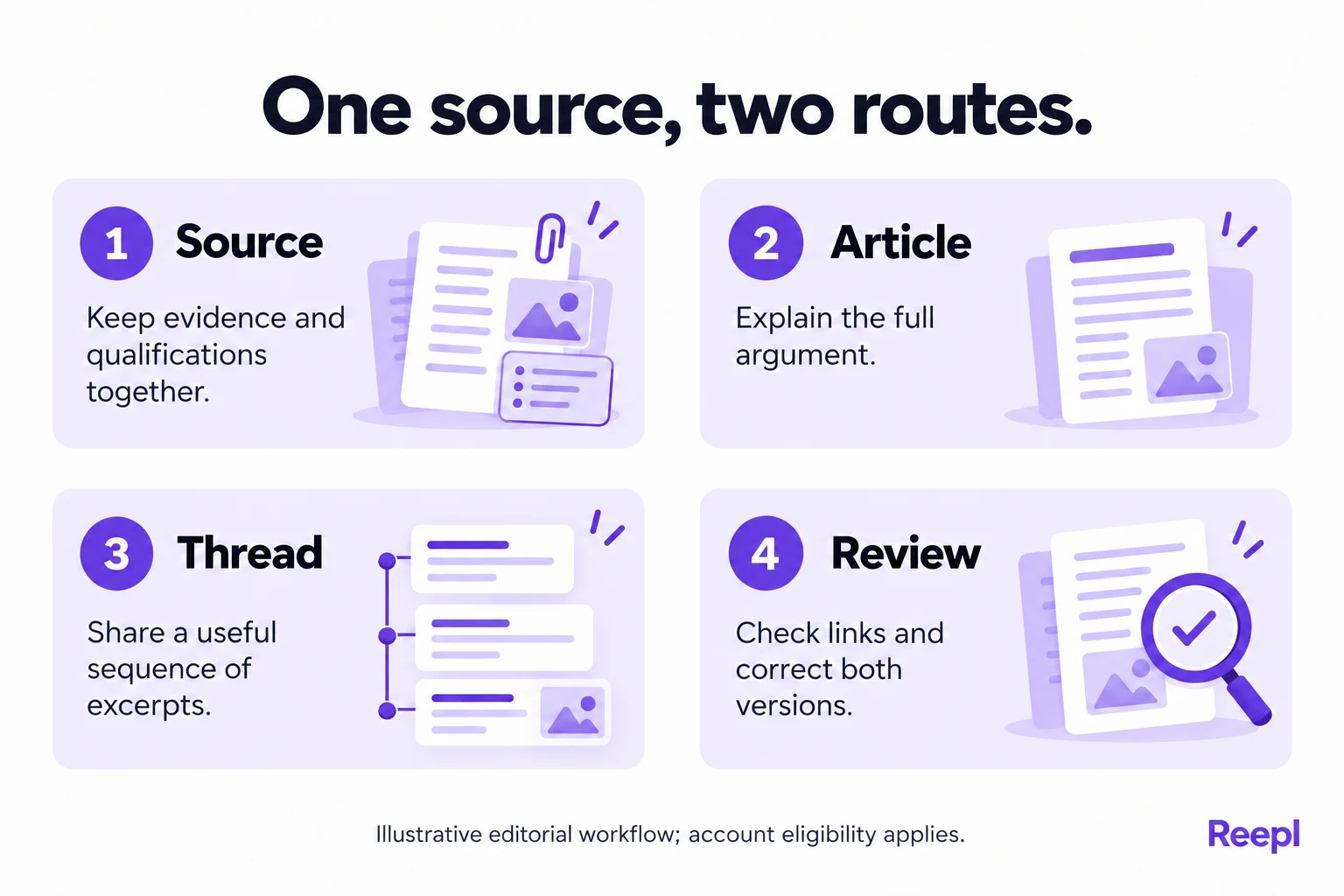
A thread and an Article work together when the thread teaches a useful portion of the argument and the Article supplies deeper explanation. Readers should receive value from the excerpts even if they never open the full piece.
X's own Article guidance recommends sharing excerpts as threads that link to the full work. Treat that as a distribution option, and judge each excerpt by whether it teaches something on its own.
For an Article about simplifying onboarding, build a thread around the diagnostic method. Keep the detailed research notes, alternative designs and edge cases in the Article. The thread can end with a descriptive link explaining exactly what extra material the reader will find.
Avoid publishing two nearly identical introductions followed by two identical conclusions. Repetition makes the second version read like a reminder. Choose a different entry point, such as a common mistake or the most surprising constraint.
Keep a shared evidence sheet behind both versions. Record the claim, source and limitation once. When a fact changes, review both formats against that sheet instead of relying on memory or leaving an older thread to contradict the updated Article.
X's automation rules, checked in October 2026, prohibit duplicative or substantially similar automated posts in the circumstances described by the policy. Distinct excerpts should earn their place editorially; scheduling does not justify repeatedly distributing the same message.
For adapting the underlying material to another professional audience, our guide to turning a blog into a LinkedIn® post explains a related editing task. Preserve the source evidence while rewriting the context for the destination.
What does a useful format decision look like in practice?
Consider an illustrative founder who has written a detailed internal note about a confusing onboarding checklist. The note contains observations from product reviews, competing design ideas and a proposed next experiment. No measured improvement has happened yet.
The founder initially drafts an opening that says the redesign solved onboarding. That claim exceeds the available evidence. Before choosing a format, the founder changes the claim to: “Here is how we would test whether our checklist asks for too much too early.”
The thread now has a clear sequence. The opening names the problem. The next segment distinguishes necessary setup from optional customization. Another explains what to observe. The final segment states the proposed experiment and the uncertainty it is intended to resolve.
The Article develops the same decision more fully. It explains why the optional settings were added, which users might still need them, how the test would work, and what would count as an inconclusive result. Readers can inspect the trade-off themselves, and the founder never has to claim a result that has not happened yet.
A practical planning template keeps the two versions aligned:
| Planning field | Example entry |
|---|---|
| Reader | A founder reviewing first-use friction |
| Immediate task | Separate essential setup from optional work |
| Main claim | Test whether optional settings interrupt the first useful action |
| Evidence available | Observations and documented design constraints |
| Evidence missing | Results from the proposed revision |
| Thread promise | A short diagnostic sequence |
| Article promise | The reasoning, options and proposed test |
| Reader's next step | Inspect one optional setup requirement |
Rewrite the example in your own language before using it. A voice that sounds natural in a product review is usually a better starting point than borrowed phrases about transformation. Our guide to finding your writing voice offers exercises for identifying those patterns.
What would the same idea look like in both formats?
Write a short sample in each format before committing to a long draft. The sample should reveal whether the explanation benefits from sequence or from a navigable reference. Below is a hypothetical exercise: an illustrative data analyst wants to explain how to check a weekly dashboard number before sharing it.
A complete short thread draft
Opening: Before you share this week's dashboard number, check that you can state its definition, its date range and what changed since last week. A polished chart can still leave all three unclear.
Second post: Start with the definition. “Active accounts: workspaces with at least one saved report in the past seven days” tells a reader far more than the label “Active”.
Third post: Name the date range and any gap separately. If a day of data is missing, say so next to the number itself, where a reader will see it, and keep it out of a footnote.
Closing: Finish with one owner and the next question. Then ask a colleague to explain the number back in their own words. That checks clarity; whether the number supports a decision is a separate review.
Each segment carries a specific job. The example would become weaker if another post merely repeated that data quality matters. A visual could help if it showed the definition next to the chart, but the sequence already works as text.
An Article outline from the same source
The Article could be titled “A metric check sheet for weekly reports.” Start with the blank sheet itself, then explain each field: metric name, definition, date range, known gaps, owner and next question. Add a completed fictional example and a section on numbers that should wait for a conversation with the data owner before anyone shares them.
The difference is substantive. The thread teaches a quick inspection. The Article becomes a reusable document with explanations of trade-offs. If you cannot supply those extra details, publish the thread alone. An empty promise of depth is not a reason to create a second destination.
How should you design the reading path?
Make the main claim understandable before asking readers to open another format. A thread and an Article have different entry points, so plan the route through the material instead of assuming everyone arrives at the beginning and reads everything.
For a thread, give the opening a clear subject and preserve the subject in later segments. “The weekly number excludes one day of missing data” survives being seen alone. “This is where everything falls apart” does not. X's documentation shows that connected posts can appear through different timeline and sharing views, which makes local context useful.
For an Article, use headings that name decisions. “When should a number wait for the data owner?” helps a scanning reader more than “Going deeper.” A reader who already understands the template can jump directly to the exception without reading the same introduction again.
Keep source links next to the claims they support. A long list at the end makes a skeptical reader hunt for the evidence. If a source describes a policy, label it as policy. If you are proposing a workflow, label it as your recommendation. Formatting does not turn an editorial opinion into a documented platform mechanism.
Choose the destination of a shared link deliberately. Link to the Article when the reader needs the full template and limitations. Link to the thread when the sequence itself is the useful object. Test the destination while signed out if access conditions matter, and state any subscription requirement before someone follows the link.
How can you compare formats without inventing a winner?
Define the desired reader action before publishing either version. For a reference Article, the desired action could be using a template or asking a detailed implementation question. For a diagnostic thread, it could be recognizing a problem and trying the first check. Those objectives overlap, but they are not identical.
Keep an editorial log with topic, account, format, publication date, reader task and what you observed. Summarize relevant replies in a sentence each. A correction from a practitioner can improve a reference more than a stack of general compliments.
Use one log entry per piece:
- Topic: [subject]
- Format and account: [thread or Article, and which account]
- Published: [date]
- Reader task: [what the reader should be able to do]
- Planned action: [for example, a detailed question or a template request]
- What happened: [one-sentence summary of relevant replies]
- Next change: [one thing to try in the next piece]
Compare like with like. A familiar topic in a thread and an obscure topic in an Article differ in more than format: existing audience interest, distribution, timing and the strength of the opening can all differ. Small comparisons can guide your next choice; they will not give you a general rule.
When a thread attracts questions that require long answers, that is a concrete reason to develop an Article. When an Article's useful method can be taught in a short sequence, that is a reason to prepare a thread. Let reader needs create the second version instead of forcing every idea into a fixed package.
Review maintenance costs too. A reference document with changing product instructions needs updates, while a dated opinion may need only context. If you cannot maintain a detailed guide, narrow its promise and identify its scope. The best format is the one you can make accurate, useful and supportable for the reader's task.
How should you review the draft before publishing?
Review the draft for three things: usefulness, accuracy and reader effort. Start with the promise in the opening: can a reader complete the promised task after reading? Then check whether the examples and limitations support that promise without overstating what happened.
Ask a colleague to identify the main claim without prompting. If they remember a dramatic hook but misunderstand the actual finding, revise the hook. A technically accurate paragraph cannot fully repair an opening that gives the wrong impression.
Then run this six-step check:
- Write the task the opening promises in one sentence.
- Check that each claim has its source link next to it.
- Label every illustrative example and fictional number.
- For a thread, read each post alone and replace vague references with the actual subject.
- For an Article, confirm the answer appears before the background.
- After publishing, open the live version and confirm it is the one you intended.
Reepl is an AI writing platform that puts your social media on autopilot in your own voice: it finds what to post about, drafts your posts, and keeps your calendar full, and you decide how much it does without asking.
Use that editorial control to keep the source, claim and review step together. Check the publishing options available to your connected X account before committing to a workflow. A prepared draft still needs a final reader-focused review and confirmation that the intended version is published.
Assess the result against your purpose. X's view-count documentation explains that repeated views may count and views are not all unique. A large view count alone cannot tell you whether readers understood a method or used your reference explanation.
Keep the next review simple: note the questions readers ask, the passages they misunderstand and the examples they request. Those observations give you concrete revisions for the next thread or Article without pretending that one format has won for every topic.
Continue with our guides to scheduling X threads and adapting one source for three platforms.
Put your next idea into words
Draft in your voice, review the details, and choose what to publish.