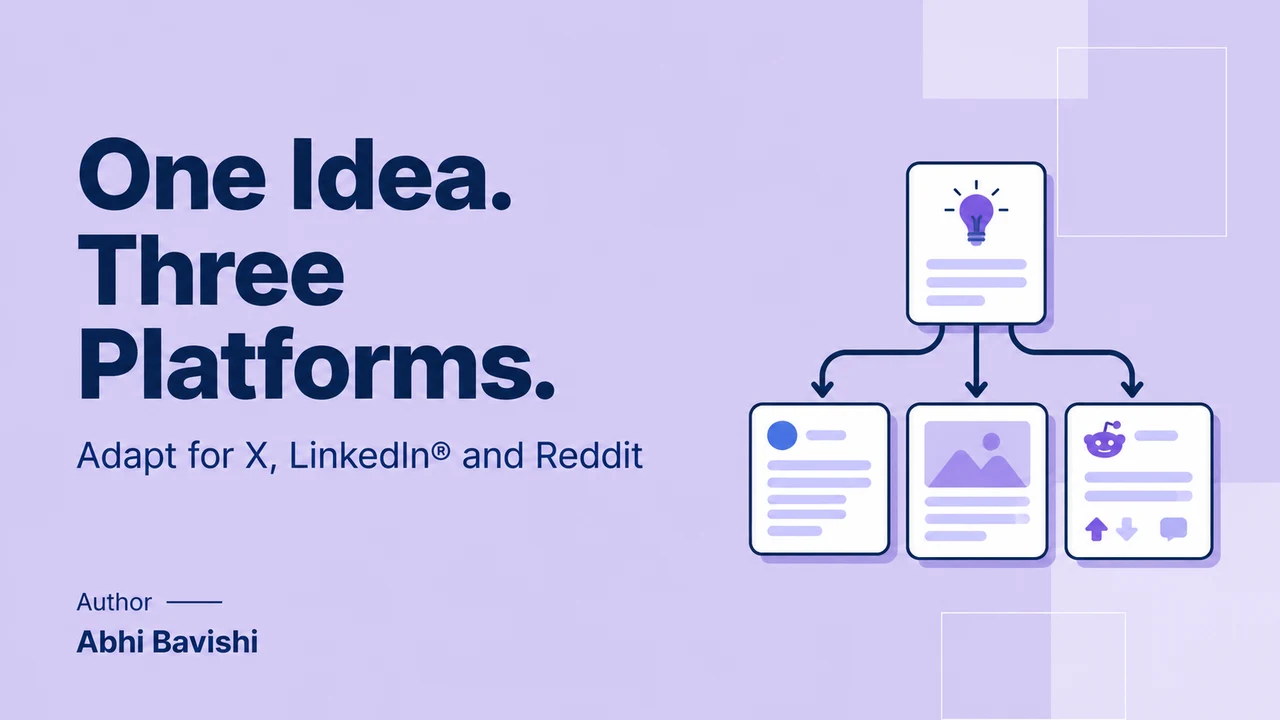
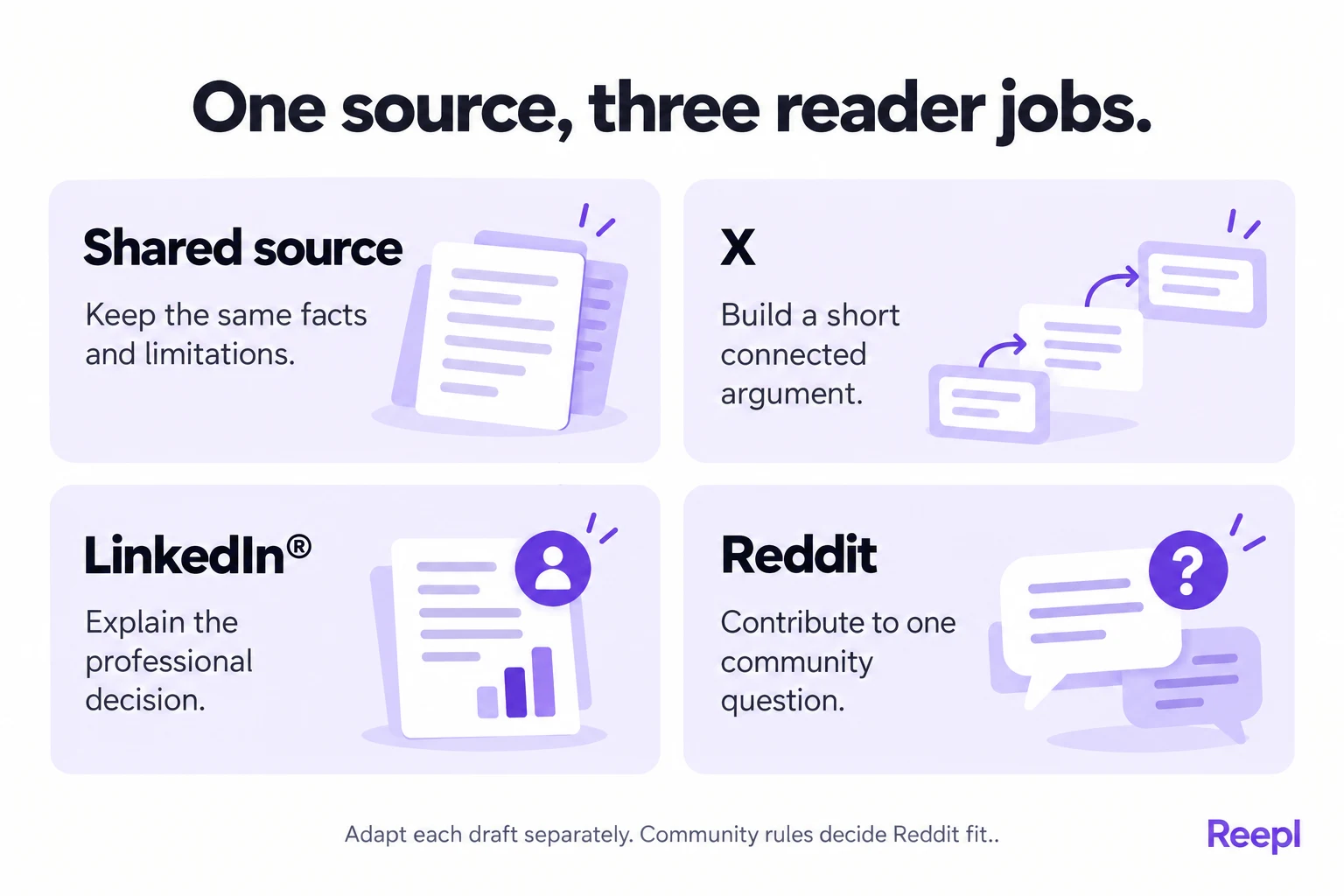
Repurpose one source for X, LinkedIn® and Reddit by keeping its facts and limits fixed and changing the reader's task. On X, write a connected sequence. On LinkedIn®, explain the professional decision. On Reddit, answer a specific community question only where the community's rules welcome it. Review each version separately before publishing.
Key takeaways
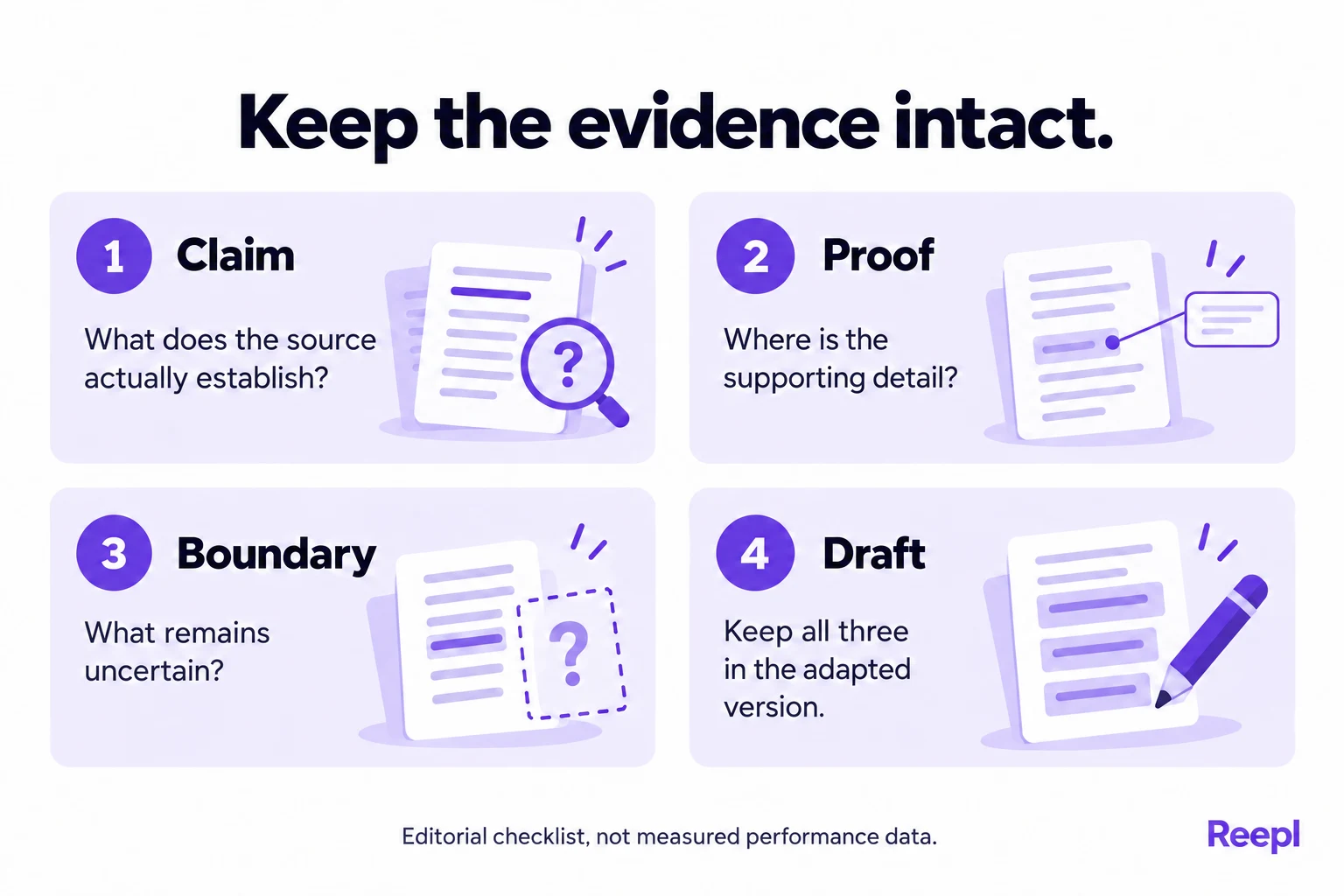
- Keep the claim, its evidence and its limits identical in every version; change the entry point, the context and the ending.
- Build a source sheet before drafting: main claim, supporting observation, link, limitation and date.
- Give each version one reader task: a connected sequence on X, a work decision on LinkedIn®, a specific community question on Reddit.
- Read a subreddit's rules and recent discussions before drafting, and disclose your connection to any product you mention.
- Review and publish each version as its own step; three adapted drafts mean three separate reviews.
What should stay the same when you repurpose a source?
The facts, ownership and limits of the source should stay the same. Content repurposing is adapting existing material for another useful format or audience. A shorter version can simplify the explanation, but it should not strengthen a claim beyond what the original evidence supports.
Start with material you own or have permission to reuse. A product note, original video, workshop explanation or published article can provide a strong foundation. Someone else's public discussion can inspire a question, but public availability does not make their experience your own.
Create a source sheet before drafting. It becomes the reference for every adapted version:
- Main claim: [one sentence, as narrow as the evidence]
- Supporting observation: [what you saw, heard or measured]
- Source link: [where a reader can check it]
- Limitation: [who or what the claim does not cover]
- Date checked: [month and year, for any claim about product behavior, policy or pricing]
- Reuse status: [yours, permission granted, or inspiration only]
For example, “Three interviewees misunderstood this label” is narrower than “Customers hate this feature.” Preserve that difference when shortening the story. A punchier opening is not an improvement if it changes the meaning or implies a larger study than you conducted.
LinkedIn®'s Professional Community Policies, checked in October 2026, require authentic information and prohibit false or misleading content. That principle supports a practical editing rule: every version should remain defensible when someone compares it with the original source.
Keep quotations exact and distinguish them from your interpretation. When a quote is unnecessary, summarize the idea and link the source. Quotation marks belong only around words someone actually said or wrote, never around an AI-generated paraphrase. Keep an uncertain statement uncertain.
What should change between X, LinkedIn® and Reddit?
Change the reader's starting point, the amount of context and the next action. A person reading a short X sequence, a professional reflecting on a work decision and a community member answering a specific question may need different versions of the same evidence.
On X, organize a connected argument. X's thread guidance describes a thread as connected posts from one person. Give each segment a distinct role, and preserve enough context for a reader who encounters one post before seeing the opening.
On LinkedIn®, explain the professional decision. Identify the role, constraint or trade-off that makes the example useful at work. A concise account of what changed your mind can be more relevant than a generic list of lessons detached from the situation.
On Reddit, begin with the community's topic and existing conversation. Reddiquette asks people to read community rules before submitting and encourages constructive participation. The right adaptation may be a detailed answer, a discussion post or no post at all.
| Destination | Useful starting point | Context to include | Appropriate next step |
|---|---|---|---|
| X | A specific observation or problem | Enough detail for each segment | Try the method or inspect the source |
| LinkedIn® | A professional decision | Role, constraint and consequence | Compare experience or apply the lesson |
| A community question | Relevant detail and disclosed affiliation | Discuss the substance within the rules |
Choose the ending for each destination. A booking link may be irrelevant to a community troubleshooting question. A direct source link may be useful in one setting and prohibited in another. Review the destination before deciding what the ending should ask.
How do you choose the strongest idea from a long source?
Choose the idea that answers one specific question completely. A long video or article may contain several usable lessons, but one adapted post rarely needs all of them. Select the argument before summarizing, so the draft has a purpose beyond reducing word count.
List the source's decisions, examples and disagreements. Then ask which item would help a reader act differently today. “We changed the order of setup tasks” is a topic; “How to decide which setup task can wait” is a useful reader question.
Separate the central lesson from background material. Keep background that changes the recommendation, such as an unusual audience or a regulatory constraint. Remove background that simply explains the order in which events happened to the author.
For a video, note the relevant timestamps and verify the original wording. A transcript can omit emphasis or misrecognize a product name. Check the source before quoting a sentence, especially when an error would change the speaker's position.
For a written source, mark the passage supporting each major claim. If the adapted post introduces a new causal explanation, investigate it or remove it. A source describing what happened does not necessarily establish why it happened.
Our guide to turning a podcast into distinct LinkedIn® posts offers a related way to separate ideas. Use the same source-selection discipline here, then adapt the selected idea independently for X and the relevant Reddit community.
How do you preserve accuracy when AI helps rewrite?
Give AI a bounded source and a clear editing task, then check every factual sentence against the source. AI can suggest structure and alternative wording. You remain responsible for whether the final version accurately represents the evidence and fits the destination.
Ask for a claim list before polished prose. A list exposes unsupported additions that can disappear inside fluent paragraphs. Mark which claims are directly supported, which are interpretations and which need more evidence before they can appear in the post.
Use a bounded instruction and fill in the brackets:
“Here is my source: [paste the passage]. Rewrite it as [an X thread, a LinkedIn® post or a Reddit answer] for [reader and their situation]. Keep the original qualifications. Add no outcomes, customer quotes, statistics or causal claims. List any sentence that depends on information missing from the source.”
That makes uncertainty visible before you start choosing hooks.
Review compression carefully. Removing “in this example” can turn a narrow observation into a universal recommendation. Removing “we plan to test” can turn a proposed experiment into a completed result. Those changes are small in length and large in meaning.
X's automation rules permit certain publishing activity while prohibiting duplicative or substantially similar automated posts in the situations described by the policy. Adaptation should create useful versions, not a supply of nearly identical text for repeated posting.
Check voice after checking truth. Read the draft aloud and replace phrases you would never use in a conversation with a customer. Our guide to writing posts that sound like you explains how specific experience helps remove generic language.
What would three adaptations of one source look like?
Consider an illustrative founder who has written a note about a complicated onboarding checklist. The note argues that optional profile settings may interrupt the first useful task. The founder has observations and a proposed test, but no measured result from the revision.
The shared claim is deliberately narrow: “We want to test whether moving optional settings later makes the first task easier to complete.” Every adaptation must preserve the fact that this is a hypothesis. None should announce a conversion improvement that has not been measured.
The X version can explain a diagnostic sequence: identify the first useful action, list what blocks it, separate essential setup from optional work, and define what the next test should observe. The ending asks readers which optional step they would investigate first.
The LinkedIn® version can focus on the product decision: why the checklist grew, which internal assumptions were challenged and how the team chose a smaller experiment. The professional lesson is how to choose a small experiment while the answer is still unknown.
The Reddit version begins with a community question about first-use friction. The founder explains the relevant setup, discloses their connection to the product, shares the proposed method and asks a specific question about a trade-off. Any link depends on the community's rules.
A compact drafting template captures the differences:
| Field | X version | LinkedIn® version | Reddit version |
|---|---|---|---|
| Reader task | Follow the diagnostic | Understand the decision | Discuss a relevant trade-off |
| Opening | Name the obstacle | Explain the work context | State the community question |
| Evidence | One observation per segment | Observation plus decision context | Enough detail to assess the case |
| Limitation | The revision is untested | The revision is untested | The revision is untested |
| Ending | Apply one check | Compare a professional experience | Answer the specific question |
The drafts should sound related because the same person wrote them. They should not look copied because each version does a different job. Preserve your normal vocabulary while changing the structure and context required by the reader.
This example also shows when to stop. If the Reddit community already has a closely matching discussion, a thoughtful reply may be more useful than a new submission. If the community prohibits the material, keep the source for another appropriate destination.
How do you decide whether a Reddit version belongs?
Decide whether the contribution belongs before drafting a promotional ending. Reddit's platform rules require people to follow community rules and participate authentically. Local moderators can set requirements that are more specific than general advice about posting on Reddit.
Read the rules and several recent discussions. Notice what people ask, how much detail helpful answers provide and whether links or commercial affiliations are restricted. A post that fits the subject can still fail the community's expectations about format or purpose.
Answer five questions before you draft a Reddit version:
- Do the community rules allow this kind of post, and any link you plan to include?
- Is there already a discussion where a reply would help more than a new post?
- Does the contribution answer the question in full on the page?
- Have you stated your connection to any product you mention?
- Would the post still be useful if you removed every link?
If any answer is no, fix it or skip the community.
Search the community for the question you intend to answer. If an active discussion already exists, contribute there when appropriate. Avoid treating the same source as a reason to post substantially similar messages across many communities without considering their differences.
Disclose your relationship to a product when that relationship matters. A founder's experience can be useful, but readers should understand the perspective behind it. Dressing a promotional recommendation up as independent advice, or inventing a customer role to seem neutral, misleads the people you are asking for help.
Give enough value in the contribution itself. If readers must visit your site before they can understand the answer, the post may function mainly as an advertisement. A source link can support a complete explanation without becoming a substitute for one.
Treat removal or moderator feedback as information about fit. Review the reason and adjust your approach. Reposting the same material with cosmetic changes does not solve a mismatch between your objective and the community's rules or expectations.
Can you see complete drafts from one source?
A useful adaptation changes the reader's entry point while preserving the source's actual claim. The following drafts are fictional examples built from one source note: an illustrative two-person design studio is testing a shorter client feedback form. The studio has changed the form but has not measured an improvement.
Illustrative X thread
Opening: A client feedback form can collect every comment and still hide the decision you need. We are testing a shorter form with three fields: what to keep, what to change and which decision is blocked.
Next segment: The blocked-decision field matters. “We cannot choose the homepage layout until legal approves the headline claim” is more useful than a page of notes about button colors.
Closing: We have not measured the effect yet. The first check is simple: can we start the next revision without booking another clarification call?
Illustrative LinkedIn® post
We kept adding questions to our client feedback form. We still had to call clients to ask which comment mattered most. Our proposed fix is a shorter form organized around what to keep, what to change and which decision is blocked. The trade-off is real: a shorter form may miss detail a client wanted to share. We are keeping a free-text box at the end and testing whether the form makes the next revision clearer. We have no outcome to report yet. If you collect client feedback, check what you can act on before asking clients to write more.
Illustrative Reddit contribution
I run a two-person design studio. We are testing a client feedback form organized around what to keep, what to change and which decision is blocked. The difficulty is leaving room for detail a client wants to add. For people who use short feedback forms, how do you decide which questions stay on the form and which belong in a follow-up call? We have not evaluated the change yet.
The first-person wording belongs to the fictional author in these sample drafts. Replace it with your actual experience before using it. The Reddit draft is suitable only where this kind of discussion is welcome; its lack of a sales link does not override local rules.
How do you review a source before distributing it again?
Check whether the source remains true, reusable and useful for the new audience. A popular older post may contain an outdated interface, a withdrawn feature or a customer story that you no longer have permission to repeat. Repurposing increases the number of places that error can travel.
Separate durable reasoning from dated instructions. A principle such as naming the blocked decision can remain useful while a screenshot of a scheduling menu becomes obsolete. Keep the principle, replace the procedural detail and record which version each adapted post uses. Update or remove an old price, even when it makes the story simpler.
Run four checks on any older source before you adapt it again:
- Is every claim still true today? Recheck dates, prices and interface steps.
- Do you still have permission to reuse each quote, screenshot and customer story?
- Do the caveats still fit the new audience?
- Which published versions already exist, and which will need the same correction?
If a check fails, fix the source before any version goes out.
Check ownership at the same time. A guest's recorded answer, a customer screenshot and your own original explanation have different reuse conditions. Sharing controls on a platform cover sharing there; check separately whether you may reuse a passage in a new commercial asset. If permission is unclear, use a new illustrative example and identify it as such.
Review the source's caveats as deliberately as its main point. A note about one team's workflow may not apply to a regulated environment or a larger organization. When the destination audience changes, explain that condition again. A retained link does not carry the original context to new readers.
If the source is no longer defensible, retire the adaptation instead of polishing it. The useful work may be a new post explaining why your recommendation changed. That preserves your actual thinking and gives the audience a reason to revisit the topic.
How should you measure whether adaptation helped?
Judge each version against its reader task and measure the cost of maintaining the whole set. A post that answers a useful community question may succeed without sending traffic elsewhere. A reference-oriented thread may be useful because readers ask for the underlying template. Avoid forcing those outcomes into one cross-platform reaction score.
Create a simple record for each version:
- Source: [title and link]
- Destination: [X, LinkedIn® or the named community]
- Published: [date]
- Intended action: [what the reader should do or ask]
- Observed response: [one-sentence summary of relevant replies]
- Misunderstanding to fix: [the passage readers got wrong]
Note specific misunderstandings. If X readers repeatedly miss the uncertainty, move that caveat into an earlier segment. If professional readers understand the idea but cannot apply it, add the missing decision criteria to the next version.
Track corrections across the source family. When a factual change affects all versions, list each published destination and decide how to update or contextualize it. A change to the blog does not automatically correct a thread, a copied caption or a community reply. Assign someone to close that loop.
Count editing and review effort as part of the decision. Preparing another platform version can be worthwhile, but it can also consume time that would improve the original explanation. If you lack the context to contribute responsibly to a community, skip it. That is a sound editorial decision.
The practical end point is a small set of distinct, accurate contributions. Choose the next adaptation from a real reader need: a question unanswered, a format inaccessible or an example missing. That gives reuse a purpose beyond filling more calendar slots.
How can you manage the drafts without confusing adaptation and publishing?
Keep one source record and separate final drafts. Label each version by destination, intended reader and review status. That makes it easier to change the source once while still checking how the correction affects each format.
Reepl is an AI writing platform that puts your social media on autopilot in your own voice: it finds what to post about, drafts your posts, and keeps your calendar full, and you decide how much it does without asking.
Use your review controls to keep the source claim intact while preparing different posts. Treat Reddit composition as a separate community-specific step. Ready X and LinkedIn® versions leave the Reddit decision open, and each version gets its own final check before it publishes.
Before release, check the destination account, actual text, links and any media descriptions. X's image-description guidance provides a practical model for describing essential visual information. Adjust the description when a crop or revised chart changes the meaning.
Review outcomes by reader task. Useful questions, corrections and relevant conversations can reveal whether the adaptation worked. Raw reactions across different destinations are not directly comparable without understanding what was counted and how the audience encountered the post.
Start with one source and the two destinations you understand best. Add another destination when you can explain why its readers need a distinct contribution. A smaller set of carefully adapted posts is easier to review and maintain than a large collection of lightly rewritten copies.
Continue with our guides to turning an article into a document carousel and finding a relevant Reddit community.
Put your next idea into words
Draft in your voice, review the details, and choose what to publish.