To find your LinkedIn® voice, study writing and speech that already sound like you, turn the choices that repeat into three checkable traits and a one-paragraph brief, then test that brief on a new idea. Give AI the brief and real samples, and check each draft against your beliefs, facts and boundaries.
Key takeaways
- Describe your voice through observable choices (word choice, rhythm and stance), because adjectives such as “authentic” fit everyone.
- Collect 8 to 12 samples that sound like you, including a transcript of yourself talking, and drop the pieces that feel like a costume.
- Reduce the patterns to three checkable traits, then a one-paragraph brief with your audience, traits, opening habit and ban list.
- Keep style samples separate from the facts of the next post, and test the brief on an idea that is not in your samples.
- Adapt tone to the situation, such as good news, a correction or a disagreement, while your underlying point of view stays the same.
That is the short version. For the wider case on why AI drafts so often miss, see our guide on whether AI can write LinkedIn® posts that sound human. This one goes deeper on the part most people skip: working out what your voice is before you ask anything to imitate it.
What a LinkedIn® voice actually is
Your LinkedIn® voice is the set of choices that stays the same while your topics and tone change: which words you reach for, how your sentences move, and what you are willing to say out loud. Topics change from post to post. Tone shifts between a congratulation and a complaint. Voice sits underneath both.
A useful way to hold it is three layers. Word choice is the vocabulary and phrases you use, and the ones you refuse to. Rhythm is how long your sentences run, where you break lines, and how you pace a point. Stance is what you believe, what you push back on, and how much of yourself you put in the post. Most posts that feel generic are missing the third layer: they have words and rhythm, and no stance.
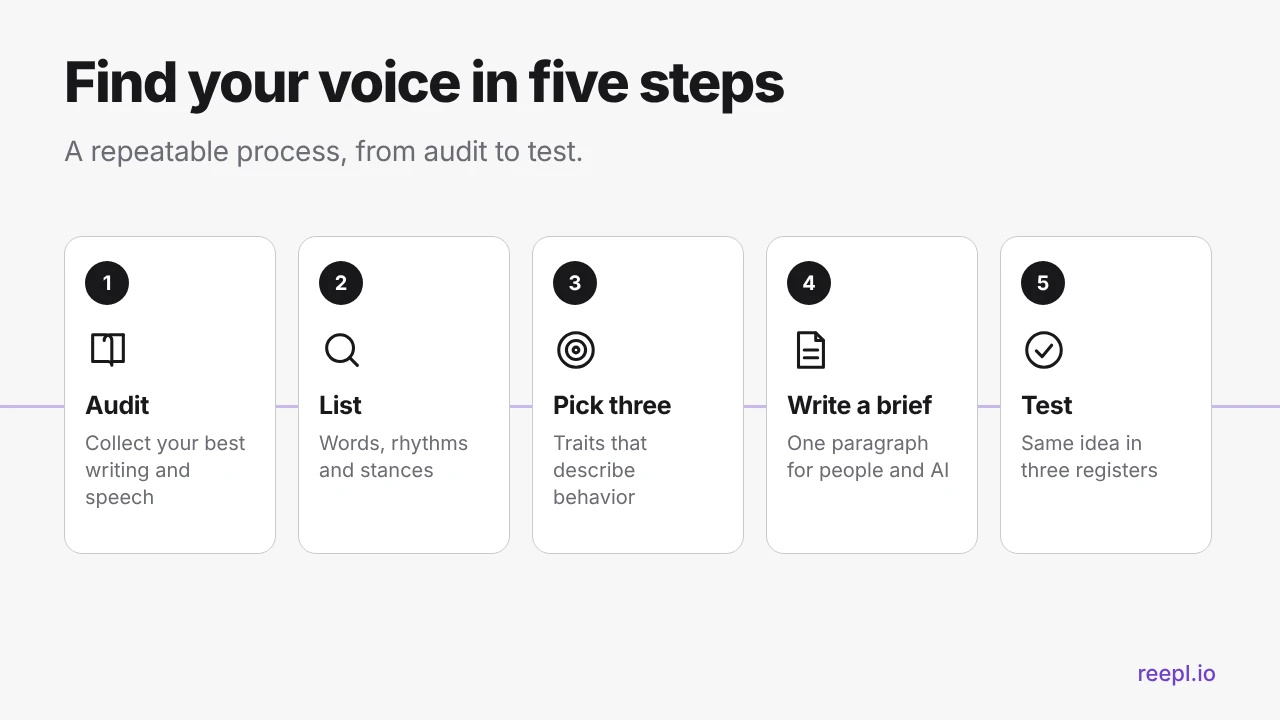
Step 1: audit your best past writing and speech
Start your audit with evidence: writing and speech you already produced. Describing yourself comes later, because the words people pick for their style ("authentic", "professional", "engaging") fit everyone.
Collect 8 to 12 samples
Pull together writing and speech that you read back and think "yes, that is how I sound". Good sources include:
- Your own LinkedIn® posts that felt natural to write. Choose them by how much they sound like you, and ignore how they performed.
- Comment replies and DMs where you answered a real person without overthinking it.
- Emails to clients or colleagues that you were happy with after sending.
- Anything you have said out loud, such as a podcast guest spot, a talk, or a call you recorded with permission.
Add speech on purpose
Most of us write more stiffly than we talk. Record yourself explaining your work to a smart friend for three minutes, then transcribe it. The gap between the transcript and your posts is usually where your real voice is hiding: the shorter sentences, the aside you would never type, the blunt way you describe a mistake.
Mark each sample: me or costume
Read each piece and mark it either "me" or "costume". A costume sentence is one you wrote because you thought a LinkedIn® post should sound that way. "I'm thrilled to announce" is a classic. Keep only the "me" samples.
Step 2: list the recurring words, rhythms, and stances
Read your "me" samples for patterns that repeat without you trying: the words you use, the rhythm of your sentences, the stances you take and the way you open.
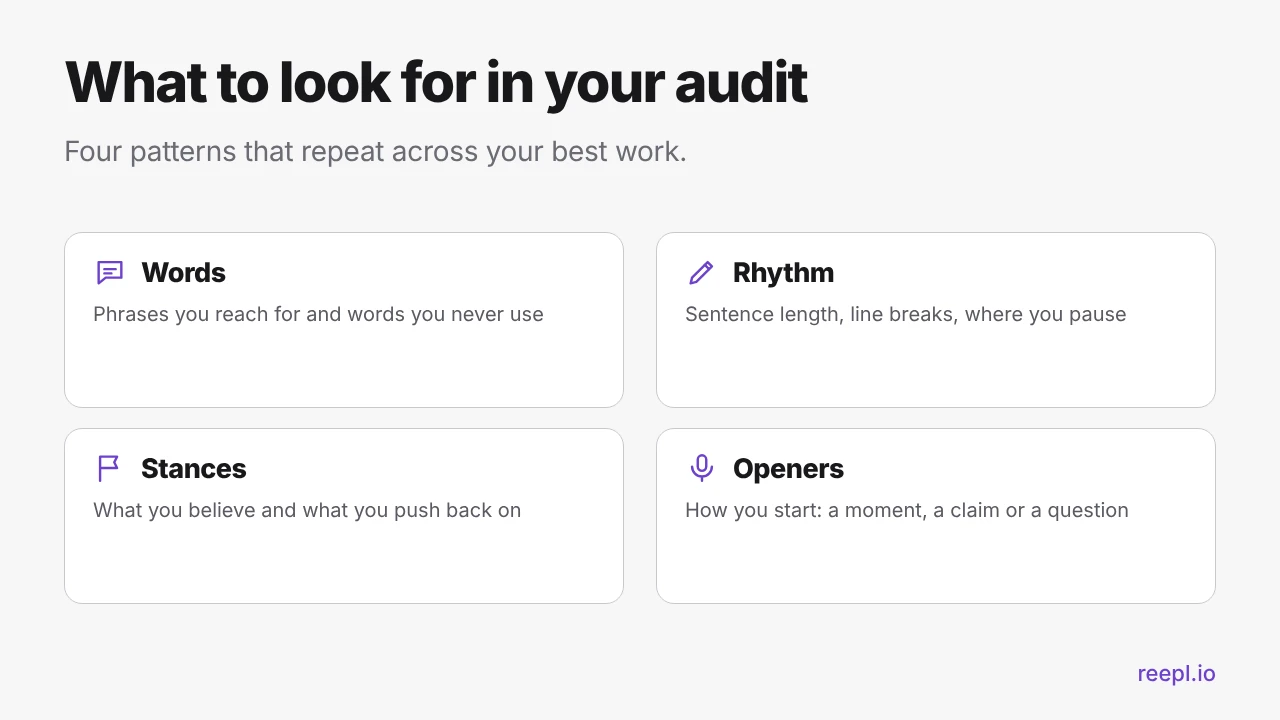
Words
Underline the phrases you use more than once. Note the words you would never say: if you have never written "leverage" or "synergy" in a sample, that absence is part of your voice.
Rhythm
Count roughly how long your sentences run. Do you write in short bursts, or do you let one sentence carry a whole thought? Do you use one-line paragraphs for emphasis? Rhythm is hard to describe but easy to spot on the page, and it is what AI most often flattens into medium-length sentences of the same size.
Stances
Write down the opinions that appear across your samples, even in disguise. What do you push back on? What do you recommend without hedging? Where do you admit uncertainty? A stance can be small. "Most onboarding checklists are too long" is a stance. "Onboarding is important" is not.
While you are here, note your openers too. Some writers open with a moment ("Last Tuesday a client asked me..."). Some open with a flat claim. Some open with a question. If every sample opens the same way, that habit belongs in your brief.
Record what you find in a short note you can reuse:
- Words I use often: [phrases that repeat across samples]
- Words I never use: [jargon or stock phrases absent from every sample]
- Typical sentence: [short bursts / one long thought / a mix]
- Stances I hold: [two or three opinions that recur]
- Usual opener: [a moment / a flat claim / a question]
Step 3: pick three voice traits
Pick three traits, each describing a behavior a writer could check. Three is enough to steer a draft, whether you write it on a tired day or a model writes it. "Authentic" cannot be checked. "Opens with a specific moment instead of a general claim" can.
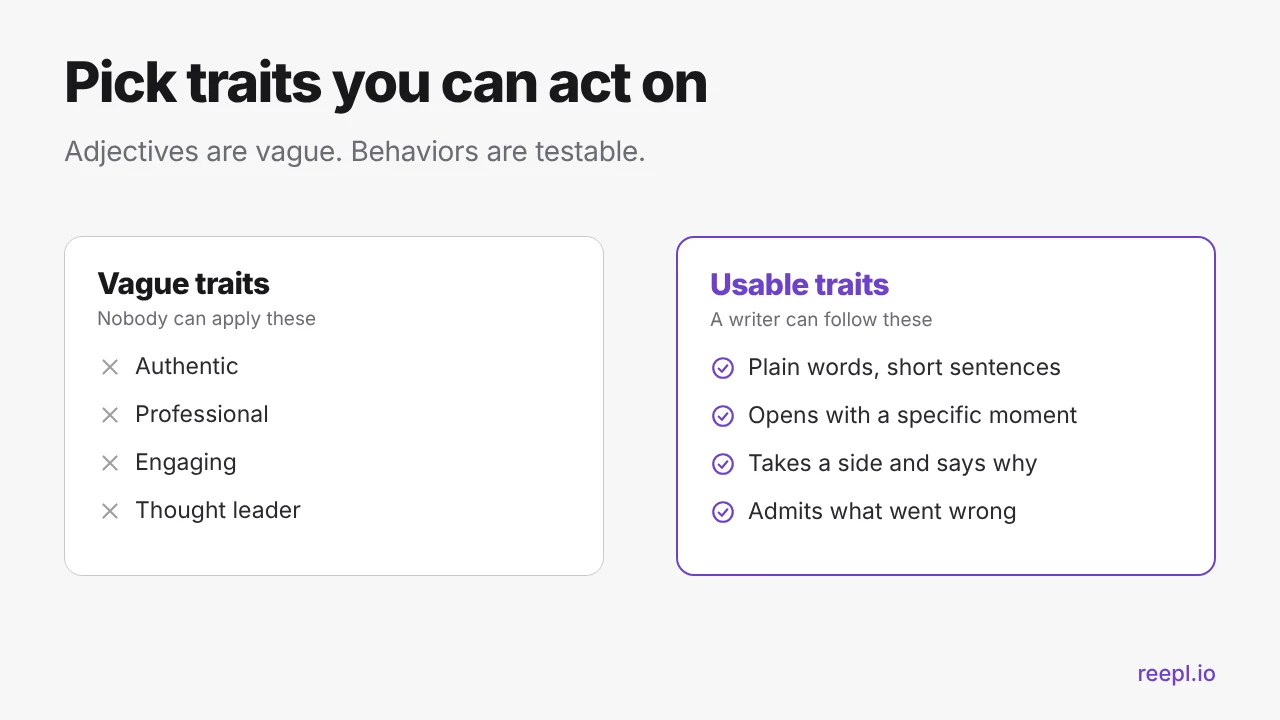
A trait works best in a "this, not that" form, because it tells the writer where the edges are:
- Plain, not simple. Short words and short sentences, but the ideas still carry real detail.
- Specific, not general. A named situation or number from your own work beats "many businesses struggle with".
- Opinionated, not loud. You take a side and explain why, without hype or shouting.
Step 4: write a one-paragraph voice brief
A voice brief is a short paragraph that turns your three traits, your audience, and your no-go list into something you can hand to a person or paste to an AI model. Keep it to one paragraph.
A useful structure has four parts: who you are writing for, your three traits, how you open and close, and what you avoid. Here is an illustrative example for a fictional independent consultant. Copy its shape; the consultant is invented:
"I write for operations leads at mid-sized logistics firms who are tired of vendor hype. Plain words and short sentences, with real detail in every point. Specific examples from client work, never 'many businesses'. I take a side and give the reason, without shouting. I open with a specific moment or a flat claim and end with one practical next step. I never write 'thrilled to announce', 'excited to share' or a generic question to the audience."
It has an audience, three behaviors, an opening habit, and a short ban list, and no adjectives like "engaging". Save it somewhere you can paste from. To write your own, fill in: "I write for [audience] who [their problem]. [Trait one]. [Trait two]. [Trait three]. I open with [habit] and end with [habit]. I never write [ban list]."
Step 5: test it with the same idea in three registers
Test the brief by writing one idea's opening in three registers and reading each aloud. A brief is a hypothesis until it survives that test. Same idea, three registers. Here is an illustrative idea: "I stopped offering discounts."
- The teacher: "Discounts teach clients to negotiate. Here is what I do instead."
- The storyteller: "A client asked for 20% off on a Friday afternoon. I said no, and I almost lost her."
- The challenger: "Discounting is not a sales tactic. It is a refusal to explain your price."
Read all three aloud. One will feel like something you would actually say. Another will feel like a costume. The register that survives the read-aloud test is your default, and it should shape your brief. Repeat with two or three different ideas. If the same register keeps winning, your voice is stable enough to describe. If not, go back to step 1 and add more "me" samples.
How to make AI match your voice
AI matches your voice best when you give it four things: real samples, your voice brief, a banned-phrases list, and your own edit after every draft.
1. Give it real samples instead of adjectives
Telling a model to "sound authentic and conversational" gives it nothing to imitate. Paste in a handful of your best "me" posts instead, and say what to copy: the rhythm, the openers, the way you take a side. Tell it to match the style and leave the topics and phrasing behind.
2. Give it your voice brief
Paste the paragraph from step 4 at the start of every drafting session. Samples show what you sound like. The brief says why, so the model can apply the pattern to a new topic.
3. Give it a banned-phrases list
Models drift toward certain tics. Name them. Start with the usual suspects, then add your own from the "costume" pile in step 1:
- "In today's fast-paced world" and "let's dive in"
- "I'm thrilled to announce" and "excited to share"
- "game-changer", "unlock", "leverage", and "landscape"
- The "it is not X, it is Y" construction, and closers that end on a generic question to the audience
4. Edit after, every time
Rewrite every draft in your own words before it goes live. A draft you reviewed and rewrote in your voice is a different thing from a prompt pasted straight into the feed. For more on where AI drafting helps and where it falls short, see can AI write LinkedIn® posts that sound human.
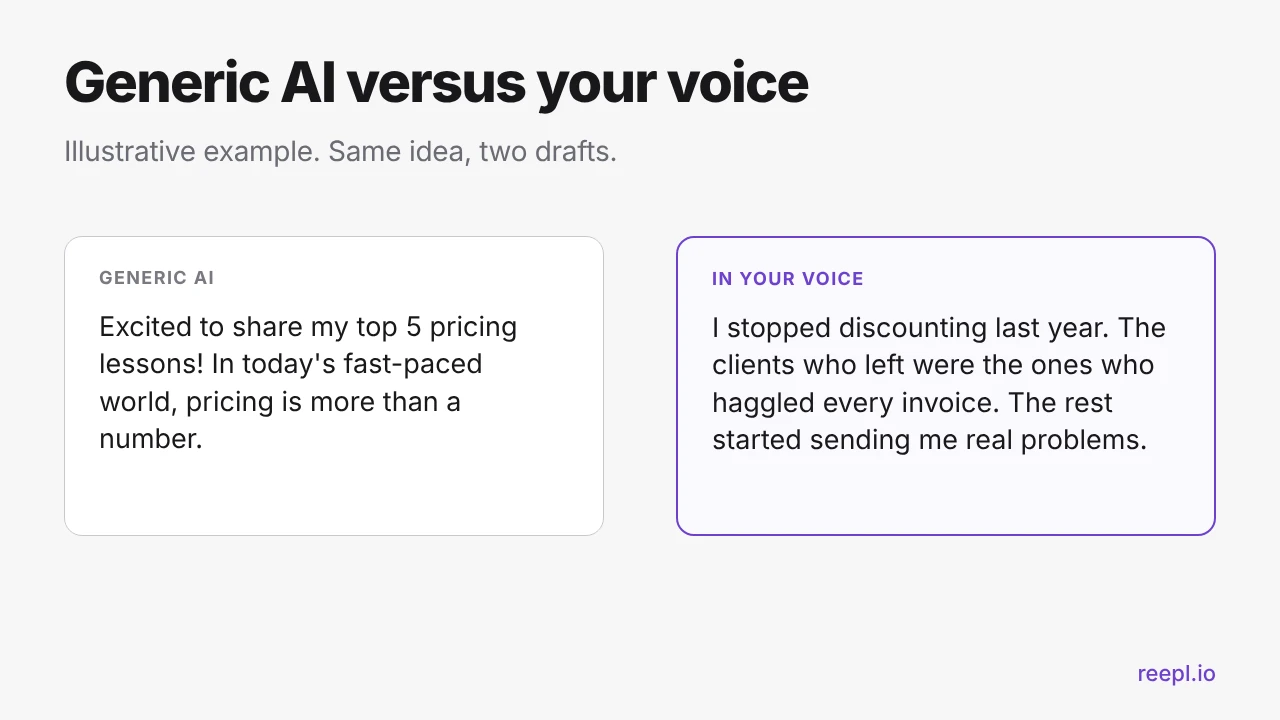
The illustration above is invented to show the pattern. The second has an opening moment, short sentences, a stance, and no banned phrases. None of that came from a smarter model. It came from a better brief.
How can you reuse a voice brief in Reepl?
Reepl is an AI writing platform that puts your social media on autopilot in your own voice: it finds what to post about, drafts your posts, and keeps your calendar full, and you decide how much it does without asking.
A saved voice profile helps carry tone, style, and audience preferences into drafting. Use your own writing samples and the brief from step 4. Keep facts about the current post separate from style examples so an old story does not accidentally become a new claim.
You can also run the exercise manually with a document of samples and instructions. Reepl becomes useful when repeating that setup is slowing down a regular writing routine. You choose how your own posts are reviewed and scheduled. For engagement, Reepl drafts comments and messages for you to review, edit, and send.
Check current plans for the features you need. Treat a voice profile as a starting point, and review beliefs, personal experiences and implied results as carefully as the wording.
What belongs in a useful voice audit worksheet?
A useful voice audit worksheet records evidence in seven columns: sample, audience, purpose, wording pattern, sentence rhythm, stance and permission to reuse. It works when another writer can read the same samples and understand your choices without you in the room.
For an illustrative consultant, one sample might say: “Before replacing the process, check who owns the exception.” The wording pattern is a plain instruction. The rhythm is a direct opening followed by an explanation. The stance is that process changes need an ownership check first. Those observations are more useful than calling the sentence “authentic.”
Include samples that did not work. A launch announcement you disliked can show where you become stiff. A confident answer in an email can show how you explain the same subject naturally. Mark why you reject a sentence, such as exaggerated certainty, unnecessary formality, or a joke that does not fit your public work.
Leave casual speech habits out of the brief. Speech contains repetition, false starts and filler that distract in writing. Preserve the underlying choices: how you explain a tradeoff, which examples you use, and where you admit uncertainty. A written post can sound like you while being easier to read than a verbatim transcript.
| Dimension | Observable instruction | Evidence to collect |
|---|---|---|
| Vocabulary | Use the familiar term before introducing the technical term. | A passage where you explain a specialist concept. |
| Rhythm | Use complete paragraphs with occasional short emphasis. | A post whose pacing feels natural. |
| Stance | State a recommendation and its main limitation. | A reply where you explain a judgment. |
| Humor | Use dry asides only when the subject permits. | An example you would still stand behind publicly. |
How should you test whether an AI actually follows the brief?
Test the brief on a new idea that is absent from the sample set, with its facts supplied separately. If the model produces a convincing version only by borrowing a familiar story from your samples, it copied you and the brief needs work. Tell the model which facts it may use.
The OpenAI prompt engineering guide describes using examples and relevant context to guide output. For a voice test, make those roles explicit: “These examples show style only. The fact sheet below is the only source of claims for the new post.” Then request a draft and a list of assumptions it had to make.
Score the output on five separate checks, each a yes or a no:
- The factual meaning matches the fact sheet.
- The recommendation is one you actually hold.
- The vocabulary fits your word lists.
- The pacing fits the audience.
- The opening and closing are ones you would choose.
A draft can match your rhythm while inventing your opinion. Treat a “no” on the second check as a serious failure, however convincing the draft sounds.
Ask a colleague who knows your work to compare the draft with your ordinary writing. Treat their feedback as editorial judgment and ask for specific mismatches. “Too polished” is hard to fix; “you usually explain the exception before giving advice” can improve the brief.
Avoid using a detector as the final judge. OpenAI discontinued its AI text classifier in July 2023 because of low accuracy. One retired tool says nothing definitive about every detector on the market, and it does show that a classifier label can be wrong. Judge the draft by the five checks above: does it truthfully express you?
How can a writer change tone without losing their voice?
Keep your stable choices and adjust the tone to the situation. A congratulatory post, a technical explanation, and an apology should not have the same emotional tone. Forcing a playful style into a serious correction can make the voice feel artificial even if the vocabulary matches your usual posts.
Consider an illustrative founder whose voice uses plain words, explicit tradeoffs, and short explanations. In a product update, that might become: “We removed a step because it asked customers to repeat information.” In a correction, it might become: “The earlier post used the wrong date. We have corrected it and checked the linked document.” The tone changes, while clarity and responsibility remain.
Build tone notes around situations. Define how you handle good news, disagreement, uncertainty, and sensitive subjects. For each, include an example you approve and a boundary. You might welcome dry humor in a process story and exclude it entirely from layoffs, incidents, or another person’s difficulty. One line per situation is enough: “When [situation], I [how I handle it]. Example: [approved sentence]. Never: [boundary].”
Multilingual writing needs another check. A literal translation can preserve every word and still change the social meaning. Review formality, idioms, and the way disagreement is expressed for the intended audience. Adapt the voice brief for each language you write in: keep the point of view first, then choose natural wording.
What should you protect when collecting writing samples?
Protect confidentiality, other people’s rights and your own credibility. Only use samples you have the right to share with the drafting service. A client email may sound exactly like you and still contain confidential information. Remove names, private terms, business details, and any sentence that cannot safely leave the original context. Prefer public writing when it represents you well.
The LinkedIn® User Agreement addresses rights to shared content, and the Professional Community Policies prohibit misleading representation. Keep the voice exercise clear of impersonation and borrowed experiences: build the brief from your own wording, never from a competitor’s distinctive phrasing presented as your voice.
LinkedIn®’s guidance on AI-assisted content, consulted in October 2026, says the content should reflect your perspective and experience and asks you to review it. That standard covers the claims as well as the sound. You must be able to explain why the post says what it says.
Maintain a small version history for your brief. Note what changed and why: a new audience, less humor in technical posts, or a clearer rule about uncertainty. Review representative drafts after a change. When you add samples, remove the ones that conflict with them, so the instructions stay coherent.
What should you do next?
Finding your LinkedIn® voice is a small research project. Gather samples of how you really write and speak, notice what repeats, boil it down to three behaviors, and write them into a paragraph you can paste anywhere. Then test it on one idea in three registers.
Every draft gets easier after that, whether you write it yourself or have AI draft it first. The voice is yours. The tools just need a clear brief and real examples, and you still decide what goes live.
Turn a useful idea into a clear draft
Bring your own context, review the draft, and keep the final wording yours.