A LinkedIn® ghostwriter costs what the agreed editorial work requires: interviews, research, drafting, revisions and coordination all change the quote. Public packages offer useful price examples, but not a market average. Build your budget from a written scope, add your own review time, and run a small paid trial before a longer commitment.
Key takeaways
- Compare a defined package of work, because a post count alone hides differences in interviews, research, formats and revisions.
- Budget the first month separately: onboarding, extra revisions, design and your own review time sit on top of the recurring fee.
- Ask in writing who interviews you, who drafts, who checks claims and who owns comments and private conversations.
- Use a small paid trial to judge voice, accuracy and how the writer handles feedback before a longer commitment.
- Treat break-even calculations as assumptions to test, never a promise of new business.
What do public ghostwriting packages cost?
Two public provider pages offer concrete starting points. We checked both in October 2026; their advertised offers have different scopes and should not be treated as the lower and upper limits of the market.
| Provider and public offer | Advertised monthly price | Scope and conditions to check |
|---|---|---|
| Cleverly: Influencer | $697 | Lists 12 posts per month, ongoing content interviews, a content calendar, and an account manager. The package also bundles services beyond writing. |
| storyarb: Executive | $4,999 | Lists 15 social posts per month and a six-month minimum. A footnote requires a designated point of contact and at least two executives to qualify. |
Cleverly’s offer provides a defined monthly post count with ongoing interviews. Its page also includes a network growth campaign, so ask what a writing-only arrangement would contain and which activities you would authorize.
Storyarb describes a broader editorial team and an interview-led process. Its two-executive qualification matters: request written confirmation of whether the displayed price and post allowance apply per executive or across the engagement.
These are provider-advertised dollar prices, not negotiated quotes or an endorsement of performance claims. Confirm currency, taxes, setup charges, current availability, and the full commitment before budgeting.
A cheaper package may fit if you supply organized ideas and want drafting support. A broader service may fit if you need interviews, research, and editorial planning; compare those responsibilities before comparing the numbers.
What number should go in your own budget?
Use a current written quote for purchasing decisions, and separate the cash invoice from your time. The arithmetic below uses hypothetical inputs, not additional provider prices.
Suppose a writer quotes $1,600 per month for eight posts, one interview, and one revision round per post. Add an assumed $300 onboarding fee, and the first-month cash budget becomes $1,900 before tax or separately quoted expenses.
If interviews and reviews take four hours per month, that time remains your responsibility. You are buying editorial help while retaining ownership of the ideas published under your name.
What should a ghostwriting quote include?
A useful quote defines deliverables, working process, and boundaries.
Deliverables and formats
Specify the number of posts and the formats. Eight text posts are not the same deliverable as eight document carousels with original layouts. Ask whether headlines, image copy, captions and alternative versions count separately.
Define what counts as delivery. A draft ready for your review differs from a post fully approved and prepared for publication. If several drafts remain unused, establish whether they roll into the following month or expire with that month’s allocation.
Interviews and source material
Ask how the writer discovers what you actually think. Possible inputs include recorded conversations, voice notes, existing articles, sales questions and approved internal documents. Clarify who prepares interview questions and who organizes the resulting material, and specify technical research or interviews with other employees if you need them.
Revisions and approval
A revision round is one consolidated set of requested changes to a draft. Agree on this definition before work starts, because scattered feedback can create disputes about what was included.
Ask what happens when a draft misses the agreed brief. Correcting an unsupported claim or a misunderstood position is a different request from a completely new topic after approval, so put the treatment of each situation in writing.
Responsibilities after drafting
Specify who checks sources, secures permissions, handles confidential material, and makes the final publication decision. If scheduling is included, ask how access and approvals work.
Comments and private conversations need their own agreed owner as well. Write down who answers each, since a contract for writing posts may cover none of them.
Our human approval workflow gives you a checklist for reviewing the final draft.
A scope checklist for the quote
- Posts per month: [number], in [formats].
- Inputs: [interviews, voice notes, supplied documents].
- Revision rounds per post: [number], with a revision round defined as one consolidated set of changes.
- Delivery means: [draft for review, or approved and ready to publish].
- Unused drafts: [roll over, or expire].
- Owners: sources [name], permissions [name], final publication decision [name], comments and messages [name].
How do different pricing structures compare?
Compare pricing structures by how they allocate uncertainty. A fixed fee creates a predictable invoice only when both sides agree on the work covered by that fee.
| Structure | Useful when | Clarify before buying |
|---|---|---|
| Per post | You supply clear ideas and need occasional drafts. | Research, revisions, formats, and minimum order. |
| Monthly retainer | You want a recurring production process. | Deliverable count, meetings, rollover, and cancellation. |
| Hourly work | The task is exploratory or hard to define. | Spending cap, time reporting, and approval for overruns. |
| Fixed project | You need a launch package or paid trial. | Acceptance criteria, milestones, and ownership. |
| Advisory plus editing | You can draft but need direction and quality control. | Whether rewriting is included or separately charged. |
For hourly work, request an estimate and a spending ceiling. For per-post work, ask whether rejected drafts count toward the order.
How do you compare two quotes fairly?
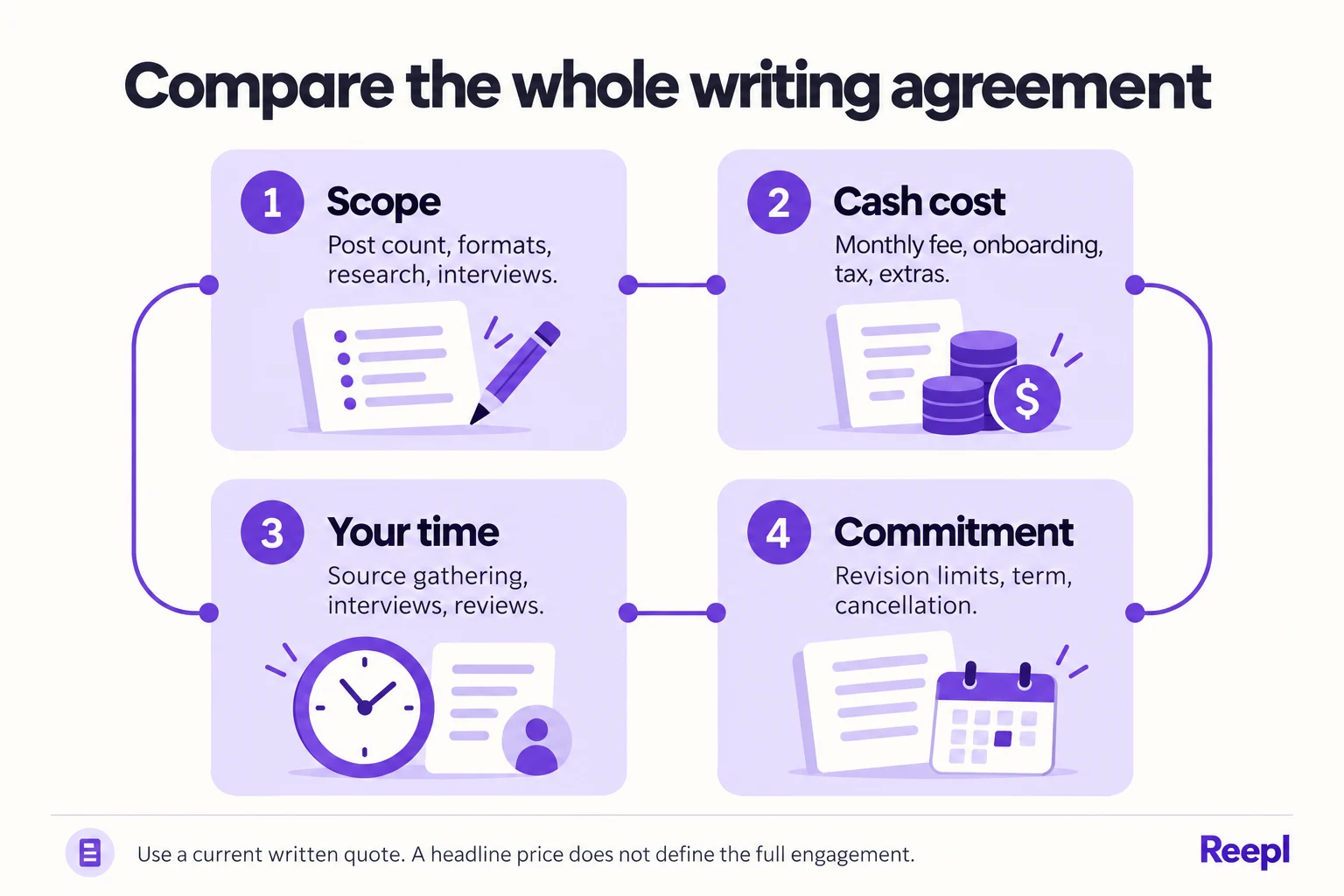
Normalize the scope first, then compare total cash and the work left for you. Dividing the invoice by the post count is useful, but it cannot tell you whether the package solves your actual problem.
Consider these explicitly hypothetical proposals. Neither represents a real provider or a market benchmark.
| Assumed proposal | Drafting package | Monthly fee | Your assumed time |
|---|---|---|---|
| A | Eight posts from notes you provide | $1,200 | Seven hours |
| B | Eight posts, an interview, research, and planning | $2,000 | Three hours |
Proposal A costs $150 per post before considering your time. Proposal B costs $250 per post on the same basis.
If you only need writing support and already have organized notes, A may fit well.
Suppose you assign your working time an internal planning value of $125 per hour. A’s time cost becomes $875, making its combined planning cost $2,075.
B’s time cost becomes $375, making its combined planning cost $2,375.
Under those assumptions, B costs $300 more in combined monthly resources and saves four hours of your time. That may be worthwhile if interviews draw out ideas you would otherwise struggle to document.
It may not be worthwhile if you enjoy drafting and already maintain a strong idea library. The time value is not another invoice. It is a decision aid. Ask each provider to confirm which tasks remain yours before calculating the total cost.
Which costs are easy to miss?
Separate recurring fees from setup costs and conditional extras. The first month can require more work than the months that follow, especially when the writer has to learn your terminology and preferences.
Ask about onboarding interviews, voice documentation, research subscriptions, design, rush requests, additional meetings and platform scheduling. Also clarify tax, payment fees, currency and minimum commitment; a quote in dollars should identify which currency it means.
Contract terms can matter more than a small monthly difference. Compare notice periods, cancellation rights, payment timing and what happens to unfinished work. Ask whether you receive editable files and whether the writer can display your work in a portfolio.
Include confidentiality expectations and your policy on AI assistance. The practical questions are which tools receive your information, what material requires permission and who verifies the final text. A promise that the writing will sound human answers none of them.
Finally, account for coordination. If three internal reviewers leave conflicting comments, someone must consolidate the feedback; assign that responsibility before blaming the writer for a slow approval cycle.
Should you hire a ghostwriter, an editor, or use software?
Choose based on the work you need someone else to own. A ghostwriter can provide interviewing, judgment and drafting. An editor improves material you already produce. Writing software helps you generate and organize drafts while leaving more editorial responsibility with you.
| Option | Best fit | Responsibility you retain |
|---|---|---|
| Write yourself | You have ideas, time, and a workable process. | Research, drafting, editing, and consistency. |
| Hire an editor | You can create substance but want clearer prose. | First drafts and most source gathering. |
| Hire a ghostwriter | You need someone to draw out and shape ideas. | Access to your thinking and final approval. |
| Use writing software | You want drafting support and can review closely. | Input quality, fact checks, voice, and final judgment. |
Compare a software subscription with a full editorial service by the labor each one covers. A human writer may notice a weak argument, challenge a premise or interview you until a specific example emerges. In a software-assisted process, someone still has to do those tasks.
Voice quality also deserves a practical test. Supply several examples of your real writing and explain what you dislike about generic posts.
Our guide to training AI on your writing style includes a voice brief you can also share with a writer.
How can you calculate break-even without inventing ROI?
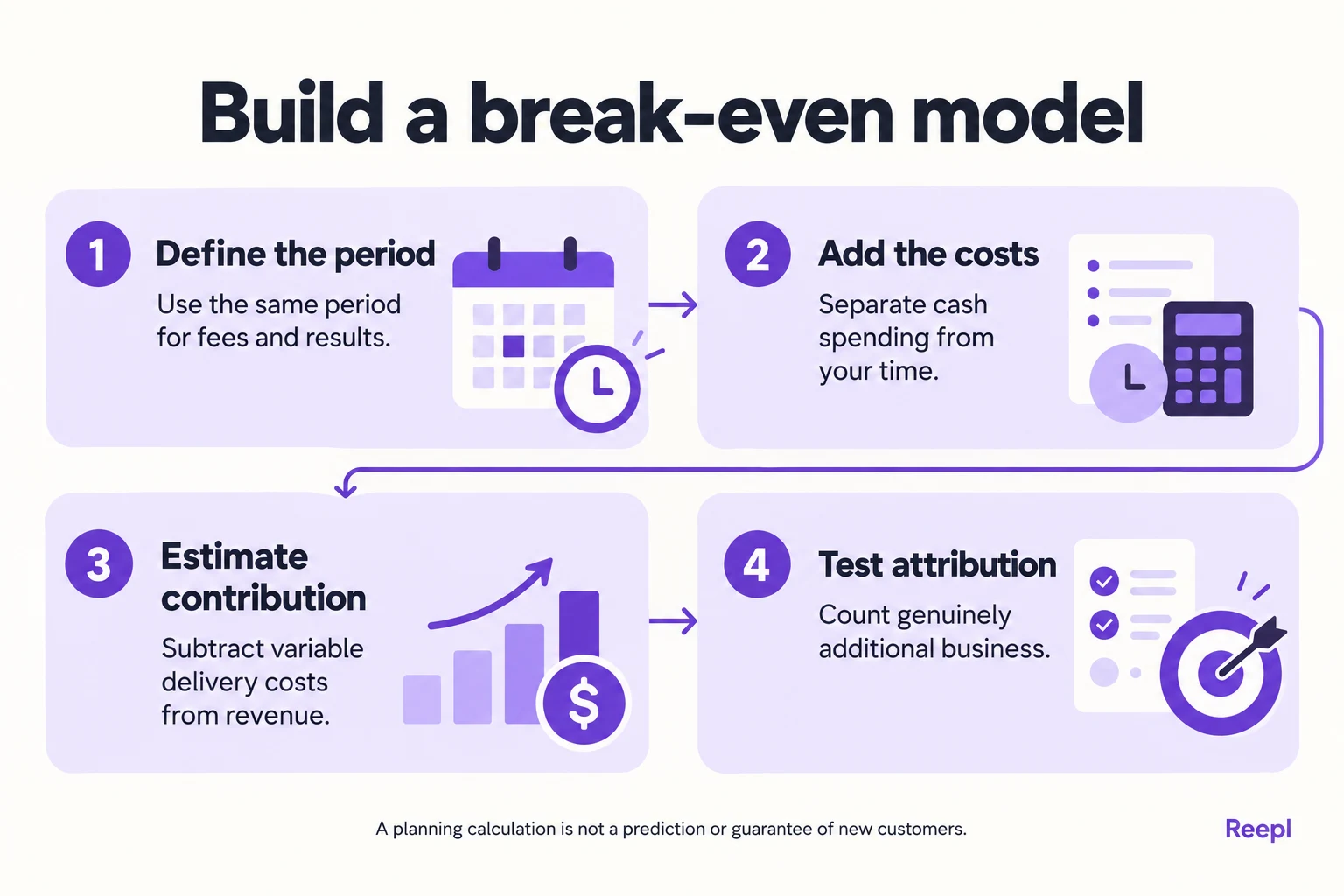
Use contribution profit and explicit attribution assumptions. Revenue alone overstates the amount available to cover the writing expense because you still have to deliver the service or product you sell.
Here is a hypothetical calculation. Assume the ghostwriting fee is $1,800 per month and each additional customer contributes $2,400 after variable delivery costs. Ignore taxes, fixed overhead, and retention effects for this simplified example.
The cash break-even calculation is $1,800 divided by $2,400, or 0.75 additional customers per month. Across a three-month period, $5,400 in fees would require three whole additional customers at the assumed contribution level to cover the fees.
Now include three hours of your time per month at an assumed internal value of $100 per hour. The three-month combined planning cost becomes $6,300. Three customers still cover that amount under these assumptions, but the remaining margin becomes smaller.
None of this predicts that posts will produce those customers. You also need a credible way to distinguish incremental business from customers who would have bought anyway. Record how inquiries began, ask buyers what influenced them, and avoid assigning every sale to the most recent post.
If the goal is recruiting, reputation, or supporting sales conversations, use a separate evaluation framework. Forcing every objective into immediate customer revenue can make a useful service look ineffective or a weak one look successful.
What should you ask before signing?
Ask questions that expose the working relationship, not just the provider’s ability to write a persuasive proposal.
- Who will interview me, write the drafts, and review the work?
- What do you need from me each week, and how much time should I reserve?
- Can you show relevant work you have permission to share?
- How do you verify facts and handle confidential information?
- What happens if a draft misrepresents my position?
- What is excluded, and how do you price additional work?
- What do I receive if either side ends the arrangement?
Request a small paid trial with a defined brief and revision process. Assess the questions the writer asks, the accuracy of the draft, and how well they incorporate feedback.
How should you run a paid ghostwriting trial?
Buy a small sample of the actual working relationship, including the interview and revision process. A polished portfolio shows what a provider can publish; a paid trial shows how the provider works with your incomplete notes, specialist vocabulary and feedback. Keep the trial narrow enough that neither side needs to simulate a full monthly engagement.
Use an ordinary topic for the trial and keep your most impressive success story for later. For example, a hypothetical managing partner at a small accounting firm might ask the writer to explain why the firm moved client document requests from email to a shared checklist. The partner supplies the actual sequence, one competing option and the reasons it was rejected. If results have not been measured, the partner says so plainly, and the writer should keep that uncertainty in the draft.
- Agree on one interview, two text drafts and one consolidated revision round as an illustrative trial scope.
- Give the writer a short audience brief and examples of your natural writing.
- Require a source note for factual claims and a list of unresolved questions.
- Review meaning before style, then send one organized set of comments.
- Compare the revised draft with the brief and record what still requires your effort.
Record whether the writer asks questions that expose a missing argument. A useful question might be, “Why was email acceptable before the firm took on more clients?” That can uncover the condition behind the advice. A weaker process turns the notes into a confident story without asking whether the conclusion follows.
Judge the trial on accuracy, author recognition, usefulness and how much rewriting you do. Impressions from a short assignment mix the writer's contribution with topic, audience, timing and the account's history, so leave them out of the decision. If the first version misses your voice but the revision responds precisely to feedback, that is a different problem from repeated invented claims.
| Trial check | What a good result looks like |
|---|---|
| Questions asked | At least one question exposed a gap in your argument. |
| Accuracy | Every factual claim matches its source note. |
| Voice | You recognize your own phrasing and position. |
| Feedback | The revision fixes what you asked for and nothing you did not. |
| Your effort | The rewriting left for you fits the time you budgeted. |
What boundaries belong in the writing agreement?
A writing agreement should specify access, disclosure and reuse as well as delivery. These boundaries can change the cost because reviewing restricted material or arranging permissions takes work. Ask the provider to price that work explicitly, so it never hides inside “research.”
Start with account access. The LinkedIn® User Agreement, reviewed in October 2026, addresses account credentials, unauthorized automated methods and other people's intellectual property. Purchasing writing support does not authorize every bundled account action. Ask how drafts reach you and how your own posts are scheduled through authorized publishing access.
Next, separate a genuine opinion from an endorsement. If a post recommends a product because of a material relationship, the FTC's endorsement guidance is relevant to U.S. advertising. The writing contract should identify who supplies relationship information and who checks the disclosure. A writer cannot disclose a relationship that you concealed in the brief.
Ask about ownership of the delivered text, editable files and reusable design elements, and what happens to interview recordings and unpublished notes after the contract ends. The U.S. Copyright Office's AI resources explain why AI-related copyright questions require more care than a blanket promise that every output is protected.
These are procurement checks, not legal conclusions about a particular contract, and your individual agreement sets the actual terms. A regulated business, a confidential acquisition or a disputed ownership situation may need qualified review. Budgeting for specialist review can be more sensible than asking the ghostwriter to make decisions outside the writer's expertise.
How do you decide whether to renew the retainer?
Renew against the job you hired the writer to do. If the goal was to turn interviews into accurate posts with less founder rewriting, inspect that process directly. If the goal was sales support, ask whether relevant prospects referenced the explanations and whether the sales team found them useful.
Keep a simple monthly ledger and fill it in at the end of each month:
- Drafts commissioned: [number]. Approved: [number]. Published: [number].
- Author review time: [hours].
- Drafts held, and why: [missed brief, author delay, permission, timing].
- Most useful post and why: [link, reason].
- Change for next month: [scope, inputs or deadlines].
Count an unused draft honestly. It may still be a useful asset, but it has not done the same job as a published explanation. Separate a delay caused by the author from a delay caused by a missed brief.
An illustrative renewal conversation might show that technical posts need substantial rewriting while hiring posts are consistently useful. Instead of renewing the same package, narrow the writer's scope and assign technical evidence review internally. The accounting partner from the trial example might find that the interviews are the valuable part and ask for interview-led editing in place of a larger post quota.
Agree on the evaluation period before looking at results, and fit its length to the work: a short launch project and an ongoing executive presence have different objectives. Ask what changed, what remains uncertain and what work each party can improve next month. Stop or resize the engagement when the needed expertise, available source material or review capacity no longer matches the service.
Copy this quote request
Send the same request to each shortlisted provider so their answers are comparable.
I’m seeking LinkedIn® ghostwriting support for [role and audience]. My goal is [specific business or communication goal].
Please quote for [number] posts per month in [formats], using [interviews, supplied notes, or other sources].
Include your interview process, research scope, revision rounds, turnaround time, and the time you expect from me.
Identify who writes and reviews the drafts, how you check claims, and how final approval works.
Please separate onboarding, recurring fees, optional design, scheduling, and additional-work charges. State currency, tax treatment, minimum term, and cancellation terms.
Explain confidentiality, AI tool use, content ownership, and portfolio permissions.
Please also quote a small paid trial and describe what it would include.
Treat lead targets as goals with a stated measurement method. Ask providers to distinguish work they control from commercial results they hope the work will support.
Start with one written brief, request comparable quotes, and calculate both the invoice and the work that stays on your calendar.
Put your next idea into words
Draft in your voice, review the details, and choose what to publish.