Pick a LinkedIn® MCP by where the post must end up. Reepl fits voice context, drafts and scheduling to a chosen channel. Composio exposes individual LinkedIn® API actions for developers. Zapier connects publishing actions to other apps, with a Company Page focus. Browser-based community servers serve research. Then confirm the destination and review step.
Key takeaways
- Name the final object first: a research summary, a saved draft, a calendar entry and a public post each need different tools.
- Name the destination in every request, because a personal profile, a Company Page and a teammate's channel can have different access requirements.
- Browser-session servers and OAuth API connections are different connection methods; label a browser server as browser-session software.
- Ask for a saved draft first, then approve one version, an absolute date and a named time zone in a separate instruction.
- Removing public-posting permission does not make a connection read-only: some tools can still create, update or delete drafts.
What makes a publishing MCP different from a research server?
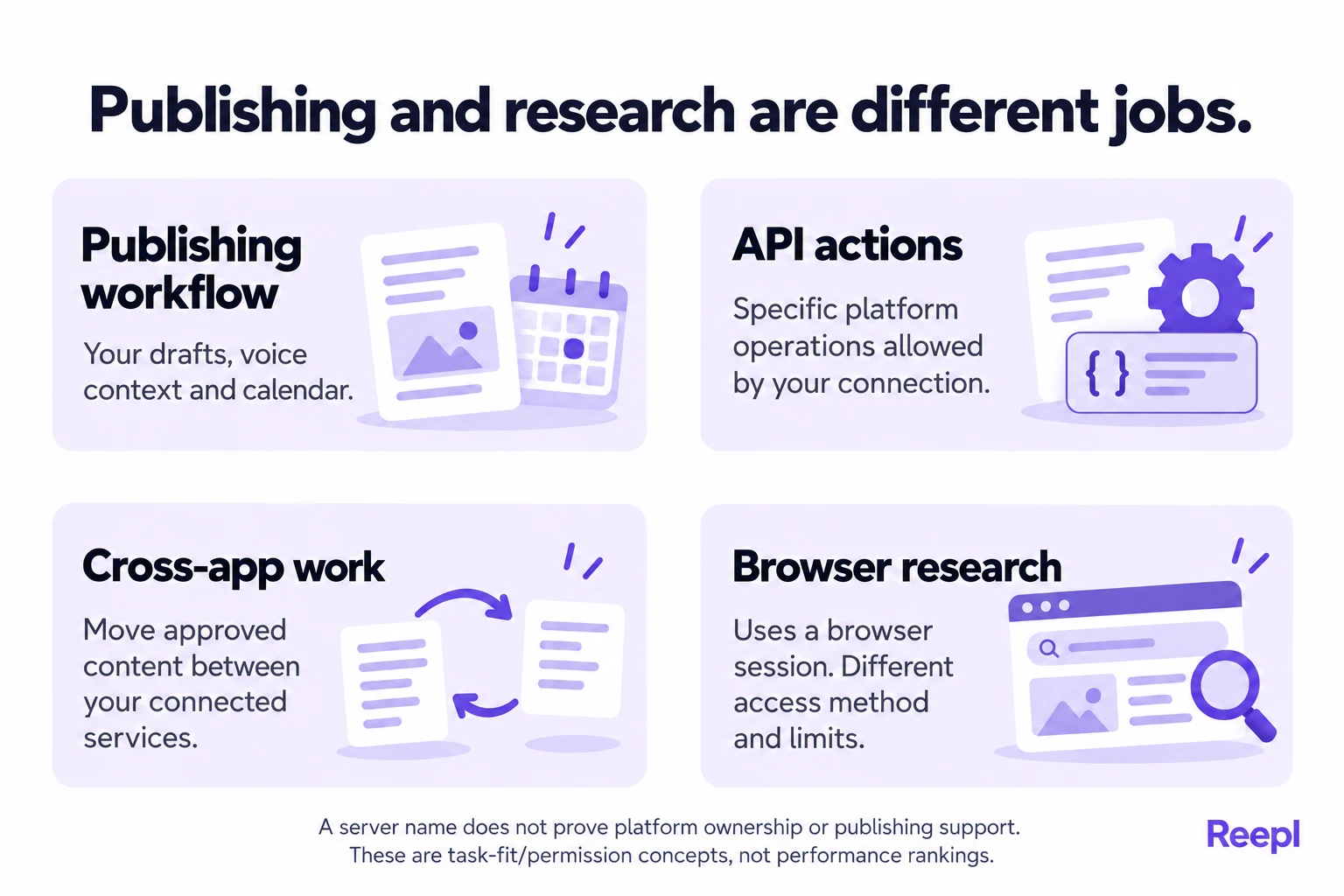
A publishing MCP can save, schedule or publish your own post; a research server retrieves information to inform a decision. When you ask an assistant to turn a product update into a post, that difference decides whether it can save the draft, choose the right account and schedule it, or only return text to copy elsewhere.
That distinction matters more than a large MCP tool count. A server that reads profiles can be useful for research without being able to publish your post. A server that publishes can still lack the draft management or calendar behavior your team needs.
This comparison reviews documented capabilities checked in October 2026. We ran no hands-on posting tests, so it offers no account-safety promises or performance rankings. Reepl is included alongside other approaches because the right choice depends on the work, not a universal winner.
A publishing workflow changes something you own or manage: a draft, calendar entry or public post. Research retrieves information to inform a decision. Both can appear in an assistant conversation, but they require different tools and should have distinct stopping points.
For example, “find relevant companies” is a research task. “Save my announcement as a draft” writes to an editorial workspace. “Publish this announcement from our Company Page” is a public action. One successful task does not imply permission or support for the others.
The distinction is visible in public project discussions. A request in the community browser server’s repository describes people asking for publishing capabilities that the server does not provide. An open request is evidence of a need, not a shipped feature.
Start your evaluation by naming the final object you need. If that object is a reviewed calendar entry, inspect scheduling and draft support. If it is a research summary with source links, inspect data access and retrieval limits instead.
Which options fit publishing, API work and connected workflows?
The table compares task fit, with no scores. “Not established” means the inspected documentation did not show the capability; the provider may still offer it through another feature.
| Option | Documented strength | Authentication approach | What to verify |
|---|---|---|---|
| Reepl | Voice context, drafts, calendar operations and connected-channel publishing | OAuth connection to Reepl and connected social accounts | Intended workspace, channel, plan and whether the result requires approval |
| Composio | Specific actions such as creating posts, sharing URLs, uploading media and retrieving selected data | OAuth2; managed OAuth is documented for this toolkit | Required platform scopes and whether the action is available to your account |
| Zapier MCP | Calling publishing actions alongside operations in other connected apps | Managed app connections with action controls | Exact supported destination, selected action and shared task usage |
| Community browser research server | Profiles, companies, jobs and other browser-accessible research | A signed-in browser session | Different access method; do not assume publishing support or platform ownership |
When is Reepl the useful fit?
Reepl is an AI writing platform that puts your social media on autopilot in your own voice: it finds what to post about, drafts your posts, and keeps your calendar full, and you decide how much it does without asking.
The MCP connection exposes specific actions within that broader product. Recurring Andy routines are separate and currently support personal LinkedIn® accounts only.
Reepl fits a workflow that starts with your facts and writing preferences and ends in a draft or calendar entry. Its current MCP tools include voice context, draft creation and editing, scheduling, and reading scheduled or published posts.
The assistant can list available channels, so you pick the destination by name instead of leaving it to a guess from a brand name in a prompt. Those channels can include personal profiles, Company Pages and teammate accounts. Workspace roles and approval behavior still matter, so a channel’s presence is not unrestricted publishing permission.
This is especially useful when you want the editorial work to remain visible after the conversation ends. A saved draft can be reviewed in the application, and a scheduled post can be checked in the calendar instead of existing only as a promise in chat.
Consult Reepl’s current pricing for the applicable plan. Check which actions your plan includes there before you budget.
When is Composio the useful fit?
The Composio toolkit documentation lists actions for creating a post, sharing an article or URL, creating a video post and handling media uploads. It also lists selected read operations, including your own information and company-related data.
This approach fits a developer who wants to assemble a workflow from specific API actions. You may already have the source material, review interface and scheduling system elsewhere, and need only the authenticated action.
Managed OAuth is documented for this toolkit, but the same page raises questions about scope combinations and rate limits. Treat those as part of the evaluation. After connecting, check each endpoint you need against your account’s permissions, because a listed endpoint may still be unavailable to your account.
Composio’s MCP configuration guide describes limiting allowed tools. That can help separate a drafting or research connection from a publishing connection. Verify the resulting tool exposure instead of assuming the assistant will voluntarily avoid every available write action.
When is Zapier MCP the useful fit?
Zapier’s integration page explicitly connects Create Company Update and Create Share Update actions to MCP. It is a useful candidate when approved content originates in another connected app and publishing is one step in a larger workflow.
An illustrative example is an editor approving a product announcement in a content system before an assistant sends it to the selected publishing action. The value is the connection between services, provided the required action and destination are supported.
Verify the destination carefully. The inspected product FAQ emphasizes Company Page posting. Check the actual action available in your account before you plan personal-profile posts around a generic “share update” label.
Zapier’s MCP page states that MCP is included in its plans and each tool call consumes two tasks from the existing task quota. That gives you a cost basis, but the practical total still depends on the number of calls and your plan allowance.
Why should you distinguish OAuth from browser access?
Some community servers use an authenticated browser session to read pages or perform browser actions. Others call documented platform APIs through OAuth permissions. Those methods can expose different information, require different setup and fail in different ways.
The current README for the community browser server describes reusing a signed-in browser session or opening a login window. It should therefore be labeled as browser-session software, not as an official platform-operated MCP or an OAuth publishing API.
The repository showed recent activity when checked. Maintenance activity can help you assess whether a project is being worked on, but it cannot establish that every action is reliable, permitted for your use case or equivalent to an API integration.
For the publishing workflow in this article, prefer evaluating the documented publishing action and its authorization requirements directly. Choose by the documented action, not by a server name that resembles the platform you want to post to.
Also separate vendor claims from platform approval. A third party can support a platform without being owned, endorsed or approved by that platform. Check a vendor's own statements before describing any option as approved or endorsed by the platform.
How would a reviewed publishing workflow work?
Imagine an illustrative consultant writing about a lesson from a recent project. The source note contains the situation, a decision and an outcome the client has allowed them to discuss. The goal is one useful post, not a fabricated case study.
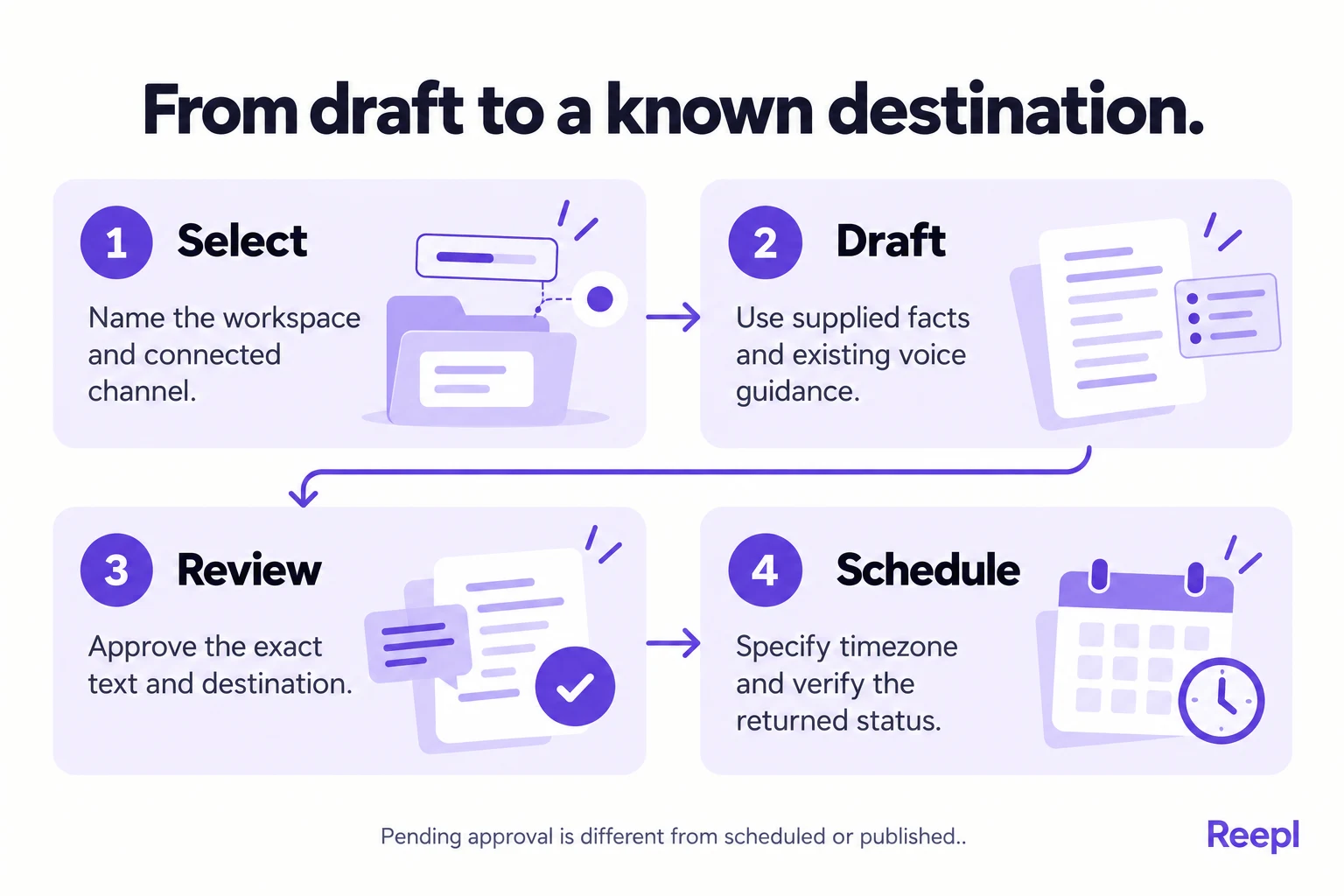
Begin by selecting the workspace and destination. “Our account” may mean a personal profile, a Company Page or a teammate’s channel. If multiple channels are available, name the intended one before the assistant creates or schedules anything.
Use my consulting workspace and personal channel. Read my existing voice guidance. Draft a post from the notes below, preserving the client’s anonymity and the stated outcome. Save it as a draft and show the text. Stop after saving; leave publishing and scheduling for later.
That instruction has three useful boundaries: the source is supplied, the voice guidance already exists, and the requested outcome is a draft. It does not authorize changing the shared voice profile or turning uncertain results into a stronger marketing claim.
Review the substance before polishing the opening. Does the story explain the actual decision? Is the outcome supported by the notes? Have you removed details that would identify the client? A compelling hook cannot repair an inaccurate account of the work.
The current Reepl publishing tools accept plain text and line breaks. Markdown markers can appear literally on LinkedIn®, so inspect the final text and remove bold headings or Markdown links that could show as raw symbols.
After editing, approve a specific version and time. Use an explicit timezone and an absolute date. If another person reviews posts for the destination, ask the assistant to report whether the action created a review request or a scheduled entry.
Schedule the approved draft for November 5, 2026, at 08:30 America/New_York on my personal channel. Show the final stored time and returned status. If approval is required, report that state instead of saying the post is scheduled.
Reepl’s current scheduling tool requires an explicit timezone offset, a future time and rounds to a 15-minute slot. Ask the assistant to translate the timezone into the required timestamp and report the actual stored time, because the stored minute may differ from the one you asked for.
For edits, preserve the version you reviewed. The current tool supports content revisions so a newer edit is not overwritten without notice. When a post has changed, reread it before approving or scheduling the replacement version.
Keep a short approval note with each scheduled post:
- Version: [draft identifier or first line]
- Destination: [personal profile, Company Page or teammate's channel, by name]
- Requested time: [date, time and named time zone]
- Stored time reported: [the slot the tool returned]
- State returned: [draft, awaiting approval or scheduled]
- Approved by: [name]
How do you turn requirements into a fair shortlist?
Compare the output you need before comparing brand names. Write a short acceptance statement such as: “An editor can save a draft, the account owner can review the exact version, and an approved post can reach the intended Company Page at a known time.” Each clause becomes something you can verify in documentation or a bounded test. Write your own: “A [role] can [save a draft], the [account owner] can [review the exact version], and an approved post can reach [destination] at [a known time].”
Separate essential requirements from conveniences. A team that publishes regulated material may require a recorded approval outside the AI chat. A solo consultant may only need a durable draft and a calendar. Voice context is valuable for the consultant, but it cannot substitute for the team's approval record.
| Your requirement | What to verify | What not to assume |
|---|---|---|
| Publish to a Company Page | Exact action, connected Page and account authority | Personal-account publishing implies Page support |
| Retain editorial review | Where approval and the approved version are stored | A chat message automatically satisfies team policy |
| Schedule ahead | Persistent calendar state and timezone handling | A create-post action includes a scheduler |
| Use an established voice | How the assistant receives writing guidance | A publishing API creates a voice profile |
| Recover from an error | Returned identifier and ability to inspect the destination | A timeout proves nothing was published |
In October 2026, the inspected sources support different strengths: Composio exposes configurable API operations, Zapier connects defined actions to other applications, and Reepl retains social writing context and drafts. A feature missing from those pages may still exist, so ask the provider about any requirement its public documentation leaves unresolved.
Cost follows the actual sequence. A workflow might read context, create a draft, update it, schedule it and check the result. Include the necessary calls and account subscriptions in your estimate. Price the whole sequence, because most of the work happens after the first paragraph exists.
What does a Company Page release brief need to contain?
A Company Page release brief needs the organization's identity, the approved material and the person responsible for release. A workspace name alone is insufficient when an agency serves several similarly named clients or when an employee can publish to more than one Page.
Consider an illustrative agency preparing an announcement for a fictional company called Northstar Research. The editor's notes say that a new interview guide is available. They say nothing about the guide being certified, independently validated or used by a particular number of teams. Those unsupported claims must remain absent even if the assistant thinks they make the announcement stronger.
Prepare an unpublished announcement from the supplied release notes. Use the Northstar Research workspace and list the connected destination before saving. Preserve the release date, guide title and source link exactly. Add no customer names, adoption figures or endorsements. Show the final text and identify where the draft is stored.
The editor checks the source link, the subject and every factual statement. The account owner then approves a specific saved version. Only after the destination and time are known should the workflow request scheduling. If the connection cannot select the required Page, stop and use a supported publishing route instead of substituting the editor's personal account.
Attach the approval to the version, not merely to the campaign name. A last-minute change from “available to request” to “available to everyone” changes the factual promise. It deserves another check even if the typography and tone are unchanged. Plan to run that check yourself, since the listed providers may not enforce it automatically.
After the action, record the saved identifier and returned state alongside the campaign brief. The next teammate should be able to tell whether the announcement is a draft, waiting for approval, scheduled or public without reconstructing the entire chat conversation.
What should you do when the assistant reports success but the post is missing?
First identify what succeeded. A tool may have saved a draft or submitted an approval request successfully without publishing anything. Read the returned object and inspect the relevant application view before treating the situation as a platform failure.
If a scheduled entry exists, compare its stored time and timezone with your request. If a public URL exists, inspect that URL under the correct account. If the response is ambiguous, check the destination for the approved text before repeating the write. A network timeout and a rejected request are different outcomes.
Next check destination access. An administrator's role can change after initial setup, or the social connection can require renewal. Reconnecting should use the provider's normal authentication flow. Never paste session cookies or credentials into a chat as a shortcut around an unclear permission problem.
Preserve the source draft during diagnosis. Deleting and recreating objects may erase the link between the approved copy and the attempted publication. If you decide to use the native composer instead, record that decision so another teammate does not later retry the original scheduled action.
A practical first deployment is one author, one known destination and one reviewed post. Expand to more workspaces after the team can retrieve drafts, distinguish states and recover from a failed call. The best MCP for your publishing process is the one whose behavior your team can understand and operate reliably, not the one with the most impressive directory listing.
What should agencies check before connecting a client workspace?
Agency work increases the importance of identity. The assistant may have access to several workspaces, each with different voice guidance, people and destinations. A familiar client name in the chat is not enough to prove which workspace a tool will use.
Reepl’s current consent screen describes access across accessible workspaces, with a default workspace used when a call does not specify one. Changing the default is a convenience, not a security boundary. Pass the intended workspace explicitly for client work.
Shared voice guidance also deserves care. Asking an assistant to make one draft more direct should not silently rewrite the team’s voice profile. Keep a one-off editorial preference in the draft request unless you intend to change future writing for everyone affected.
Finally, distinguish public-post approval from draft editing. Disabling posting access does not necessarily create a read-only connection. Some nonpublishing tools can still create, update or delete drafts. Review the actual capabilities exposed by the provider and the account’s role.
Continue with our guides to understanding MCP connection permissions and comparing X MCP workflows.
Put your next idea into words
Draft in your voice, review the details, and choose what to publish.