An AI-assisted LinkedIn® publishing workflow needs one named owner who approves the exact text, evidence, media and timing before release, with the sources in hand and the authority to stop it. Choose a mode for each kind of post (save as draft, send for review, or schedule directly), and send every material edit back to review.
Key takeaways
- Name who approves the exact version that will publish, even when one person holds every role.
- Send reviewers the source notes, audience, permissions and publication date with the draft, and check facts and permission before voice.
- Stop publication when evidence is missing, permission is unclear or the context has changed, and write down what would release each stop.
- Match the mode to the draft: drafts for exploration, review for an explicit decision, and direct scheduling only for a tightly defined brief you supervise.
- Keep publishing your own posts separate from comments and messages, which you review and send yourself.
What does human approval actually require?
Human approval requires a named person who sees the exact version, with its sources, and can reject it. Human-in-the-loop publishing is a workflow in which people retain defined decision points over AI-assisted posts. The decision, including the power to say no, is the useful part; an approval button alone supplies neither.
A reviewer needs enough information to judge what the draft says, because a fluent paragraph without its source notes encourages a superficial check. Provide the intended audience, the underlying facts, any permissions, and the proposed publication date alongside the text.
Approval must also apply to a particular version. If someone adds a claim after review, the earlier approval no longer covers that claim. Your process should return material changes to the approver, whether you manage that rule in software or a shared document.
When comparing human-in-the-loop LinkedIn® tools, inspect the whole path from generation to publication. Ask where a draft waits, who can change its state, and what happens when nobody reviews it. A workflow that depends on a teammate noticing a notification needs an explicit fallback.
Who owns each decision?
Assign four responsibilities: author, editor, approver, and publishing operator. They need not be four people. A solo consultant can perform them in sequence, using separate passes to avoid confusing a smooth sentence with a checked fact.
| Responsibility | Decision to make | Evidence to retain |
|---|---|---|
| Author | What is the actual point? | Source notes and intended takeaway |
| Editor | Is the argument clear and supported? | Corrections and unresolved questions |
| Approver | Will this person stand behind the final post? | Approval of the final wording |
| Publishing operator | Is this the correct version, account, and time? | Final text and scheduling details |
The account holder should understand what will appear under their name. For a client or teammate, an internal editor's approval should not silently substitute for that person's authorization.
Create a small ownership record before drafting begins:
Post owner:
Editor:
Final approver:
Person responsible for scheduling:
Intended account:
Source document:
Proposed publication date and time zone:
Latest approved version:
If the approver is unavailable: hold publication.
If the source changes: return to review.
Keep this record wherever your team already coordinates work; a shared document works if responsibilities stay clear. The fields are an editorial recommendation, so map them onto whatever your tools actually record.
Agencies managing multiple authors should also keep each person's source material and voice instructions distinct. Our ghostwriter cost guide explains what to include in a paid writing agreement; this checklist governs the final publishing decision.
What should the reviewer check before approval?
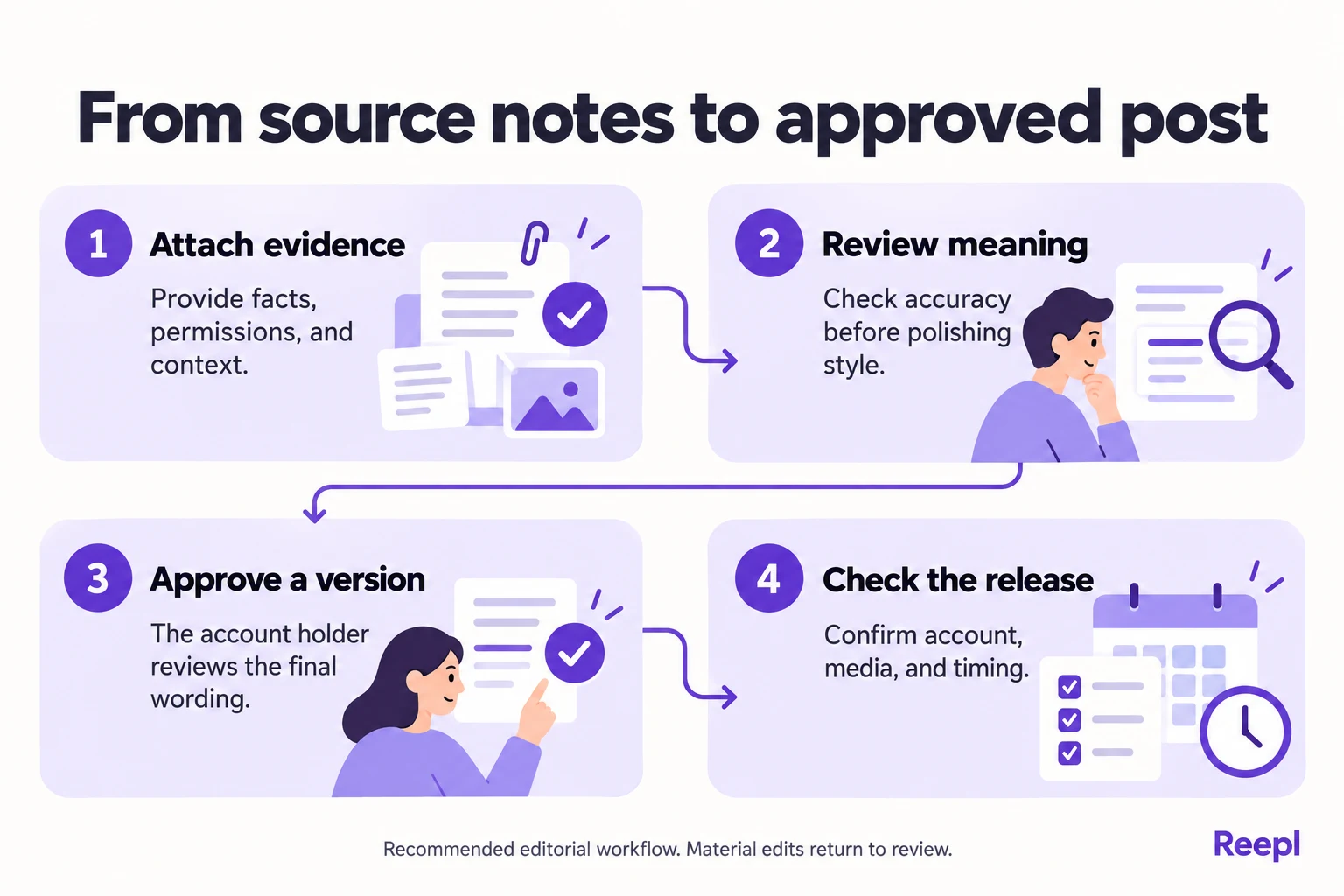
Review the meaning before the presentation: facts and permission first, then voice, clarity, and scheduling, so nobody spends time polishing a post that should never proceed.
Copy this checklist. Treat any unchecked factual or permission item as unresolved; a generally positive review leaves it open.
Copyable editorial checklist
Facts and evidence
[ ] Every number, date, result, and attributed claim has a source.
[ ] The draft distinguishes an observation from an interpretation.
[ ] First-person experiences belong to the named author.
[ ] Examples are labeled when hypothetical or illustrative.
[ ] No outdated source is presented as a current fact.
Permission and context
[ ] Names, screenshots, and identifiable stories may be shared.
[ ] Private information has been removed or approved for release.
[ ] Links and attachments support the claims beside them.
[ ] The post remains appropriate for its planned publication date.
Voice and usefulness
[ ] The author would comfortably say these sentences aloud.
[ ] The opening accurately represents the rest of the post.
[ ] The reader receives one clear idea or useful next action.
[ ] The conclusion does not make a stronger claim than the evidence.
Release
[ ] The approver has reviewed the final text and media.
[ ] The intended account, date, time, and time zone are correct.
[ ] Later substantive edits will trigger another review.
[ ] Someone owns checking the published result and any correction.
Reviewers should write actionable comments. “Feels off” identifies discomfort but leaves the author to guess. “The source says the trial started Monday; this paragraph says it finished Monday” identifies a concrete correction. A useful comment follows one pattern: “[sentence] says [claim]; [source] says [what it actually says]; change it to [fix] or remove it.”
Use different passes if a post contains several kinds of evidence. Check calculations against the original figures, then read the prose aloud. A voice review should never become the only review just because the AI draft already looks polished.
When should a draft stop moving toward publication?
Stop publication when a reviewer cannot establish that the post is accurate, authorized, and appropriate to release. Define these conditions before deadlines make the decision feel expensive.
| Stop condition | Immediate action | Who resolves it |
|---|---|---|
| An outcome has no supporting record | Remove the outcome or hold the post | Source owner |
| A story identifies someone without clear permission | Hold the identifying material | Author and relevant person |
| The author disagrees with the central position | Return to briefing | Author |
| New information changes the claim | Return to factual review | Editor |
| Final wording differs materially from approved wording | Request fresh approval | Approver |
| Account or timing is uncertain | Hold scheduling | Publishing operator |
A stop rule needs a release condition. “Check the result” leaves room for endless discussion. “Obtain the dated report or remove the result claim” defines two concrete paths forward. Write each stop rule in that shape:
| Stop condition | Release condition |
|---|---|
| A number or result has no dated source | Obtain the dated source, or remove the claim |
| A named person has not approved their story | Get their approval, or replace it with a labeled hypothetical |
| The launch, event or offer the post mentions has changed | Update the facts, or move the slot |
| The final approver is unavailable | Hold the post, or route it to a backup with real authority |
If a claim cannot be supported by the deadline, publish a narrower post or leave the slot open. That is an editorial decision, and a calendar with a gap is still a consistent one.
Should you save drafts, require review, or schedule directly?
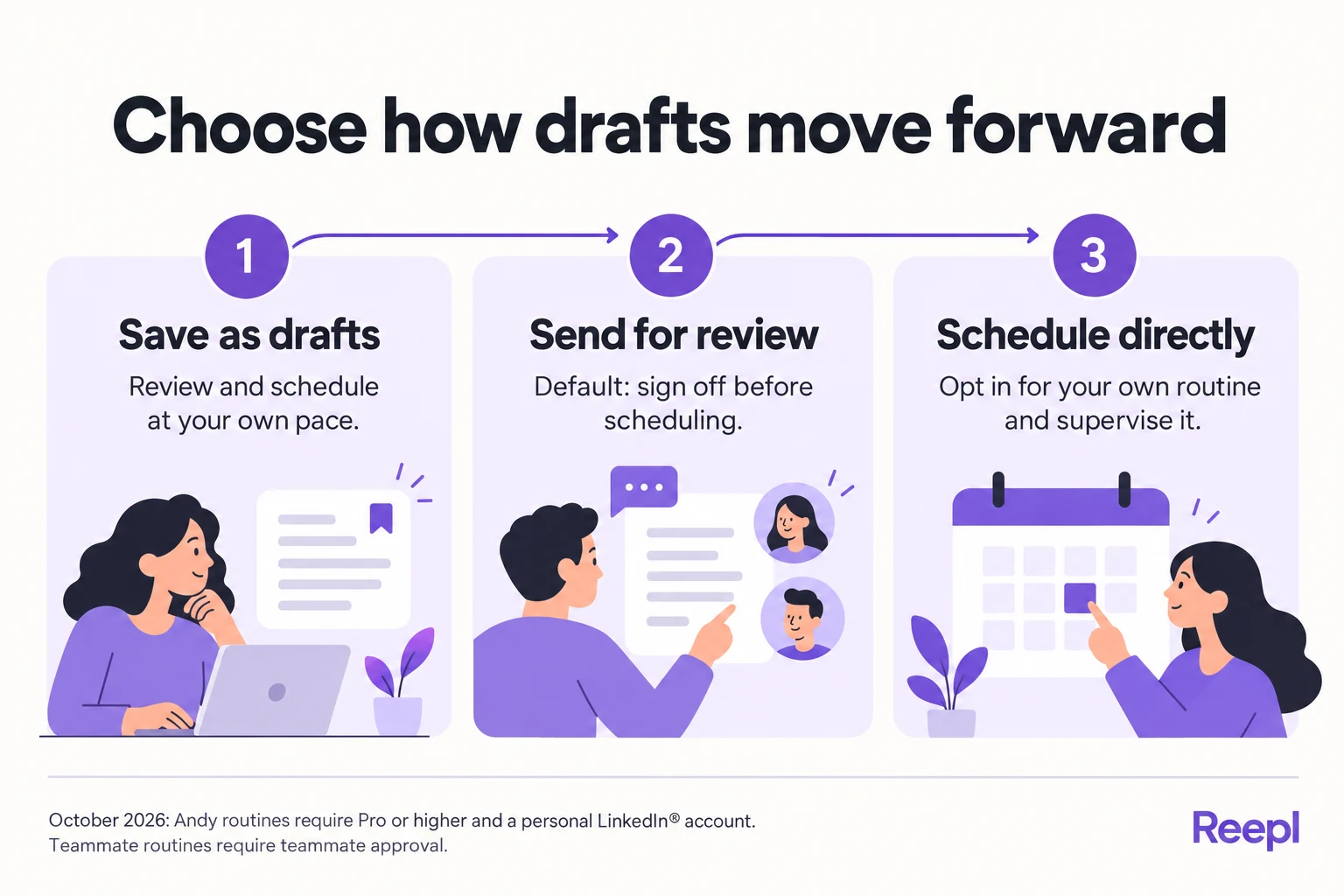
Choose the mode that fits the draft's uncertainty and your publishing responsibilities. Draft storage supports exploration. Review supports an explicit decision before release. Direct scheduling delegates more of the recurring process and therefore needs a tightly defined brief and active oversight.
| Kind of post | Suggested mode |
|---|---|
| A new idea, or an angle you are unsure of | Save as a draft |
| Anything with a result, a client story, a named person or an announcement | Send for review |
| Recurring general explanations under a tightly defined brief you supervise | Schedule directly, if you have chosen that level of delegation |
| Workflow choice | Useful situation | Human responsibility |
|---|---|---|
| Save drafts | The idea or evidence is still developing | Decide whether the draft should progress |
| Send for review | The post needs explicit approval before release | Review the final version and resolve questions |
| Schedule directly | A recurring brief is stable and the owner opts in | Supervise the routine and intervene when needed |
Direct scheduling is not a prize for using AI successfully. Some authors will always prefer reviewing every post. Others may use recurring educational posts while keeping announcements in a separate manual process; you hold that line yourself, with no topic-specific product setting required.
Before delegating scheduling, define the routine's permitted subject matter and what would make you stop it. For example, a hypothetical consultant might allow general explanations of established processes but reserve client stories for manual drafting and review. Write it as one line: “This routine covers [topics]. It excludes [topics]. Pause it if [condition].”
How do Reepl's current review controls work?
Reepl is an AI writing platform that puts your social media on autopilot in your own voice: it finds what to post about, drafts your posts, and keeps your calendar full, and you decide how much it does without asking.
As of October 2026, Andy routines are available on Pro and higher plans and support personal LinkedIn® accounts only, so company pages, X, and Reddit are outside them. The routine choices are Send for review, the default; Save as drafts; and Schedule directly, an opt-in choice.
A routine created for a teammate always requires that teammate's approval. Do not treat direct scheduling for your own routine as permission to bypass another person's review.
These controls operate within the current routine workflow; per-channel approval settings are not a supported control to rely on here.
Use the mode names as practical decisions. Save a draft when the idea needs work. Send it for review when a person needs to judge the final text. Consider direct scheduling only when you have deliberately accepted that level of delegation and can supervise it.
The editorial records, stop rules, and checklist in this article are practices you run yourself, alongside whichever routine mode you choose. Confirm your actual process before depending on it.
What does the workflow look like on a real draft?
Consider a hypothetical founder of a small software company preparing a post about an onboarding change. The following source notes, draft, and corrections are illustrative, not a customer case study. The source notes say the team replaced one long welcome email with a short checklist. The original email covered background, setup steps, and the next meeting.
The change launched this week. Nobody has measured completion or support volume yet. The founder wants to explain the reason for the change without naming customers.
Step one: draft from the source packet
The AI produces this deliberately flawed version:
We cut onboarding confusion in half by replacing one long email with a checklist. Customers now get started faster, and our support team has fewer questions to answer. The lesson is simple: shorter communication always wins.
The editor identifies three issues: an invented measurement, two unsupported outcomes, and a universal conclusion. The draft stops before approval, because fixing the opening alone would leave the same problem in the remaining sentences.
Step two: resolve the claims
The source owner confirms that there is no outcome data. The editor removes all result claims and asks the founder to confirm the actual reasoning. The founder approves a narrower point: the team wanted the first action to be easier to find.
The revised illustrative post reads:
We replaced our long onboarding email with a short checklist this week.
The old message covered the background, the setup steps, and the next meeting. We wanted the first action to be easier to find.
We have not measured the effect yet. For now, the change gives us a specific question to check: can someone identify what to do first without asking us?
If your welcome message keeps growing, review the first action before adding another paragraph.
Step three: approve the exact release
The founder approves the revised text and confirms that the account can share the process change. The publishing operator checks the selected account and proposed time, then schedules that version. If someone later adds a sentence about reduced support workload, the post returns to review, because the earlier approval covered the narrower claim. A recognizable final version matters more than a vague message saying “looks good.”
What evidence should travel with an AI draft?
Send a compact evidence packet with the draft so the reviewer can verify the argument without reconstructing the project. The packet should identify the source of each consequential claim, the reason the audience needs the post and any limits on using the material. A link to a large folder is rarely enough.
For an illustrative product announcement, include the approved release note, the current help page, the feature owner and the intended availability wording. If a feature is only available to a pilot group, that limitation belongs beside the sentence describing it. The reviewer should not have to infer eligibility from a screenshot or a remembered conversation.
NIST's AI Risk Management Framework is voluntary guidance for evaluating and managing AI risks. It is not a social publishing checklist or a certification of this workflow. Our practical application is to make the purpose, evidence, decision owner and unresolved risk visible before the draft reaches an approver.
| Draft element | Evidence to attach | Reason to hold |
|---|---|---|
| Product capability | Current release record and eligibility | The claim describes an unreleased option |
| Customer result | Measurement scope and permission | A result lacks a denominator or consent |
| Professional opinion | Author's position and relevant context | The author does not recognize the view |
| Third-party visual | Source and reuse basis | Publication rights remain unclear |
Keep only the material reviewers need. A post about a support process may need an anonymized description, not a full customer ticket export. Removing unnecessary information makes the review easier and reduces the chance of publishing a detail that never belonged in the draft.
Which checks come from policy, and which are editorial choices?
Platform policies define boundaries; your editorial process decides how to check them. No checklist, approval tool or AI model makes a post compliant on its own; the content itself has to meet a requirement such as sharing authentic information.
The LinkedIn® Professional Community Policies, reviewed in October 2026, address false or misleading information and authentic participation. For an editor, that means checking whether a first-person story really belongs to the author and whether an attractive headline misstates the evidence. The platform document supports the boundary; the sentence-by-sentence review is our recommendation.
The LinkedIn® User Agreement separately addresses rights to shared material and unauthorized automated activity. Approval of a post's wording does not authorize sharing someone else's confidential information or using every possible account-access method. Include media, attached documents and publishing access in the release decision.
Commercial relationships require their own check. The FTC's endorsement guidance discusses disclosing relevant relationships in U.S. advertising. If an AI draft turns a neutral product mention into a recommendation, recheck whether the wording and disclosure still fit. A reviewer should understand why the product appears in the post.
Rights questions are also separate from factual accuracy. The U.S. Copyright Office's AI materials cover copyright questions raised by generative systems. “AI wrote it” settles nothing about whether a quotation, image or passage is yours to publish. Resolve the source and permission before approving the final media.
How can you keep approval from becoming a bottleneck?
Reduce the number of decisions the approver receives at once. An account holder reviewing a clearly sourced draft can decide faster than someone asked to select a topic, reconstruct facts and rewrite the voice in one sitting. Faster review comes from better preparation, not from making silence count as permission.
Separate factual questions from stylistic suggestions. “Did this launch for every customer?” blocks release. “Would you prefer a shorter closing sentence?” usually does not. Put blocking questions at the top of the review request and route them to someone who can answer, so the final approver never has to settle facts by instinct. A review request can follow this shape:
- Post: [working title] for [account], planned for [date, time and time zone]
- Blocking questions: [facts only someone else can confirm, with who should answer]
- Sources: [links to the evidence packet]
- Optional suggestions: [style notes that can wait]
- Approve by: [cutoff]. If not approved: [hold, or name the backup approver]
Use a release cutoff that fits the team's availability. For example, a team might require approval by the previous working afternoon for a morning publication. That is an illustrative operating choice. If the cutoff passes, move the item back to the backlog and keep review out of the moment of release.
Track causes of rework: missing source, wrong position, unclear reader task, changed context or formatting problem. Keep this list short enough that people use it. When unsupported results recur, improve the source packet and drafting instructions. When authors repeatedly disagree with the premise, fix the brief before changing the AI model.
A backup approver needs actual authority and enough context. Someone who can fix grammar is not automatically authorized to approve a financial claim or speak for an executive. If no suitable backup exists, holding the post is the correct workflow outcome. A quiet calendar is easier to repair than a false statement under the wrong person's name.
What happens after a post is published?
Assign someone to check the published text and respond to factual problems. Approval is an informed decision, not a promise that a post cannot contain an error.
If the published post contains a material mistake, correct the content and make the correction clear enough for readers to understand what changed. Decide whether to edit, remove, or follow up based on the specific error and its effect. Keep a brief internal record of the cause so the same issue does not recur.
Publishing your own posts is also separate from engagement. Reepl can schedule and publish your own posts, with you choosing the review controls. For LinkedIn® comments and messages, Reepl drafts and you review, edit, and send. A publishing decision does not authorize unattended conversations.
A review workflow makes ownership and judgment visible, and you remain responsible for what appears under your name. Our writing-style training guide addresses voice; approval must also cover accuracy and permission.
If missed reviews happen repeatedly, reduce the volume, change the review window, or assign a backup with appropriate authority.
Start with one draft. Attach its sources, name its approver, and run the checklist before choosing a publication time.
Put your next idea into words
Draft in your voice, review the details, and choose what to publish.