To train AI on your LinkedIn® writing style, pick a small set of representative posts, turn the patterns you want into a written voice brief, and give the AI a separate packet of facts for each new post. Correct drafts sentence by sentence, save the recurring rules, and test the brief on a topic it has never seen.
Key takeaways
- Pasting examples into a prompt is contextual prompting; fine-tuning is a separate training process that changes model parameters.
- Choose samples that show the voice you want now, including ordinary posts, and hold one back for testing.
- Write the voice brief as instructions an editor could apply to a sentence: openings, evidence, language, structure, and endings.
- Give each post its own source packet of facts, so old stories in your samples never reappear as current events.
- Test the brief on a new topic and score factual fidelity before style; no sample count guarantees a match.
What does training AI on your voice actually mean?
For most writers, “training” AI on your voice means giving it examples and a written voice brief with each request. Changing the model itself is a separate process called fine-tuning. A voice brief is a reusable description of how you express ideas, supported by examples and clear boundaries, and it is the most useful place to start.
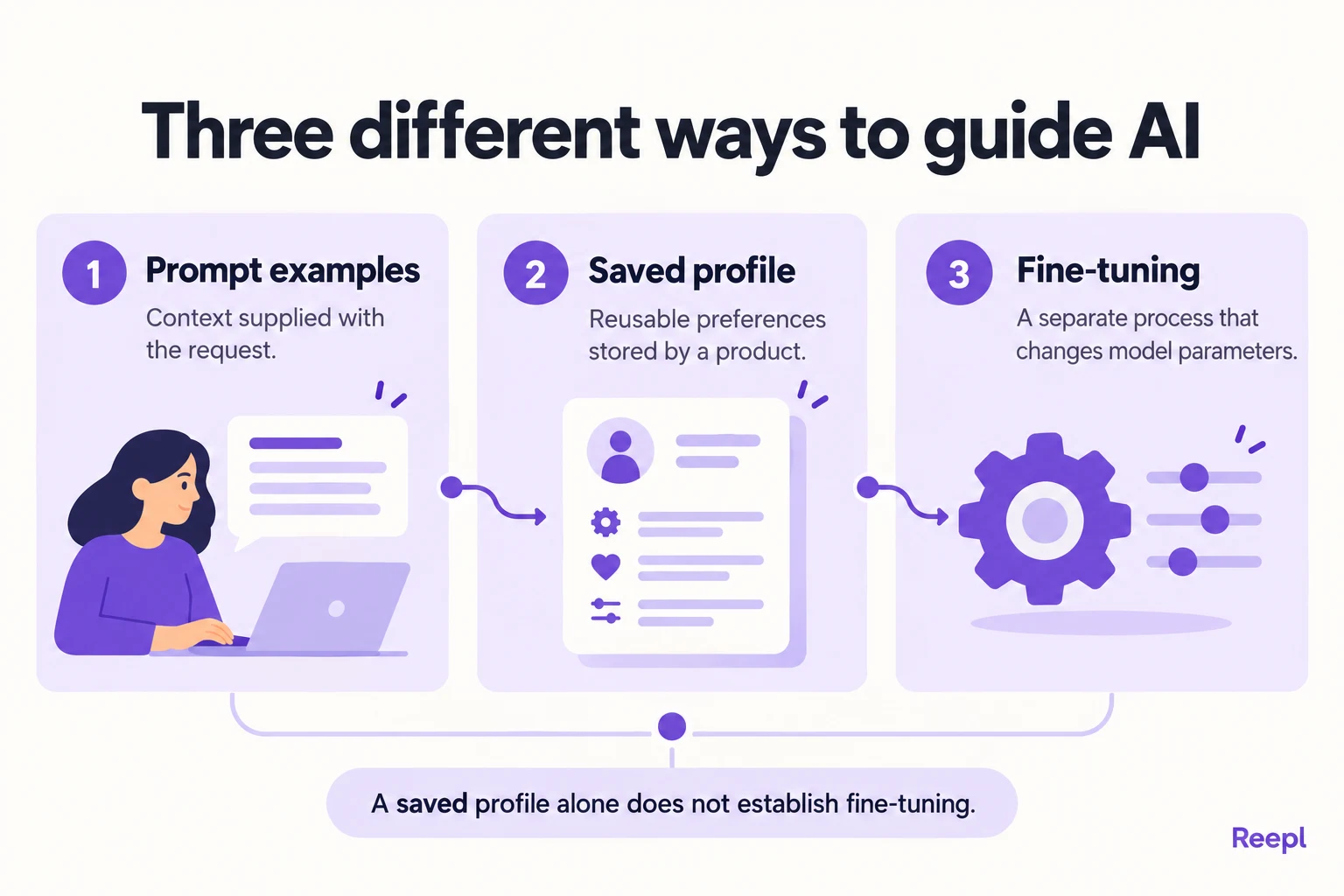
People use “training” to describe three different processes. Keeping them distinct shows you what a writing product is doing and what you still need to provide.
| Approach | What changes | What you should check |
|---|---|---|
| Contextual prompting | Instructions and examples supplied with a request | Whether the next request includes that context |
| Saved voice profile | A product stores reusable preferences or examples | Which drafting surfaces use the selected profile |
| Fine-tuning | Model parameters are adjusted through a separate training process | Training method, data handling, and evaluation |
OpenAI’s prompt engineering guide describes few-shot prompting as supplying examples in a prompt instead of fine-tuning. Pasting your posts into a conversation is contextual prompting.
Pasting examples does not, by itself, show that a provider has fine-tuned a private model for you. A saved profile can make context easier to reuse without telling you anything about the underlying training method. Treat edits the same way: save recurring corrections explicitly, unless your provider documents a learning mechanism that covers them, and check settings and documentation before depending on persistence across sessions.
This guide uses contextual prompting and a reusable voice brief. Both work without a custom model. Budget an hour for an initial pass, then revise as drafts expose gaps.
Which writing samples should you choose?
Choose samples that represent the voice you want to use now. Popularity is a separate question: a widely shared announcement may reveal little about your everyday explanations.
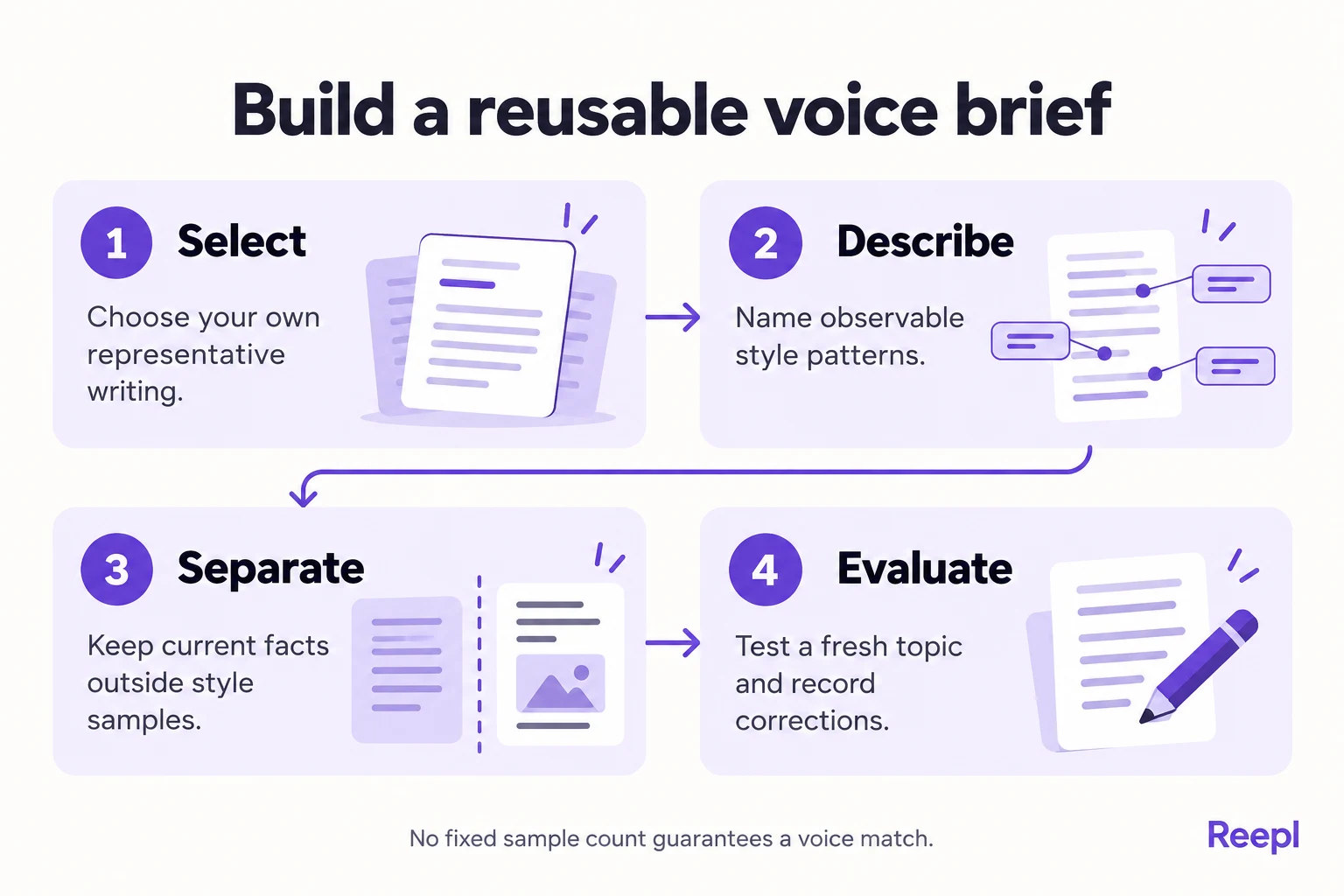
Start with a small set you can inspect carefully, because no sample count guarantees that the AI picks up your style. Cover different writing jobs. Use this checklist to build the set:
- One post that explains a decision.
- One post that shares an observation.
- One post that disagrees with common advice.
- One post that describes a process step by step.
- One recent post held back for testing, kept out of every prompt.
- Every sample is writing you own or have permission to use, with private details removed.
A client's approved public post may still be a poor example for your personal voice if you wrote it in the client's style.
An illustrative sample selection
The following scenario is hypothetical. An independent consultant wants practical, measured posts for small agency owners.
They review six pieces from their own archive:
| Candidate | Decision | Reason |
|---|---|---|
| A proposal scope explanation | Include | Shows concrete instructions and restrained claims |
| A short disagreement about pricing tables | Include | Shows how the writer challenges an idea |
| A personal conference recap | Exclude | Uses a celebratory tone rarely used elsewhere |
| A detailed checklist from an email | Include after redaction | Shows useful sequencing and vocabulary |
| A viral announcement edited by a partner | Exclude | Does not represent the writer's usual phrasing |
| A recent process reflection | Hold back | Provides a comparison for later evaluation |
The selected material contains these illustrative excerpts:
A proposal needs a clear deliverable and a boundary. More pages will not fix either omission.
Before adding a pricing tier, explain what the buyer receives. Sometimes one clearly scoped offer is enough.
Check the exclusions first. The promised work usually gets more attention than the request that falls outside it.
These excerpts suggest a practical stance, specific nouns, and advice with limits. They are too few to support a rule that every post must start with an imperative. Read complete samples before deciding that a repeated pattern is a permanent preference; the goal is to turn your existing style into usable drafting instructions.
How do you write a useful voice brief?
Write the brief as directions an editor could apply to a sentence. “Authentic and professional” leaves too much room for interpretation. “Name the decision before describing the lesson” gives the writer something concrete to do.
Ask the AI to propose patterns from your samples, then approve or reject each one. Treat the analysis as a hypothesis, because a model may mistake a shared subject for a voice characteristic or overstate a habit found in one example.
Copyable voice brief
The following brief belongs to the hypothetical consultant. Replace the details with your own preferences and attach your approved samples.
Voice brief: practical independent consultant
Version: 1
Reader: an agency owner who needs a usable next step.
Purpose: explain operational choices without pretending there
is one correct process for every team.
Point of view:
Write from practical observation. Separate what happened,
what it might mean, and what you recommend.
Openings:
Start with a concrete task, friction, or decision.
Avoid broad claims about the future of work.
Language:
Use ordinary words: scope, deadline, deliverable, decision.
Prefer active verbs and specific nouns.
Use contractions when they sound natural.
Avoid slogans, inflated promises, and invented urgency.
Structure:
Develop one main idea. Use short paragraphs, with some
sentence variation. Include a limitation when it matters.
Keep related sentences together in a paragraph.
Evidence:
Use only facts provided in the current source packet.
Never invent clients, conversations, numbers, or results.
Past samples show style, not facts for the new post.
Endings:
Finish with a useful action or a precise observation.
Ask a question only when the answer would help the reader.
Avoid:
Heroic founder stories, universal prescriptions, forced
controversy, and a sales pitch unless explicitly requested.
When uncertain:
List the missing fact outside the draft and leave the gap open.
Keep the approved brief short enough to inspect before drafting. Contradictory instructions become hard to apply, especially when yesterday's correction described one unusual post.
How do you separate voice from facts?
Give each draft two distinct inputs: the reusable voice brief and a source packet for that particular post. The brief governs expression. The packet governs what the post may claim.
For the hypothetical consultant, the next source packet contains these illustrative facts:
- During a proposal review, two deliverables had no stated revision limit.
- The consultant added a revision allowance and an exclusions section to the proposal.
- No outcome has been measured yet.
- The post should recommend checking scope boundaries before adding proposal detail.
- No client names, revenue figures, or delivery improvements may be introduced.
A copyable drafting request makes those boundaries explicit:
Write one LinkedIn® post using the approved voice brief.
Use the source packet below as the only factual basis.
Treat attached writing samples as style examples only.
Reuse none of their events or results.
Explain the decision and its limitation. Keep the post
focused on revision limits in proposals. Leave out any sales
pitch. After the draft, list unsupported details you would
need before making a stronger claim.
Source packet:
[Paste the verified facts for this post.]
This separation also helps when repurposing an older post. A sentence can remain stylistically useful after its facts become outdated.
Label the date and purpose of each source, so the AI never has to guess which parts still apply.
What should specific feedback look like?
Specific feedback names why a sentence is wrong and gives the rule that fixes it. “Make this sound more human” might change punctuation while leaving an invented result untouched.
Here is a deliberately flawed, illustrative draft for the consultant:
We transformed our sales process with one simple change. After countless frustrating projects, we discovered that clarity is everything. Adding revision limits eliminated confusion and helped us win work faster. Every consultant should adopt this approach immediately. What is your biggest sales breakthrough?
The draft misses the brief in several distinct ways. Review them separately so the next version has a usable instruction.
| Draft wording | Problem | Specific correction |
|---|---|---|
| “Transformed our sales process” | Overstates the supplied event | Open with the two deliverables without revision limits |
| “Countless frustrating projects” | Invents frequency and emotion | Refer only to the review described |
| “Eliminated confusion” | Claims an unmeasured result | State what changed in the proposal |
| “Every consultant should” | Turns a recommendation into a universal rule | Explain when the check is useful |
| “Biggest sales breakthrough” | Adds an inflated, generic ending | Close with the next practical action |
A useful revision message is: “Replace the transformation claim with the observed issue. Describe the two sections added. State that we have not measured the outcome. End with a specific scope check, without a question.”
Factual corrections take priority over stylistic ones, because a perfectly matched voice can still publish something false. Use the human approval workflow to check accuracy before polishing sentences.
The revised illustrative draft
Two deliverables in our proposal had no stated revision limit.
The work was described. How many rounds of changes the fee covered was missing.
We added a revision allowance and an exclusions section. We have not measured the effect yet, so this is a proposal change, not a sales result.
Before sending a proposal, check whether the buyer can tell where revisions end. More detail may help, but it cannot set that boundary for you.
The revision uses supplied facts, preserves uncertainty, and ends with a check the reader can perform. It sounds measured because the claims are measured, not because it contains a particular ratio of short sentences.
How do you evaluate whether the voice matches?
Judge the voice on a fresh topic, because reproducing a familiar sample is easier than applying its style to a different subject. OpenAI’s model optimization guide recommends evaluations and representative inputs when assessing model behavior. Apply that principle by evaluating fresh drafts against your brief and judgment.
Choose a new source packet on an adjacent topic, such as deciding whether to offer a paid discovery session. Keep the held-back reflection available for comparison, and keep it out of the generation prompt. Look for shared reasoning habits; matching phrases are a sign of copying.
Use this editorial scorecard as a recommended review method, not a validated scientific measure:
| Criterion | Pass condition |
|---|---|
| Factual fidelity | Every event and result comes from the new packet |
| Stance | Advice includes the appropriate limits |
| Vocabulary | Words fit your usual professional register |
| Structure | The argument develops without a borrowed template |
| Read-aloud fit | You would comfortably say the sentences |
| Originality | Distinctive wording is not copied from samples |
Mark each row pass, revise, or reject. Reject invented experiences even if every style row passes. Keep the before-and-after drafts and a short correction log, one line per fix:
- Date: [when you reviewed the draft]
- Sentence: [the exact wording you changed]
- Problem: [fact, stance, vocabulary, structure, or ending]
- Rule: [the instruction you added or changed in the brief, or “this post only”]
If the AI repeatedly adds generic questions, update the endings rule. If one announcement needs a warmer closing, adjust that post's instructions and leave the permanent brief for recurring patterns.
How can a saved voice profile help?
A saved voice profile reduces the work of reintroducing your preferences. You still choose representative inputs and check the output against the current source packet.
Reepl is an AI writing platform that puts your social media on autopilot in your own voice: it finds what to post about, drafts your posts, and keeps your calendar full, and you decide how much it does without asking.
As of October 2026, Reepl supports voice profiles based on your own published posts. Use the sample selection and evaluation process above to guide that setup.
A profile carries style. It promises no exact match after any particular number of posts, and the factual claims in each draft still need your check.
Keep a separate approved voice brief, record recurring corrections, and check whether the selected writing surface uses your saved profile. When you start a new session, confirm that the relevant context is present.
What should a repeatable voice evaluation contain?
Test the same brief on several different writing jobs and keep the inputs stable when comparing revisions. A single successful draft may reflect an easy topic. You want to know whether the voice remains recognizable when the post explains a limitation, disagrees politely or describes a process.
OpenAI's evaluation documentation defines evaluations as tests of outputs against specified style and content criteria. You can apply that principle in a simple document without building an API evaluation system. Write down the input, the expected behavior, the observed failure and the correction you made.
| Test task | What it reveals | Failure to record |
|---|---|---|
| Explain an unresolved decision | Whether uncertainty survives the draft | The model claims an outcome before it exists. |
| Disagree with common advice | Whether your level of directness survives | The draft adds hostility or removes the disagreement. |
| Write practical instructions | Whether the voice stays useful under detail | The model replaces steps with broad encouragement. |
| Write a brief announcement | Whether enthusiasm fits the occasion | The brief forces a dry lesson onto a simple update. |
For each task, use facts that are different from the style samples, so a draft cannot score well by copying. Keep one difficult source packet unchanged while you revise the brief; it becomes a useful check that the new instruction solves the recurring problem.
Keep the evaluation as separate rows, with no single “voice match” percentage. A draft that passes vocabulary checks but invents a client result is unacceptable, regardless of its overall score. Record the factual failure separately and require correction before considering style, so a pleasant reading experience cannot hide an evidence problem.
How do you diagnose a draft that still sounds wrong?
Find the smallest observable mismatch before adding more examples. Most mismatches trace back to one sample, one rule, or a thin source packet:
| Symptom | Likely cause | Fix |
|---|---|---|
| Every draft opens with a dramatic confession | An overrepresented story sample | Swap that sample for an ordinary post |
| The same phrase appears in every post | The brief turned one expression into a rule | Delete the rule, or mark the phrase as occasional |
| A routine topic gets a fake failure story | A rule such as “Always start with a mistake” | “Use a mistake only when the source includes one” |
| Reasoning is thin and generic | The source packet is thin | Add the options considered, the reason, and what remains uncertain |
Try a controlled editorial comparison. Keep the source packet and requested format identical, remove the suspected instruction, then compare the outputs. It shows whether your brief is creating the very repetition you dislike.
For an illustrative consultant brief, “Always start with a mistake” could produce a fake failure story from a routine scope checklist. Replace it with “Start with the concrete task or decision; use a mistake only when the source includes one.” The revised rule describes a preference while preserving the factual boundary.
Sometimes the mismatch comes from the facts, not the voice. A thin source packet cannot support the kind of detailed reasoning present in your best samples. Supply the actual options considered, the reason for the choice, and the remaining uncertainty; a request for richer storytelling can fill that gap with invented detail.
GOV.UK's note-taking guidance distinguishes observations from interpretations. Use that distinction in your source packet: record what someone said or did separately from what you think it means. The writing assistant can then preserve your reasoning without presenting the interpretation as a direct observation.
How should you maintain a voice brief over time?
Version the brief when a recurring preference changes. Keep a short note explaining what changed and why. If the audience shifts from technical peers to first-time buyers, your definitions and assumed knowledge may need to change even when the personality stays consistent.
Review samples for relevance and permission before reusing them. GOV.UK's research data guidance recommends limiting access to raw research material. That is especially relevant when your strongest examples began as private client emails or interview notes. A public writing profile does not require uploading entire confidential conversations.
Keep style correction separate from an accessibility review. W3C's writing guidance recommends simple language, clear paragraphs and explained abbreviations. A favorite personal habit may still make a draft hard to follow. Preserve the judgment and vocabulary that make the writing yours while editing avoidable confusion.
Finally, test a fresh topic after changing providers, models or drafting surfaces. Your saved profile may be the same while the output changes. Keep the source packet, approved brief and correction log portable enough to inspect outside any one product. For ongoing material, the guide to human-sounding AI drafts shows how product decisions and buyer questions can supply facts for new drafts.
Choose one representative sample and one new topic today. Write the brief, draft once, and save the corrections that explain how you actually think.
Turn your ideas into useful posts
Draft from your own knowledge, check the facts and keep control of what you publish.