LinkedIn® describes no universal penalty for using AI to help you write. Its current guidance welcomes AI-assisted content that reflects a real person’s perspective, experience or expertise, and says generic, repetitive material is less likely to be widely distributed. So the test for your post is substance: verify every claim and make sure the perspective is yours.
Key takeaways
- LinkedIn®’s AI content help page, consulted in October 2026, welcomes AI-assisted content that reflects real perspective and asks members to review, edit and approve it.
- The same page says generic, repetitive content lacking a clear point of view is less likely to be widely distributed. That is a quality line, with no published percentage attached.
- A “Seems like AI slop” analytics tip reflects community feedback, and the help page says the tip alone means neither removal nor a policy decision.
- An exact reach-penalty percentage needs a method that classifies AI use reliably and controls for topic, audience and format. Detector labels and anecdotes cannot supply one.
- Account activity is a separate risk: LinkedIn® restricts third-party software that automates activity, whatever rate a tool claims is safe.
How to read the evidence
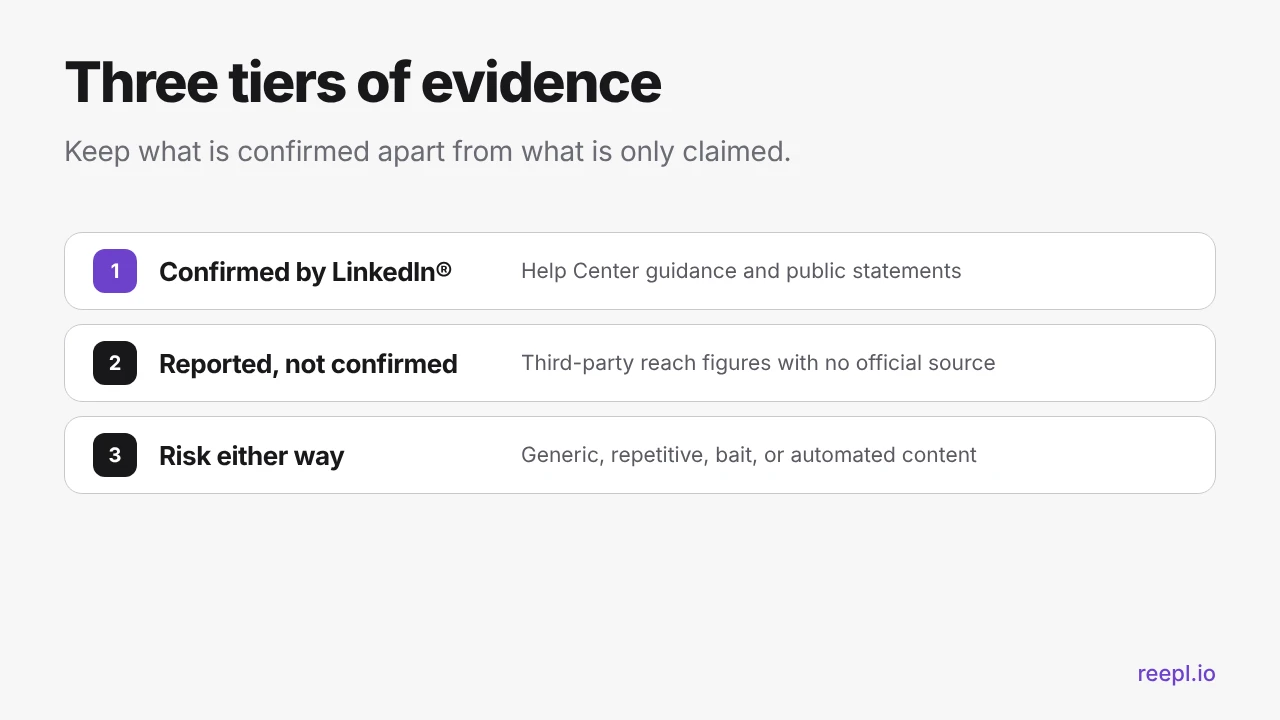
Sort every claim into one of three tiers before you act on it. Search this question and you will find confident answers in both directions: some say LinkedIn® punishes any AI-written post, others say there is no penalty at all. Both camps tend to blur three different kinds of evidence:
- Confirmed: things LinkedIn® has stated in its own help documentation or through its own executives.
- Reported but unconfirmed: claims from third-party sites, often with specific percentages, that LinkedIn® has not backed.
- Practical risk: problems that hurt a post whether or not any AI penalty exists.
What does LinkedIn® actually say about AI-assisted posts?
LinkedIn® says AI-assisted content is welcome when it reflects a real person’s perspective, experience or expertise. The official AI content help page, consulted in October 2026, asks members to review, edit and approve AI-assisted work and says members remain responsible for what they publish.
The same page says content that feels generic, repetitive or lacking a clear point of view is less likely to be widely distributed. That is an explicit quality distinction. It attaches no number to the effect, and it promises nothing about the reach of any edited post.
The page defines “AI slop” as low-effort, likely AI-generated material that can look polished while lacking substance or perspective. It also describes a “Seems like AI slop” feedback option for posts and comments. Because this is primary documentation, you can rely on it directly instead of a screenshot or a report of an early rollout.
If enough community feedback is received, the help page says a tip can appear in post analytics, and it explicitly says that receiving the tip means neither that the post was removed nor that a policy decision was made. Feedback, distribution and enforcement are related subjects, and each needs its own evidence.
The page also recommends letting others know when you relied heavily on AI and that is not obvious from context. It sets no percentage for “heavily,” so decide with three questions:
- Would a reader assume you wrote this from first-hand experience that you did not have?
- Would a reader assume an image or other media is real when AI generated it?
- Would a reader judge the post differently if they knew how much of it AI drafted?
If any answer is yes, say so in the post.
How should you judge an exact AI penalty claim?
Ask for the method. A claim that AI posts receive a fixed reduction in reach is only as good as the way it classified posts and the differences it controlled, so check four things:
- How did the researcher decide which posts used AI?
- Did the comparison account for topic, audience, account size, format and publication period?
- Were all posts observed for the same amount of time?
- Does the study separate AI use from the habits that travel with it, such as posting more often or publishing templated material?
The first question is the hardest. A text detector cannot settle it automatically: a human may use formulaic language, and an AI-assisted post may be heavily revised. If the detector mislabels those cases, the study compares groups that differ from what its headline describes.
The fourth matters because even accurate labels would leave the comparison correlational. Authors who use AI heavily may also post more frequently, choose different subjects or publish more templated material. Until a study answers all four questions, treat its percentage as a hypothesis. The practical question for you stays the same: did assistance produce useful, truthful work?
The practical risks that exist with or without a penalty
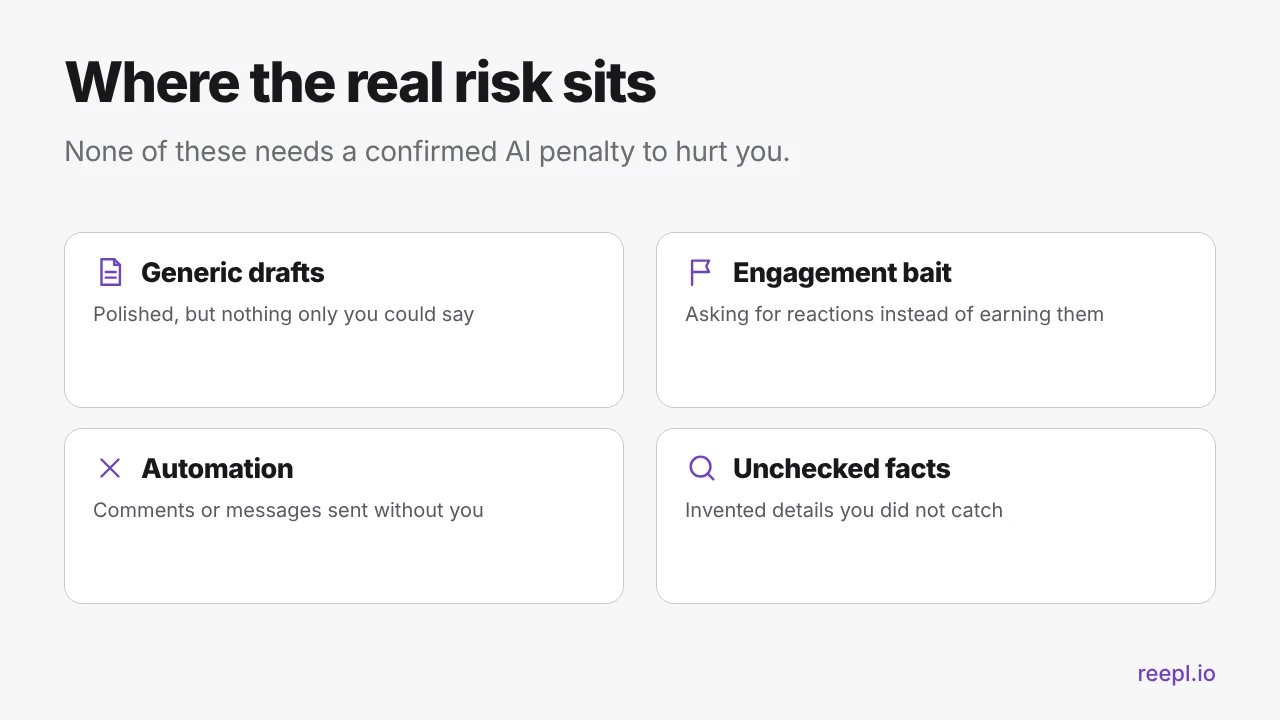
Four risks apply whether or not any AI penalty exists: generic drafts, engagement bait, automated account activity and unchecked facts. Even if LinkedIn® never ranked a single post differently because of AI, each would still cost you readers, replies and trust.
Generic, repetitive drafts
A model that has never seen how you write defaults to the safest, most average phrasing it knows. The result is the same question hook, the same three bullet points and the same tidy lesson that thousands of other accounts publish. Readers can scroll past it without ever identifying AI; they simply register that nothing in the post could only have come from you. For a fuller diagnostic, see how to tell when a LinkedIn® post sounds like AI, and for what makes drafting feel human, read can AI write LinkedIn® posts that sound human.
Engagement bait
"Agree? Comment YES below." AI drafts reach for this closer by habit. It asks for a reaction instead of earning one. Whether a human or a model wrote the bait line, it is a weak ending, and readers have seen it thousands of times.
Unchecked facts and invented details
A model fills gaps with plausible specifics: a statistic, a client quote, a date, a result. Each one reads smoothly and each one is a claim made under your name. Check every number, quotation and name against your own notes or its source, and cut anything you cannot verify. The fourth risk, automated account activity, has its own section next.
What is different about account activity?
Account activity is governed by different rules from writing. LinkedIn®’s automated activity guidance restricts third-party software and extensions that scrape, modify the appearance of, or automate activity on the website, and the User Agreement provides the broader terms. A tool’s claimed “safe” rate leaves those restrictions in force.
For engagement, keep the person responsible for reading the conversation, deciding what to say and sending the reply. That is a control boundary, and it makes no tool approved by itself. Check each tool’s actual behavior against the platform’s current rules.
An AI-assisted checklist that keeps the risk low
Keep your judgment in the process and AI becomes a low-risk drafting aid. Use this checklist before any AI-assisted post goes live.
- Start from something real. A story, a client question, a rough voice note or an opinion you hold. Prompting from a blank page is how generic drafts begin.
- Draft from your own voice. Use a tool that works from your own writing. If you are still working out what your voice is, start with how to find your LinkedIn® voice.
- Add one detail only you could add. A date, a number from your own work, a name you have permission to use, a sentence you would actually say out loud.
- Take a position. Cut the "on one hand, on the other hand" hedging and say what you think.
- Remove the bait. Delete "Thoughts?" closers and any engagement prompt that comes from no real question you want answered.
- Verify every claim. Check each statistic, quote and name against its source. If you cannot verify it, cut it.
The edit that matters most is usually small. Here is what it looks like in practice.
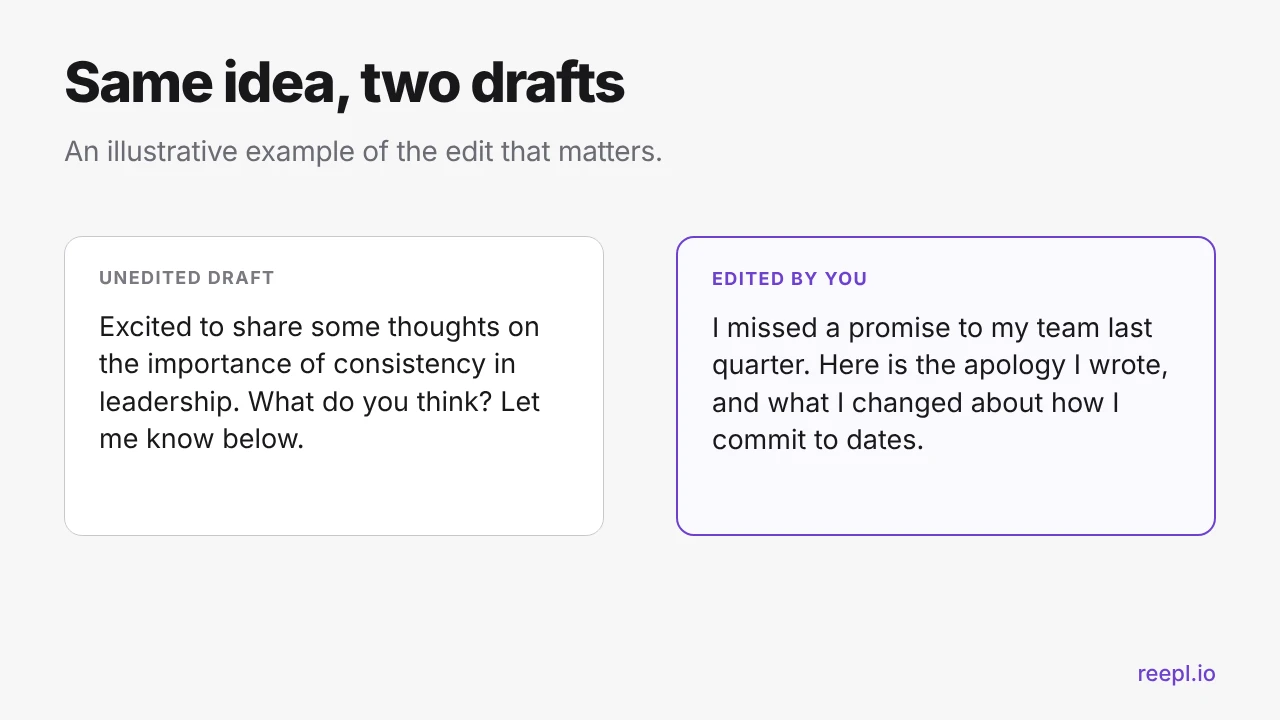
If you want a quick second opinion before you post, the free AI Slop Detector for LinkedIn® marks the lines that read machine-written and suggests rewrites. Treat it as a drafting aid.
How can Reepl support a reviewed writing process?
Reepl is an AI writing platform that puts your social media on autopilot in your own voice: it finds what to post about, drafts your posts, and keeps your calendar full, and you decide how much it does without asking.
Use Reepl to organize a genuine idea, guide the draft with your voice preferences and keep your own content in a manageable publishing workflow. You choose review and scheduling settings.
For comments and messages, Reepl drafts and you review, edit and send. Keep personal anecdotes and evidence grounded in material you supplied. If the model adds an event or outcome, remove it unless you independently confirm it. Check current plans for product access; an old quota quoted in a blog may be out of date.
A voice profile guides expression, and the facts still need your check. No writing platform, Reepl included, can promise how LinkedIn® will distribute a particular post or exempt it from policy review. The useful result is a post you can stand behind.
How do you review a post after an AI-slop feedback tip?
Read the tip as feedback on how some readers received the post, then inspect the post itself. The official explanation says the tip alone means neither removal nor a policy decision. Draw no conclusion from it about which tool drafted the post, how much AI helped or why each person responded.
Then run three checks. A polished post can fail all of them:
- Promise: does the opening suggest an insight the body never delivers?
- Perspective: could the same text appear under dozens of unrelated authors?
- Evidence: is there a concrete explanation, source or experience the author is entitled to share?
If the post contains an error, correct it and make the correction understandable. If the issue is generic advice, decide whether an edit can add real substance or whether the idea needs a new, better-developed post. Skip deleting and reposting variants to probe how the feedback system behaves.
Then improve the next brief. Supply the actual decision, the relevant audience, the evidence and the limitation, and ask the assistant to flag missing facts instead of inventing a personal anecdote. Keep a record of what you changed so the review becomes learning.
What does an evidence-led rewrite look like?
An evidence-led rewrite replaces urgency with a decision, a reason and a boundary. Here is an illustrative example from a hypothetical operations lead. A generic draft says: “The future belongs to leaders who embrace change. AI is transforming every industry, and the time to act is now.” It expresses urgency and gives the reader no situation, decision or evidence. No single adjective is the problem; the post has little to explain.
Assume the author’s real note is: “Our team had trouble deciding whether to use AI for meeting summaries because some meetings contain confidential material.” A stronger draft would say: “Before choosing a meeting-summary tool, decide which meetings should never be recorded. We separated public project updates from conversations containing confidential customer details. The tool comparison came second. If your team has not agreed on recording permissions and data handling, a better summary will not resolve that gap.”
That revised version is still illustrative, and the author may use it only if those events actually occurred. If they did not, change the frame: “A team evaluating meeting summaries should first decide which meetings must remain unrecorded.” The recommendation stays useful without a borrowed first-person experience.
The stronger version names a decision, explains its reasoning and shows a boundary. It works without a promised productivity gain or a claim about what every organization should do, and a reader can disagree with it or apply it to a real procurement conversation.
Now run a fact pass. Did the team actually separate those meeting categories? Is the policy approved for public discussion? Does the wording imply a privacy guarantee the tool cannot provide? A style pass alone would miss all three questions, so review the factual meaning before tuning the rhythm.
Why are detector scores a poor publishing objective?
A detector estimates authorship from patterns, and it cannot tell you whether a post is useful, true or yours to publish. Editing to reduce a score can produce unnatural language without improving any of those qualities, and it can distract you from a fabricated quotation or an unsupported claim.
OpenAI’s classifier notice says the company withdrew its text classifier in July 2023 because of low accuracy. One withdrawn classifier says nothing definitive about every modern detector or about LinkedIn®’s internal systems. It does show that detector output can be wrong.
The Professional Community Policies focus on conduct and content, including misleading claims and spam. Those are things a detector score never measures: a low score cannot show compliance, and a high score cannot show that the author used AI, copied a source or lacks genuine expertise.
Use a writing diagnostic to find vague language if it helps, and judge its suggestions yourself. The AI Slop Detector is an editorial aid; it gives no platform-risk score and certifies nothing about authorship. For a more durable improvement, use the voice-brief process and keep real source notes.
How can you investigate a reach change without blaming the wrong cause?
Define the change precisely, list every plausible cause, and finish with a decision you can support. AI use is one hypothesis among several. Work through these steps:
- Define the change. A post with fewer impressions than an unusually successful predecessor is different from a sustained decline across comparable posts. Record the dates, subjects, formats, audience and elapsed time at measurement, and compare like with like.
- List plausible explanations. The topic may be less relevant, the opening may be unclear, the audience may be different, or the earlier post may have ridden a timely event. A change in drafting method belongs on the list as one entry.
- Read as a prospective reader. Does the new post repeat something familiar? Does it explain something original, or only restate a trend? Does it ask for attention before giving any value? Each of these is fixable whatever the platform did.
- Compare workflows fairly. If you want to compare drafting methods, keep the task comparable and record the amount of review. An unedited generic draft and a carefully researched human post differ on more than AI use. Ask whether assistance helps you produce equally accurate, specific work with less editing effort, and treat audience performance as a secondary observation.
- Decide. Supply better source notes, reduce repetitive topics, improve the opening or spend more time reviewing claims.
Fill in a one-line record: “Post [date] got [impressions] at [checkpoint], against [comparable posts]. Possible causes: [list]. Change for next post: [one change].”
Organic distribution is no controlled laboratory, so avoid pinning a change on a single word or punctuation mark. A post revised after publication also has a different exposure history, and its later performance cannot cleanly show whether the edit removed a supposed trigger. “The cause is unknown” is a valid conclusion, and a better one than a confident explanation that sends you to fix the wrong part of the process.
Note what would change your view: a clear platform statement, an account notification with specific grounds, or a well-designed study. Recheck the current platform guidance before any consequential decision, especially if an account notification names a specific issue.
What should you do before your next AI-assisted post?
Bring a real idea and enough context to explain it. Use AI for the part it can help with, then verify the facts, refine the perspective and review the public meaning. Disclose substantial assistance where appropriate, especially if the reader might otherwise infer a human action or first-hand experience that did not occur.
Investigate a distribution change before you blame a drafting tool. The platform’s stated distinction is usefulness and perspective, so a better draft and a clearer evidence trail are the productive next steps.
What should you tell a teammate who asks whether AI is allowed?
Tell them what the current guidance says: assistance is welcome when the content reflects a real person’s perspective and expertise, and generic, repetitive output is treated differently. Then explain the team’s own editorial expectations for evidence, permissions and review.
You can say: “AI help is fine when the post reflects your own perspective and expertise. Before you publish, check [the evidence for each claim], [permission for any name or client detail] and [who reviews it].”
Avoid reassuring a teammate that a particular tool, phrasing pattern or manual click makes everything safe; that blurs content quality, account behavior and enforcement. Give them the checklist above and a route for resolving uncertain claims. The useful outcome is a draft the author understands and can support, published through a workflow that respects the platform’s rules.
| Question | What the source establishes | What remains unproven |
|---|---|---|
| Is assistance allowed? | The AI help guidance welcomes real perspective and expertise. | A guarantee of distribution for any edited draft. |
| What does feedback mean? | An analytics tip alone is no policy decision. | A precise ranking weight for each member report. |
| What about account actions? | Platform rules restrict specified third-party activity. | Any supposedly safe daily automation quota. |
| Can a detector settle it? | A detector produces a classification estimate. | The platform’s internal score or the truth of the post. |
Turn a useful idea into a clear draft
Bring your own context, review the draft, and keep the final wording yours.