ChatGPT or Claude can schedule social posts in your voice when your AI client supports an MCP connection to a service that exposes drafting and scheduling, and your social account is connected there. With Reepl, the assistant can read existing voice guidance, save a draft and schedule the version you approve. Confirm workspace, destination, text and time zone first.
Key takeaways
- Four separate checks decide whether a post can go out: the AI client's MCP connection, the tools that connection exposes, your workspace role and the social account connected in the content application.
- Reepl's quick connection uses OAuth at connect.reepl.io/mcp, while the advanced hosted profile at mcp.reepl.io/mcp exposes additional media and image-generation tools.
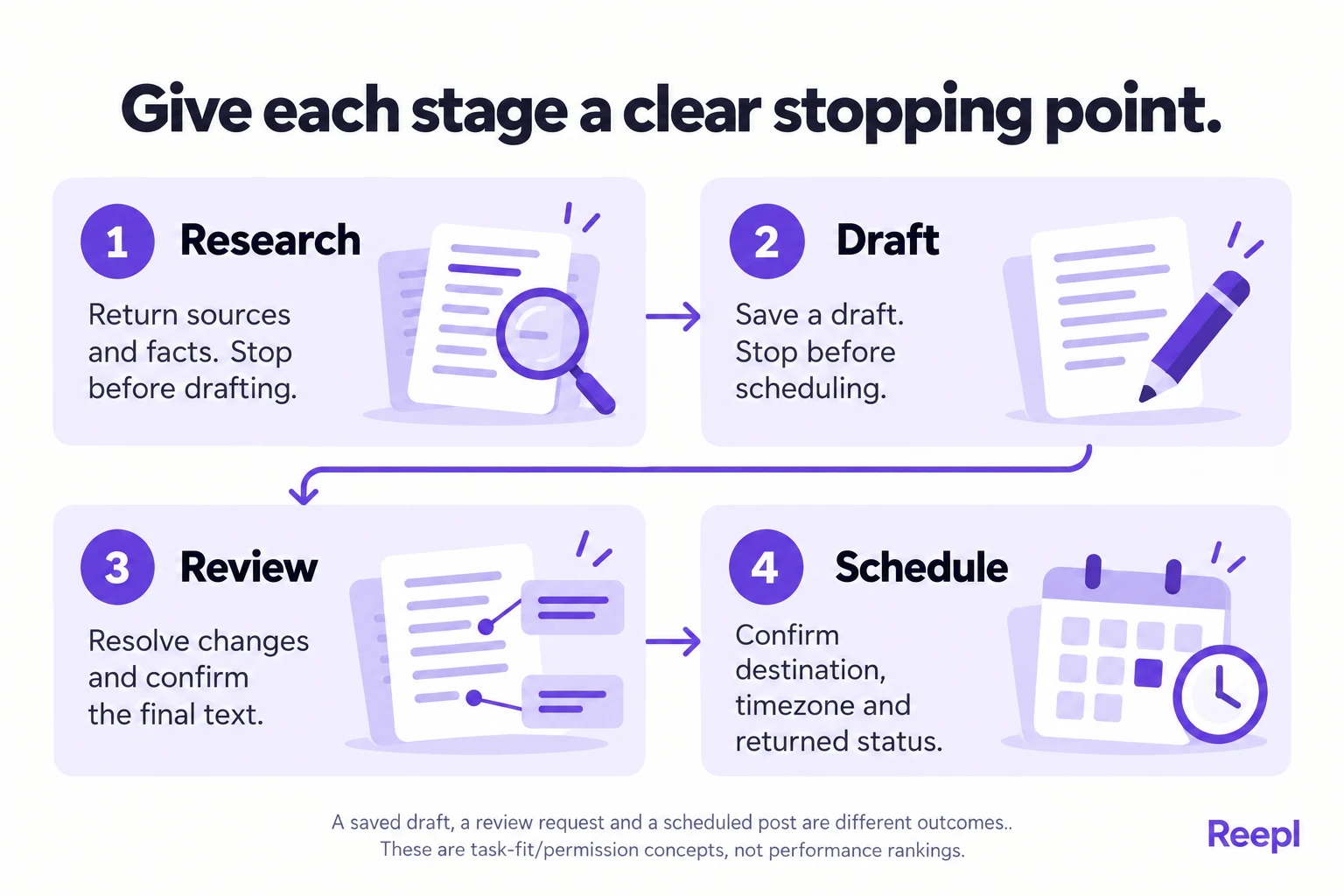
- Give research, drafting, review and scheduling separate stopping points, and name the stop in each request.
- Use stored voice guidance for one draft without changing a shared voice profile, which affects teammates' future writing.
- Read the returned state, because a draft, a pending approval, a scheduled post and a published post are different outcomes.
What does an MCP connection actually add?
An MCP connection lets the assistant use specific tools in another application, so it can read, save or schedule content there within the permissions you granted. Copying a good AI draft into a calendar is simple once. Repeating the process every week creates small points of friction: finding the right voice notes, choosing the account, preserving edits and checking whether the post actually reached the calendar.
An MCP connection can join those steps inside a conversation. It gives the assistant specific tools in another application. The value is a clearly bounded task you can inspect, such as saving one draft, while your public presence stays your responsibility.
This guide describes capabilities documented in the October 21, 2026 research record and inspected application code. We did not run an end-to-end publishing test for it. Client availability, workspace settings and the connected service’s permissions still determine what your own setup can do.
Without a connected tool, an assistant can write text but may have nowhere to save it. With an MCP connection, it can discover specific actions exposed by a service and request those actions within the permissions you granted.
OpenAI’s MCP guide describes how models connect to external servers and how authorization and approvals govern tool calls. That explains the architecture. Connection settings can still differ by plan and workspace, so check your own.
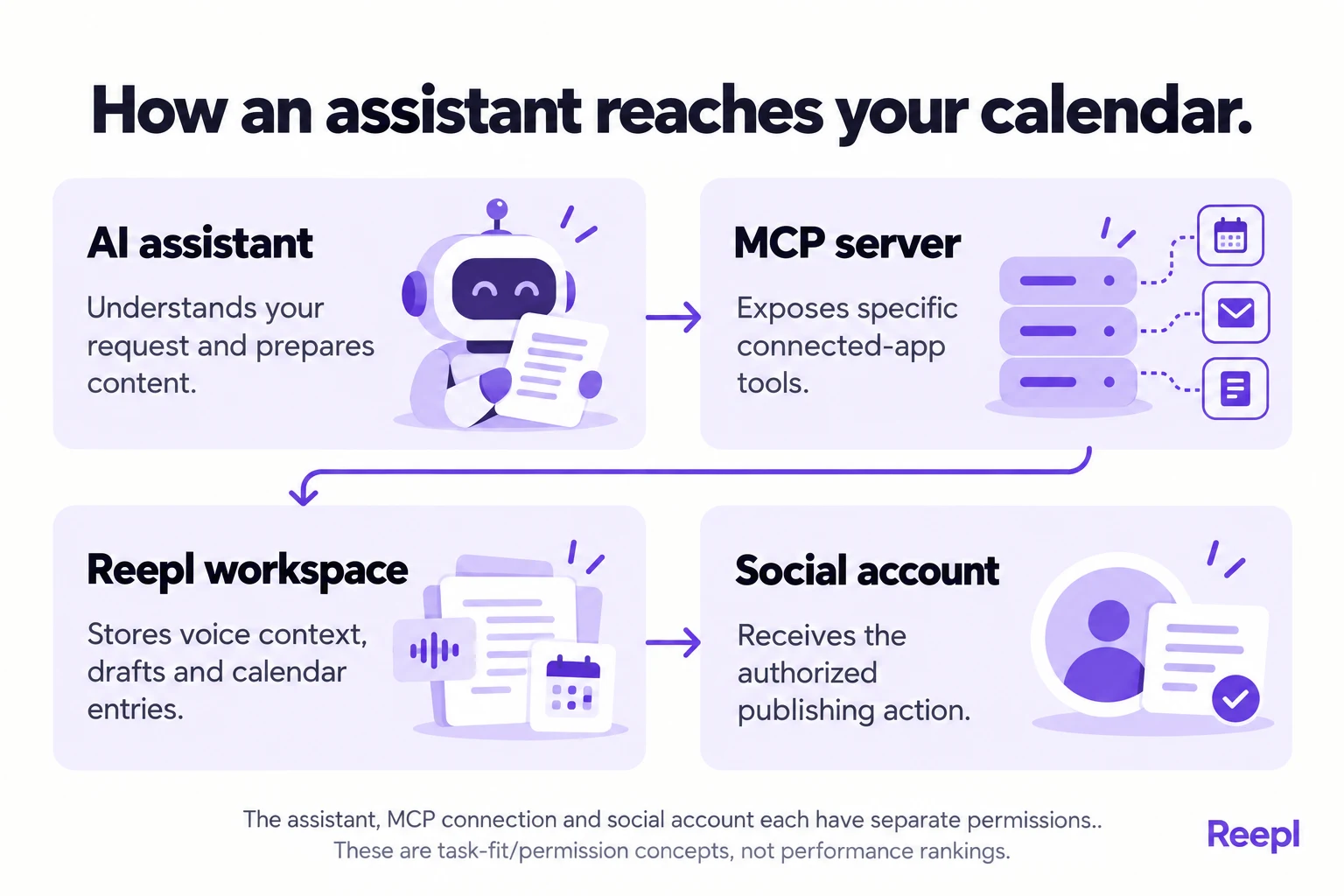
In a social workflow, the assistant interprets your request and prepares content. The MCP server exposes the relevant actions. The content application stores drafts, voice context and calendar entries. The connected social account is the destination for an authorized publishing action.
A connection does not automatically provide all four layers. A research server may only read public data. A publishing adapter may expose a create-post action without an editorial calendar. A content application may support drafts and scheduling but only for particular platforms or account types.
| Approach | What it can help with | What it does not establish by itself |
|---|---|---|
| AI chat without publishing tools | Drafting, editing and organizing supplied ideas | Access to your calendar or social account |
| Read-only research MCP | Retrieving available source material | Permission or capability to publish |
| Action adapter | Calling configured operations in connected apps | A complete voice, review and calendar workflow |
| Content-workflow MCP | Using stored context, drafts and supported publishing actions | Unlimited account access or unattended recurring execution |
What should you connect before asking for a post?
Reepl is an AI writing platform that puts your social media on autopilot in your own voice: it finds what to post about, drafts your posts, and keeps your calendar full, and you decide how much it does without asking.
That describes the broader product. The MCP connection discussed here exposes specific tools; recurring routines have separate setup and platform limits.
First, confirm that your chosen AI client supports the relevant MCP connection in your plan and workspace. Product interfaces change, and administrators may control access. Follow the current connection instructions, because an old screenshot may show a menu that no longer exists.
Next, connect the content service using its supported authentication flow. Reepl’s current quick connection uses https://connect.reepl.io/mcp with OAuth. Its advanced hosted connection uses https://mcp.reepl.io/mcp; available tools differ between those connection profiles.
That distinction matters when a task includes images or media management. The hosted profile exposes additional media and image-generation tools. If your task needs them, check that your connection exposes them; a tutorial showing the product doing that task may have used a different profile.
Then confirm the destination account is connected in the content application. Authenticating the assistant to Reepl is separate from connecting an X, Reddit or LinkedIn® account to Reepl. One successful sign-in does not replace the other connection.
Finally, select the workspace and channel. If you belong to multiple client workspaces, ask the assistant to list the available destinations and use the intended one explicitly. A default workspace makes routine work convenient, but it should not silently determine where client content goes.
Before your first request, confirm five things in order:
- Client: your AI client supports the MCP connection in your plan and workspace.
- Connection profile: the content service is connected through its supported authentication flow, with the profile that exposes the tools you need.
- Social account: the destination account is connected inside the content application.
- Workspace and channel: you know which ones the request should use, by name.
- Review: you know whether the destination sends posts for approval before scheduling.
How do you ask for a draft without accidentally scheduling it?
Give the request a concrete output and a stopping point. “Handle my content” is too broad to be useful. “Save one unpublished draft from these notes and show it to me” gives the assistant a clear action and a result you can review.
Here is an illustrative request from a recruiter explaining a change to their agency's job posts. The source notes contain the actual tradeoff and outcome, so the assistant's job is editing, with nothing to invent.
Use my recruiting workspace and existing voice guidance. Turn the notes below into one draft for my connected personal account. Keep the stated limitations and add no statistics. Save the draft and show the text. Stop before scheduling or publishing.
For research-heavy work, add an earlier stage. Ask for a short set of relevant sources, their links and the observations they support. Review that evidence before requesting a draft, especially when the subject involves another company’s product or someone else’s claims.
The difference is visible in tools such as Reddit MCP Buddy, whose current documentation describes read-only research. Research access can improve a draft without creating permission to participate in the community or publish from your account.
After the first draft, request edits to that same draft and leave publishing out of the request. For example: “Make the opening more concrete, remove the unsupported comparison and keep the ending as a question. Save the revised draft and show what changed.”
A separate review instruction makes the approval step explicit. You can approve the wording while leaving the time undecided, or approve a schedule only after confirming the destination. Those are useful distinctions when someone else manages your calendar.
How does the assistant use your voice without inventing facts?
Voice guidance describes how you write: sentence shape, tone, vocabulary, preferred structures and patterns to avoid. Source material describes what happened. They should support each other, but neither can substitute for the other.
Ask the assistant to read your existing guidance before drafting. In Reepl, the current MCP tools can retrieve voice and workspace context. That lets the conversation start with stored preferences, so you stop pasting the same writing brief every week.
Then give it facts with clear boundaries. “We moved the salary range higher in our job posts after reviewing candidate questions” is a usable observation. “This transformed our hiring” is a separate claim that needs evidence. Tell the assistant when a result is preliminary or when a customer example must remain anonymous.
An effective instruction can be simple: “Use my usual direct opening and short paragraphs, and add no numbers, customer quotes or causal claims absent from these notes.” Review the draft against that boundary before evaluating whether the wording sounds polished.
Be especially careful in shared workspaces. Changing a shared voice profile can affect other teammates’ future writing. “Make this post warmer” should normally be an instruction for one draft, not a permanent change to the workspace’s writing preferences.
A useful voice check is to read the draft aloud and identify sentences you would never say. Replace those with your own phrasing, then decide whether the correction belongs only in this post or should become lasting guidance through a separate, intentional update.
What should you confirm before scheduling?
Confirm the version, destination and time as one concrete instruction. Avoid approving “the post” when several drafts exist in the conversation. Refer to the saved draft or the exact version you just reviewed, and identify the account where it should appear.
Schedule the approved version from this draft for November 6, 2026, at 09:00 America/New_York on my personal account. Use the workspace we selected. Report the actual stored time and status, and tell me if the action requires another person’s approval.
Timezones deserve explicit treatment. The assistant should convert the named timezone to the timestamp required by the tool, considering daylight-saving rules for that date. A fixed offset copied from last month may be wrong for a later scheduled post.
Different platforms can also have different scheduling behavior. Reepl’s current LinkedIn® scheduling tool rounds to a 15-minute slot. Its Reddit scheduling description allows publication up to 15 minutes after the requested time. Ask for the actual stored or expected time instead of promising exact-minute delivery everywhere.
Plan access and usage matter before the write. Current Reepl X publishing and scheduling are marked for Premium and charge credits per tweet. Use current pricing and the action’s returned usage information, and check each connected service's costs apart from your AI subscription.
If a teammate or reviewer must approve the post, report that outcome accurately. “Sent for approval” is useful information. Replacing it with “scheduled successfully” hides the remaining work and can leave the user expecting a post that is not yet authorized to go out.
Which permissions deserve a closer look?
Separate tool exposure from user intention. A connection may expose more actions than your present task needs. Where the provider allows a narrower configuration, select it deliberately, so unrelated writes are unavailable instead of merely discouraged by a sentence in a prompt.
Composio’s MCP documentation describes allowed-tool configuration. Zapier’s MCP documentation describes app and action controls. Inspect the controls your own provider offers, because settings differ between servers.
Reepl’s current consent flow separates permission to act on connected accounts from other access. Turning public-action access off is not the same as making the entire connection read-only: draft tools and some preference changes can still modify the workspace.
Also distinguish an approval prompt from a restricted permission. A prompt asks whether to carry out a particular action. A permission determines whether the action is available at all. Both can matter, but neither should be described as an absolute guarantee against every mistaken request.
What does a complete voice-to-calendar exchange look like?
A useful exchange makes the evidence, editorial choices and publishing instruction separately inspectable. The following fictional example concerns an illustrative agency recruiter explaining why the salary range moved higher in their job posts. It shows the sequence of instructions; it is not a transcript of a live tool test.
Source note: “We moved the salary range from the bottom of our job posts to the second line. Candidates kept asking about pay before anything else on first calls. We have not measured whether the change affects who applies.”
Voice note: “Use plain language and short paragraphs. Explain the tradeoff directly. Avoid celebratory announcements, broad claims about customers and a forced question at the end.” These preferences govern style only; the facts come from the source note.
Create one unpublished draft from these notes using the selected workspace's existing voice. State the decision and explain why the placement mattered. Keep the sentence about the unmeasured outcome. Save the draft and return its identifier and exact text. Leave the shared voice profile unchanged.
A suitable draft could read: “We moved the salary range from the bottom of our job posts to the second line. Candidates kept asking about pay before anything else on first calls, so the information was in the wrong place. The rest of the post can now focus on the work itself. We have not measured whether this changes who applies.”
The draft is modest because the source material is modest. A worse version would say the change “attracted stronger candidates and more applications,” converting a plausible hypothesis into a reported result. Voice matching should never be used as a reason to retain that unsupported claim.
The recruiter might revise “so the information was in the wrong place” to “so it belonged at the top” because that sounds closer to their natural phrasing. The assistant should update the saved draft and show the change. It should not create a new calendar entry or modify the underlying voice profile as a side effect.
Approve this saved version for the selected personal account. Schedule it for November 10, 2026, at 09:00 Europe/London. Use the draft identifier above, preserve the exact text and report the stored time and resulting status.
The final response should identify what was actually saved. If the application returns pending approval, the exchange is incomplete as a publishing workflow even though the drafting work succeeded. The reviewer needs the outstanding action, not a reassuring sentence that implies the post will appear automatically.
How can you tell whether the voice guidance is helping?
Compare drafts against your own writing decisions, not against an AI detector. Select a few published pieces that accurately reflect how you want to write now. Note the vocabulary, sentence length, degree of certainty, use of examples and kinds of endings you prefer.
Turn those observations into actionable guidance. “Sound more human” is vague. “Use the concrete decision in the opening, avoid claims about everyone in our industry, and retain the limitation from the source note” tells the assistant what to do. Give it a contrasting example if the distinction is difficult to describe.
| Draft problem | Better instruction | What still needs human review |
|---|---|---|
| Generic opening | Start with the actual decision in the notes | Whether the decision matters to this audience |
| Excessive certainty | Preserve uncertainty and qualifying conditions | Whether the evidence supports the remaining claim |
| Unfamiliar vocabulary | Use the preferred terms from the supplied examples | Whether the sentence sounds natural aloud |
| Repetitive endings | End after the useful conclusion unless a real question remains | Whether the post delivers its promise |
Keep a short revision log across several drafts. Record recurring changes such as removing an exaggerated opening or adding a missing boundary. When a preference repeats and should apply broadly, make a deliberate voice update. A one-off announcement may need a different tone without changing the guidance for every future post.
Voice fidelity means your own phrasing, never distinctive phrases copied from someone else's posts. Use your own samples or material you have permission to use. The most valuable input is often a specific explanation of how you would describe the decision to a colleague.
What should a teammate know about the connection?
A teammate needs a map of responsibilities, not just an MCP URL. The MCP architecture documentation describes hosts, clients and servers as different participants. In practical terms, your AI application, the connected service and the social destination can each have their own access settings and failure states.
Record which client and connection profile are being used, which workspace contains the drafts, who owns the destination account and who can approve publication. Include where to find the saved version and how to inspect scheduled items. Keep credentials and access tokens out of the note.
- Client and connection profile: [which AI client, quick or advanced hosted profile]
- Workspace: [where the drafts live]
- Destination owner: [who owns each social account]
- Approver: [who can approve publication]
- Saved versions: [where to find drafts and scheduled items]
- Reconnection: [who renews an expired social authorization]
Identify an owner for connection maintenance. A tool missing from one client may still exist in another profile; an expired social authorization may need the account owner, not the editor, to reconnect it. A short note about those responsibilities prevents repeated drafting attempts from obscuring a connection problem.
Use the connected workflow when saved context, drafts and a calendar remove recurring manual work. If you only need a paragraph rewritten, an ordinary chat and manual copy may be simpler. Start with one successful draft-to-calendar run before treating the connection as part of a recurring editorial process.
What can go wrong after the assistant calls a tool?
A tool call can fail because an account disconnected, access changed, the requested feature is unavailable, the content violates a field limit, or a service returned an error. Start with the actual result before asking the assistant to retry anything.
For a thread, partial success is especially important. Some posts can go live before a later item fails. Ask which items already published and retain their URLs before deciding whether to continue, revise or remove anything. Repeating the whole request could create duplicates.
For a scheduled item, inspect the saved content and state in the application. If the assistant says it saved a draft, look for the draft, not a calendar entry. If it says pending approval, identify who needs to review it and whether any further action is required.
For recurring work, make a separate decision about scheduling a routine. MCP access alone is not an always-running job. Zapier’s explanation distinguishes chat actions from persistent Zaps; similarly, Reepl’s Andy routines are a separate feature with their own review modes and platform limits.
Current Andy routines require Pro or higher and publish to personal LinkedIn® accounts. Broad MCP support does not make those routines available for X or Reddit. Choose the recurring system intentionally after you have a reviewed one-off workflow that behaves as expected.
Continue with our guides to comparing MCPs for LinkedIn® and comparing Reddit MCP research options.
Put your next idea into words
Draft in your voice, review the details, and choose what to publish.