Post on LinkedIn® every day only if you can sustain useful posts, review each one and answer replies without displacing more important work. Start with the lightest schedule your week supports, track the minutes and relevant conversations behind each post, and add a slot only when you have source material and a clear job for it.
Key takeaways
- Posting frequency is a resource decision tied to one business goal, such as discovery interviews or recruiting a specialist.
- Budget the whole workflow: source collection, checking, editing, publishing, replies and review, including any colleague's time.
- The sample weekly budgets run from 60 minutes for one post to five hours for five weekday posts, before permission checks or design work.
- Test one extra slot against a baseline, with a review date and a continuation rule written before you start.
- When capacity gets tight, cut the least useful slot before you cut the factual review.
What does daily posting need to accomplish?
Daily posting needs a business purpose beyond maintaining a streak. Decide what you want your writing to help you learn or do before choosing how many publishing slots to fill.
Posting cadence is the number and pattern of posts you plan to publish over a defined period. “Daily” might mean every working day or all seven days, so write down which you mean before a five-post plan quietly becomes a seven-post obligation.
A founder seeking discovery interviews needs posts that surface relevant problems and invite appropriate conversations. A founder recruiting a specialist needs posts that explain the work and team. Someone supporting a launch may need a temporary sequence of product explanations. Each goal calls for different material and a different way to judge progress.
Choose one primary goal for the next month and write an observable signal beneath it. Fill in: “Posts over the next [four weeks] should help with [goal]. Progress means [signal], defined as [definition].” For discovery, the signal might be a conversation with someone who has the problem. For recruiting, it might be an inquiry from a candidate with the relevant background.
These signals are more specific than “grow the brand,” and they still need interpretation. A conversation may come from earlier posts, an introduction or a referral. Ask how someone found you when it is appropriate, and record “unknown” when you cannot tell, so your latest post never gets the credit by default.
For a supply of grounded topics, use our founder post idea worksheet. The decision here is how much of your week to allocate to publishing.
How much time can you actually afford?
Count the whole workflow, including follow-up, before choosing a schedule. The time to produce a first draft is only one part of the cost.
Reserve time for collecting source material, checking claims, editing, publishing, replying and reviewing what happened. Include a colleague's time if someone else helps, since a founder can cut personal drafting time while raising the company's total effort.
Use this planning equation:
Weekly capacity available for posts = protected publishing time minus replies, review, and contingency time.
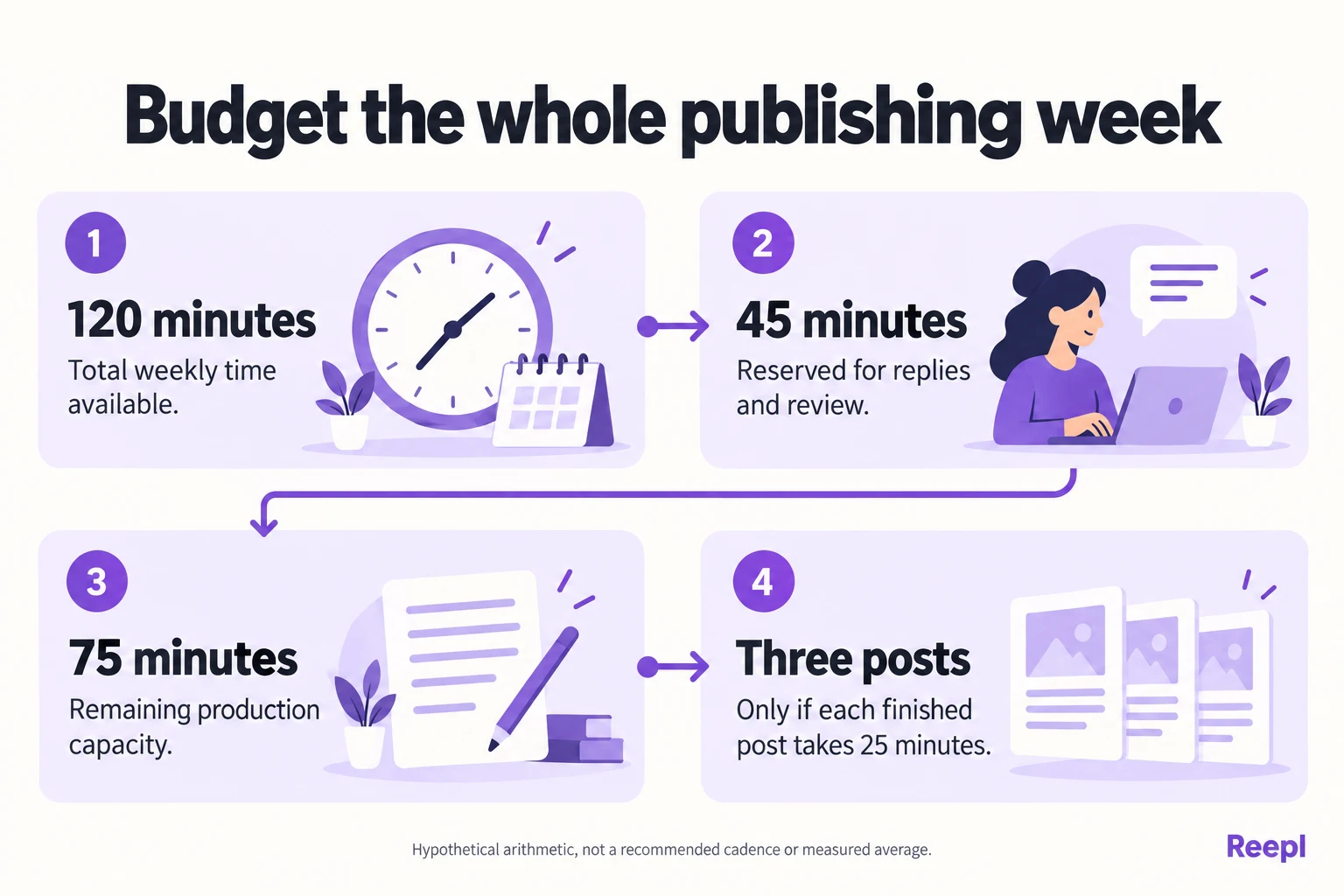
Take an illustrative founder of a three-person HR software startup who posts to find discovery interviews. With 120 minutes available, reserving 30 minutes for replies and 15 minutes for review leaves 75 minutes. If a finished post takes that founder 25 minutes, the arithmetic permits three posts. Treat three as a ceiling: the right number still depends on the goal and on how long each post really takes, since complex posts may need fact-checking, permission or design work and a short observation from your own work may take less.
Track actual minutes for a few weeks before you rely on an estimate. Fill in the equation with your own numbers:
- Protected publishing time: [minutes]
- Minus replies: [minutes]
- Minus review: [minutes]
- Minus contingency: [minutes]
- Equals drafting time: [minutes]
- Divided by minutes per finished post: [minutes] = your ceiling of [posts] per week
Then count your ideas before your slots. List the decisions, customer questions, explanations and examples already available. If you have two strong ideas, plan around those and leave room for better material to emerge.
Which starting schedule fits your situation?
Choose the lightest schedule that lets you work toward your goal and learn from it. The schedules below are planning examples to adapt.
| Current situation | Suggested starting cadence | Primary constraint | Review question |
|---|---|---|---|
| Heavy delivery work or early exploration | One post weekly | Limited attention and material | Can you publish a useful explanation without rushing? |
| Regular customer conversations | Two posts weekly | Turning notes into clear posts | Do the posts prompt relevant discussion? |
| Several reusable work examples | Three posts weekly | Editing and follow-up capacity | Does each post contribute a distinct idea? |
| A defined launch or active writing practice | Five weekday posts temporarily | Maintaining quality across the week | Does the additional effort serve the stated goal? |
A founder with one protected hour should not copy a schedule built around several hours of support. A founder who enjoys writing and has fresh material can keep a faster pace. Either way, the deciding question is whether the next post has a job. Write that job next to every planned slot: “Explain the setup requirement” is a job, while “Avoid missing Thursday” is only a reminder.
What do practical weekly schedules look like?
A useful weekly schedule includes preparation and conversation time alongside publication. Pick times when you can work reliably and be around for replies.
One post with a 60-minute weekly budget
On Monday, spend 10 minutes selecting one real question from your notes. On Wednesday, spend 25 minutes drafting, checking, and publishing the answer.
Use 15 minutes on Thursday for relevant replies, then 10 minutes on Friday to record effort and useful feedback.
This schedule fits a founder protecting time for delivery. If the post needs more review than expected, use the publishing block for review and move publication.
Two posts with a 120-minute weekly budget
Use 20 minutes on Monday to select two distinct ideas. Allocate 25 minutes on Tuesday and Thursday to finish and publish each post.
Reserve 30 minutes across the week for replies and 20 minutes on Friday for tracking and next week's notes.
One post might explain a recurring customer problem; the other might show a decision made while addressing it. Keep each understandable on its own, so a reader who missed Tuesday's post still gets Thursday's point.
Three posts with a 180-minute weekly budget
Spend 30 minutes preparing source notes on Monday. Use three 30-minute blocks on Monday, Wednesday, and Friday to draft, review, and publish.
Allocate 40 minutes across the week to conversations and 20 minutes to the tracker.
The extra post should add a useful angle: an example, a limitation or a follow-up. The newsletter adaptation guide can help you pull distinct ideas from work you already produced, each with its own purpose.
Five weekday posts with a 300-minute weekly budget
Reserve 45 minutes for planning, five 35-minute production blocks, 60 minutes for replies across the week, and 20 minutes for review. That totals five hours, before any unexpected permission checks or substantial design work.
A hypothetical launch week might cover the customer problem on Monday, the workflow on Tuesday, a limitation on Wednesday, a setup example on Thursday and unanswered questions on Friday. That sequence gives each day a distinct job without pretending the launch produces a new milestone every morning.
If seven-day posting is your actual proposal, budget the weekend posts and their conversations as separate work on top of the weekday plan.
How should you test a higher posting frequency?
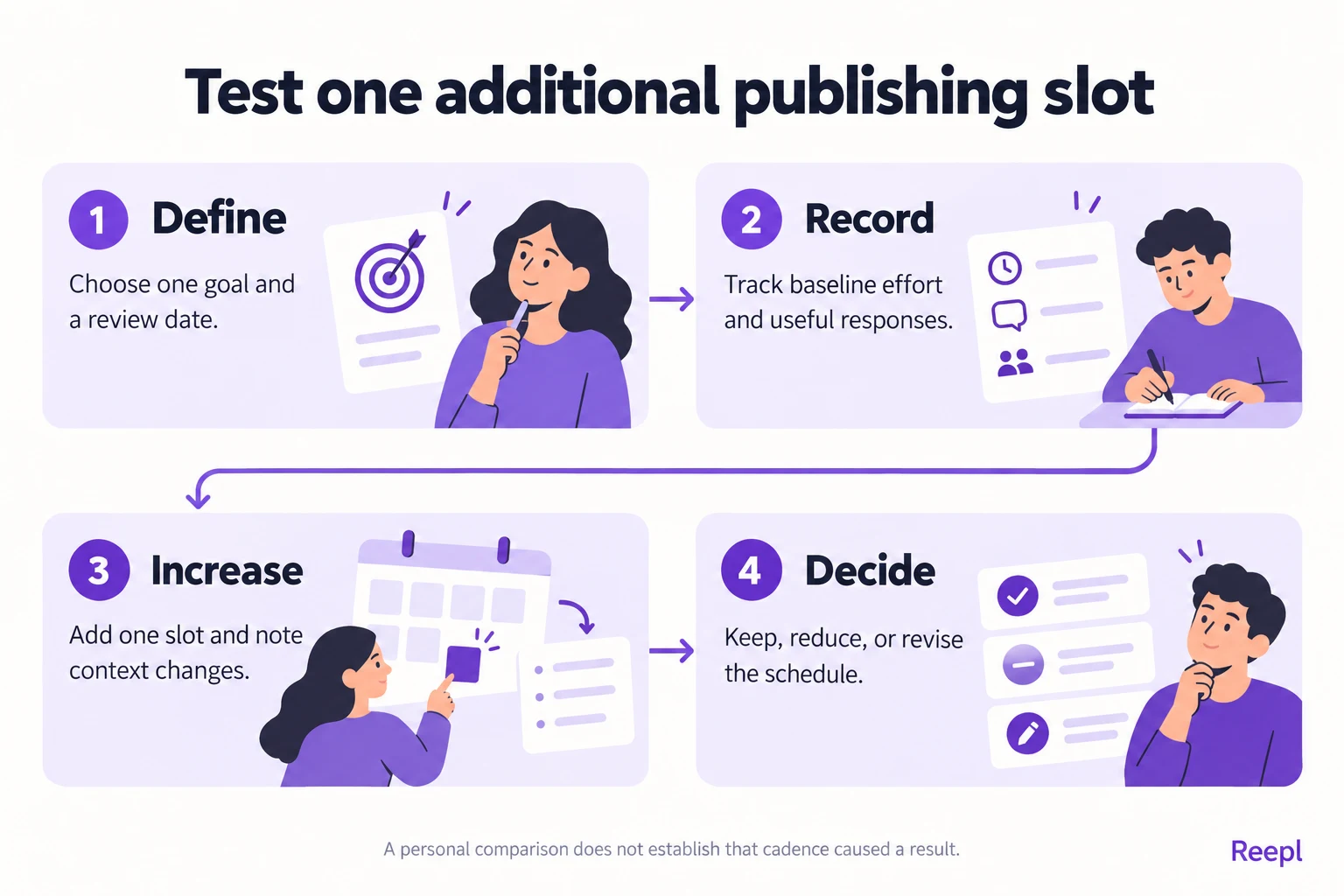
Test one additional publishing slot while keeping your goal stable. Choose a review date in advance so a temporary experiment does not become an indefinite obligation.
Define the question, observation period and continuation rule before you change the schedule. A personal comparison of organic posts is a planning exercise: it cannot isolate every factor that affects audience response or establish causation, so read its results as a guide for your next decision.
Start by documenting your current routine for a short baseline period. Then try the increased schedule for a comparable period.
Several weeks per phase is a practical planning choice. With a small account and infrequent business outcomes, even that may give you little evidence, so lean on your notes as well as the counts.
Keep the topic focus and intended audience reasonably similar. Record anything that complicates the comparison: a product launch, a conference, a major announcement, time away or an unusually strong post. You cannot hold every condition constant, and you can still note the obvious differences.
Before increasing frequency, write a continuation rule in your own words. A template:
“Keep the extra slot after [review date] only if every post met the review standard, the week stayed within [minutes], and the tracker shows at least [number] relevant conversations as defined in your tracker.”
You choose these criteria; they come from your goal and your week.
Keep readability in your review standard. The W3C’s writing guidance recommends clear, concise content and short paragraphs, which are useful checks when extra slots create pressure to rush.
Use a stop rule too. If publishing displaces customer commitments, if you find yourself inventing experiences or results to fill slots, or if replies go unanswered because the next post eats your time, reduce the schedule that week, whatever streak you had planned.
What belongs in a posting cadence tracker?
Download the posting cadence tracker (CSV)
Track effort, intended purpose, and relevant outcomes in the same place. A post-level worksheet makes the cost of extra publishing visible and prevents a single impressive number from deciding the whole review.
Use one row per planned post, including canceled posts. Record these fields:
| Field | What to enter |
|---|---|
| Week start and phase | The week plus baseline or increased cadence |
| Planned date and published date | Both dates, leaving publication blank if canceled |
| Status and post reference | Planned, published, or canceled; add a URL when available |
| Goal and topic | The intended outcome and specific subject |
| Draft, review, and reply minutes | Actual time, not your original estimate |
| Measurement date and impressions | A consistent observation window where available |
| Relevant conversations and qualified inquiries | Counts using your written definitions |
| Attribution confidence | Confirmed, possible, unknown, or not applicable |
| Context and next action | Events affecting interpretation and what to change |
For this worksheet, define a relevant conversation as a substantive exchange about your target problem with someone in the intended audience. Define a qualified inquiry with your own business criteria before you count one; a request for information may or may not meet them.
Use the same measurement window when comparing impressions, and record the observation date, because a post measured after one day is not directly comparable with one measured after two weeks. Leave a value blank when you did not check it. Zero means you checked and found none.
Copy the fields above into a spreadsheet, with one blank row per planned post. Keep weekly planning minutes separately in the same rows, entering them only once per week, so you can calculate total effort without double-counting preparation.
How do you interpret the worksheet without fooling yourself?
Compare the additional effort with the evidence relevant to your goal. Review the posts individually before deciding that the cadence itself caused a change.
Suppose, hypothetically, the HR software founder's two-post week uses 100 minutes and produces two relevant conversations, and a three-post week uses 160 minutes and produces three. Both weeks average roughly one conversation per 50 minutes, with the second slightly less efficient. The invented numbers show the calculation; two weeks of data cannot show a trend.
The third conversation might be especially useful, or all three might repeat what the founder already knew, so read the notes alongside the counts. More activity can still be worthwhile when you can say why.
Then inspect the extra post itself:
- Did it introduce a distinct idea?
- Did its audience match your goal?
- Would the same time have been better spent following up with someone already interested?
Record a decision to keep, reduce or revise the schedule, plus one reason grounded in your notes.
If drafting becomes faster while editing becomes slower, your total capacity may stay the same. Choose a cadence based on finished, reviewed posts.
What would make daily posting the wrong experiment?
Daily posting is the wrong experiment when the real bottleneck is unclear positioning, missing source material or an overloaded review process. More slots can expose those problems faster, but only fixing them helps. Name the constraint you are trying to change before adding another slot.
Consider a hypothetical founder with many draft ideas and no clear intended reader. One week addresses investors, another junior developers and another buyers. More posts would make the response harder to interpret. Choose a reader and a problem first, then watch whether your explanations produce relevant questions.
GOV.UK's research planning guidance, written for service research, recommends defining objectives and turning assumptions into research questions. Applied to cadence, replace “Daily posting will generate demand” with a question you can examine: “Can we add one useful buyer-focused post without exceeding our review budget, and what conversations follow?”
| Bottleneck | Better first action | When to revisit cadence |
|---|---|---|
| Few defensible ideas | Collect customer questions and decision notes. | When source material regularly exceeds the current schedule. |
| Slow approvals | Clarify the reviewer and deadline. | When finished drafts are approved consistently. |
| Unclear audience | Choose one reader and a specific problem. | When responses can be interpreted against that goal. |
| Little follow-up capacity | Reserve time for relevant conversations. | When an extra post will not displace those exchanges. |
Some weeks are hard to compare at all. A launch, conference appearance or major company announcement changes the available material and the people paying attention. Publish as usual, and label the week in your tracker as unusual.
How do you handle outliers, delayed inquiries and missing data?
Keep the individual post records visible when you summarize a week. A single widely shared post can dominate total impressions, which may be useful exposure, and it tells you little about whether every added post contributed or whether the result will recur.
Compare both the total outcome and the typical post, then read the actual conversations. If the extra slot produced a narrowly relevant question with low reach, the post might still justify its time. If a popular post reached people outside the intended audience, decide whether that attention serves any current goal before calling the schedule successful.
Record delayed inquiries when they happen. If someone says a particular explanation prompted their message, note the reference and timing. If they cannot say where they first found you, mark attribution unknown. Timing alone cannot tell you which post caused an inquiry.
For links to your site, Google Analytics documents campaign parameters that can label recorded traffic. Use consistent source and content names if you already have appropriate analytics. A tagged click records one route, readers may also return another way, and a tagged visit counts as a qualified opportunity only when it meets your written definition.
Keep blanks and zeros apart in the summary as well. A post you forgot to review has missing data; a checked post with no qualifying response has an observed zero. Otherwise weeks that received less careful measurement look better than they were.
How can you reduce the workload without removing judgment?
Batch source collection and first drafts, and keep publication approval attached to the actual text. Batching saves repeated setup; facts, permissions and current circumstances still need checking post by post.
GOV.UK's note-taking guidance recommends recording observations separately from interpretations. A small set of reliable notes speeds up drafting because what happened is already written down. Capture the decision, evidence and boundary while the work is fresh, then use that material in your writing block.
Keep human conversation separate from publishing throughput. The LinkedIn® Professional Community Policies, consulted in October 2026, prohibit artificial engagement and spam, so a busier schedule never justifies manufactured replies, reciprocal reaction arrangements or irrelevant outreach.
When capacity becomes tight, remove the least useful publishing slot before shortening the factual review. You can also simplify format: a clear text explanation may be sufficient when a visual would add design work without improving understanding. Keep complex diagrams for ideas that actually need them.
Choose your next schedule from the whole workload: preparation, drafting, review, publication checks and replies. Daily posting can be a reasonable temporary choice. Keep the extra slot only when it serves your business purpose and your standard of evidence.
Pick one schedule that fits next week's calendar. Put the preparation and reply blocks beside the publishing slots, then use the tracker to decide whether the commitment deserves another week.
Turn your ideas into useful posts
Draft from your own knowledge, check the facts and keep control of what you publish.