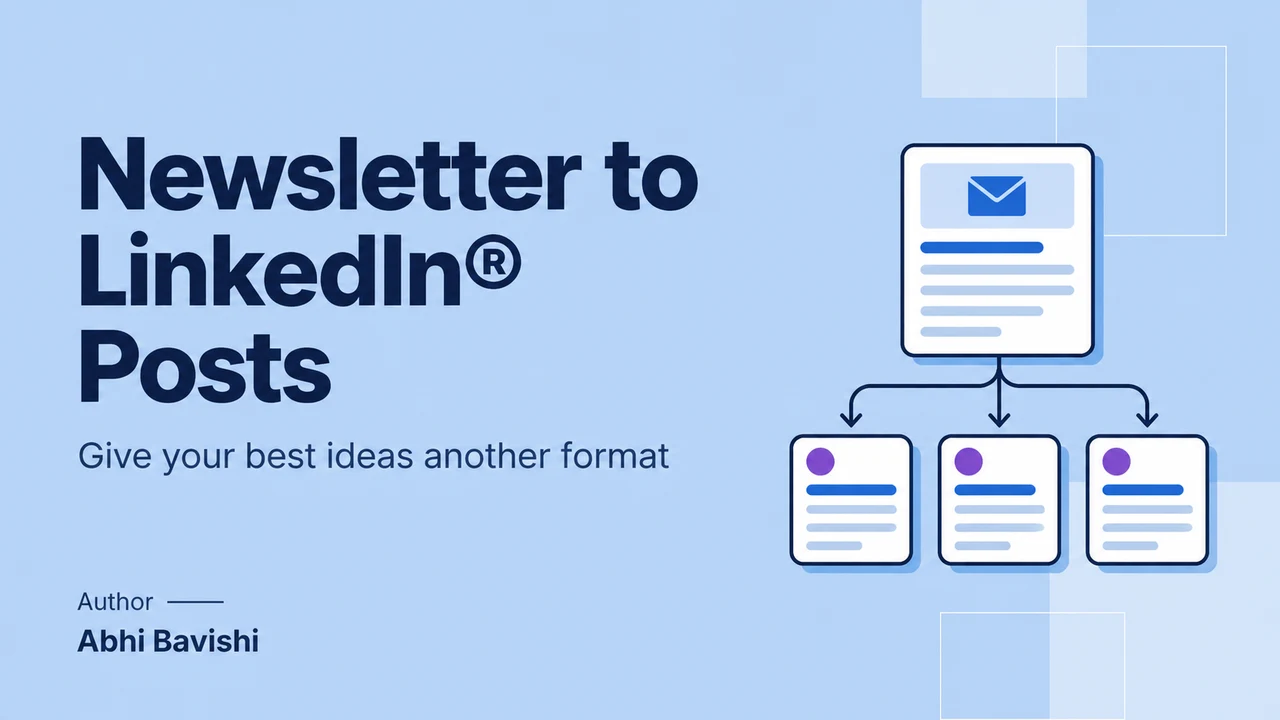
Repurpose a newsletter into LinkedIn® posts by separating its argument, example, practical method, and open question. Give each post enough context to stand alone, then rewrite its opening and ending for someone who never read the email. Check facts, subscriber expectations and reuse permissions, then publish the distinct ideas as a spaced sequence.
Key takeaways
- Treat the newsletter as source material, not a block of text to cut into equal pieces.
- Preserve the issue’s qualifications while removing email navigation, greetings, and repeated promotion.
- Give each post a different job, such as explaining a distinction or helping readers make a decision.
- Keep paid material, reader replies, and unpublished client details within the reuse boundaries you agreed.
- Compare the finished posts with the original issue before putting them on a calendar.
For audio source material, see our podcast adaptation workflow.
What changes when a newsletter becomes a post?
A newsletter reaches readers with some existing context: they subscribed, may recognize recurring sections, and can read the full argument in one place. A LinkedIn® post needs to establish its subject and value without relying on that relationship.
A standalone post is a post that makes sense without requiring the reader to open another piece first. The reader can identify the problem, follow the reasoning and use the takeaway inside the post itself, while the full issue keeps its extra depth.
Consider a newsletter sentence such as “That is why we changed the second question.” Inside the issue, “that” and “the second question” may be clear. In a post, restore the missing context: “An interview plan should identify the evidence the hiring team still needs.”
Strip the email scaffolding before you adapt anything:
- Greetings and sign-offs (“Hi everyone”, “Until next week”).
- References to earlier or later editions (“as promised last issue”).
- Recurring section labels that only subscribers recognize.
- Sponsor slots and repeated promotion.
Before (pasted from the email): “Hi everyone, quick one this week. Last time I promised to explain why we changed the second question, so here goes.” After (illustrative opening): “An interview plan should name the evidence the hiring team still needs. One question makes that visible.” The second version names the subject, drops the email relationship and gives a new reader a reason to keep going.
How do you audit the issue before adapting it?
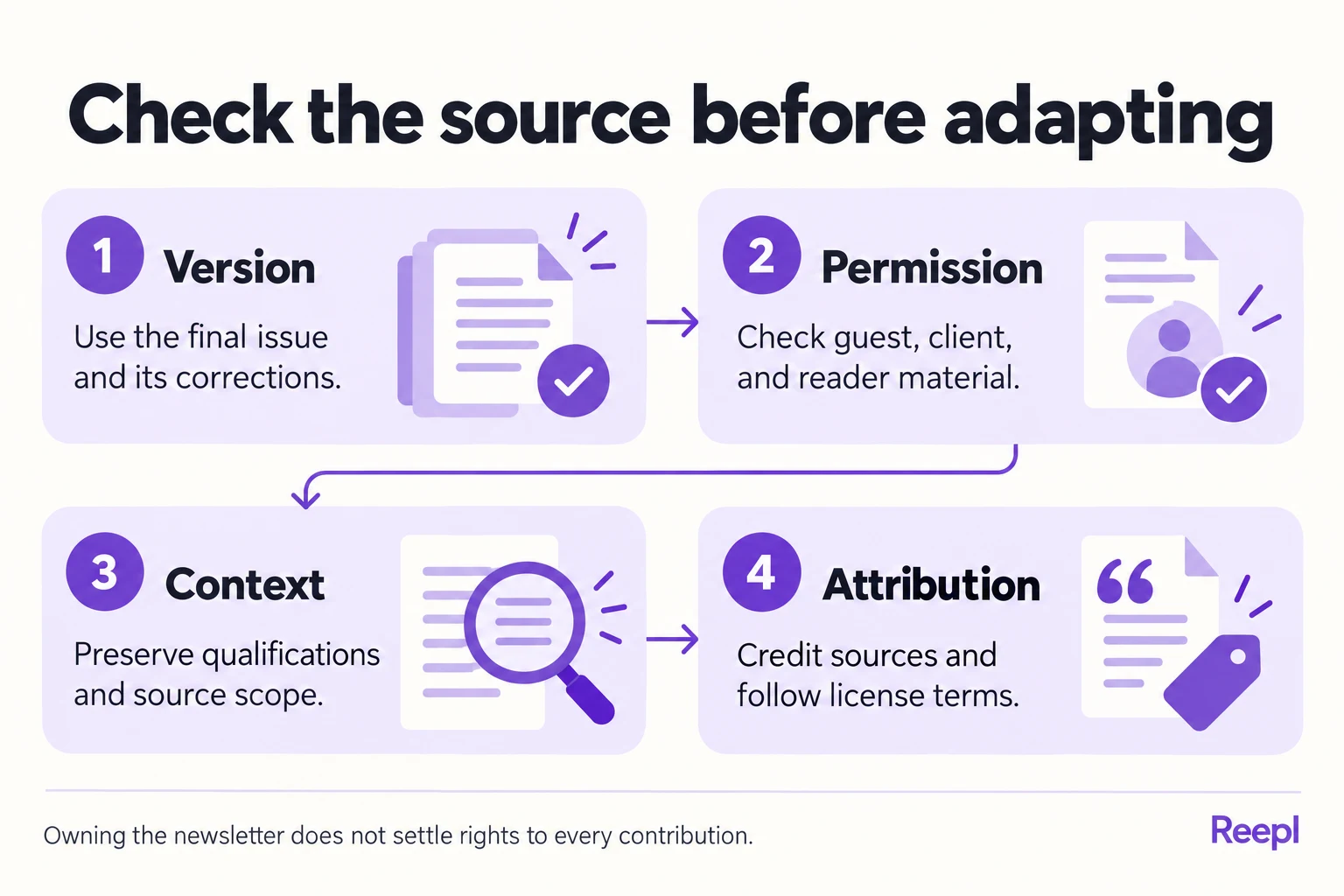
Save the final published version of the newsletter, including its date, links, and corrections. Work from the version subscribers actually received or the corrected public archive, and note any difference between them.
Read the issue once without drafting. Mark the central claim, supporting evidence, illustrative examples, instructions, caveats, and promotion.
Create a simple source map:
| Source element | Possible post | Check before reuse |
|---|---|---|
| Central distinction | An explanatory argument | Does the qualification survive? |
| Concrete example | A worked scenario | Is the example real or hypothetical? |
| Practical method | A checklist or procedure | Are any steps missing outside the email? |
| Reader question | A discussion post | Is the question yours to share? |
| Offer or promotion | A separate invitation | Is the offer still current? |
For an issue you wrote, check underlying material too. Owning the newsletter still leaves permission open for a subscriber’s reply, a guest contribution or a client screenshot.
A reader may have expected a private exchange even if their observation would make a strong post. Get appropriate permission or describe the general problem without personal details.
For another author’s issue, build your own analysis and attribute the idea. Keep their paid edition paid: your post can send readers to it, and should never stand in for it under your name.
When permission or licensing is unclear, ask the rights holder before reproducing substantial material. If a resource uses a reuse license, read its actual terms, and record the permission or license beside your source so the publication review can check the intended use. Attribution and permission are separate: credit the author, and also confirm that you may reproduce the material.
Allow a drafting session after the source review. As a planning estimate, reserve 45 to 90 minutes for a straightforward issue and a small batch, plus any approval time; a complex source takes longer.
What source will the worked examples use?
The worked examples use one short newsletter excerpt about interview planning, so you can see a single source become four different posts. The following fictional newsletter excerpt was written for this article. It is not a real edition, customer story, or account of our experience.
The four finished posts below retain that fictional framing where they use the scenario.
Fictional newsletter: “An interview should name the evidence.”
A fictional recruiter receives a request for an extra interview. The request lists panel members, available times, and a hiring deadline, but it never names the evidence the interview should provide.
The recruiter asks what information would change the hiring decision. The team explains that it needs evidence about how the candidate prioritizes competing customer requests.
That answer changes the starting point: review existing interview notes before deciding whether another conversation is needed.
The newsletter recommends adding three questions to an interview plan: What decision will this conversation support? Who will make that decision?
What evidence is still missing?
This is a preparation method, not a reason to delay urgent work indefinitely. Some interview requests already have a clear purpose.
Early recruiting conversations may explore mutual fit before a specific hiring decision is possible. In those cases, state the learning goal and agree how to review what was learned.
The excerpt reports no canceled interview and no hiring improvement. Its useful distinction is between scheduling another conversation and identifying the evidence it should provide.
What do four native LinkedIn® posts look like?
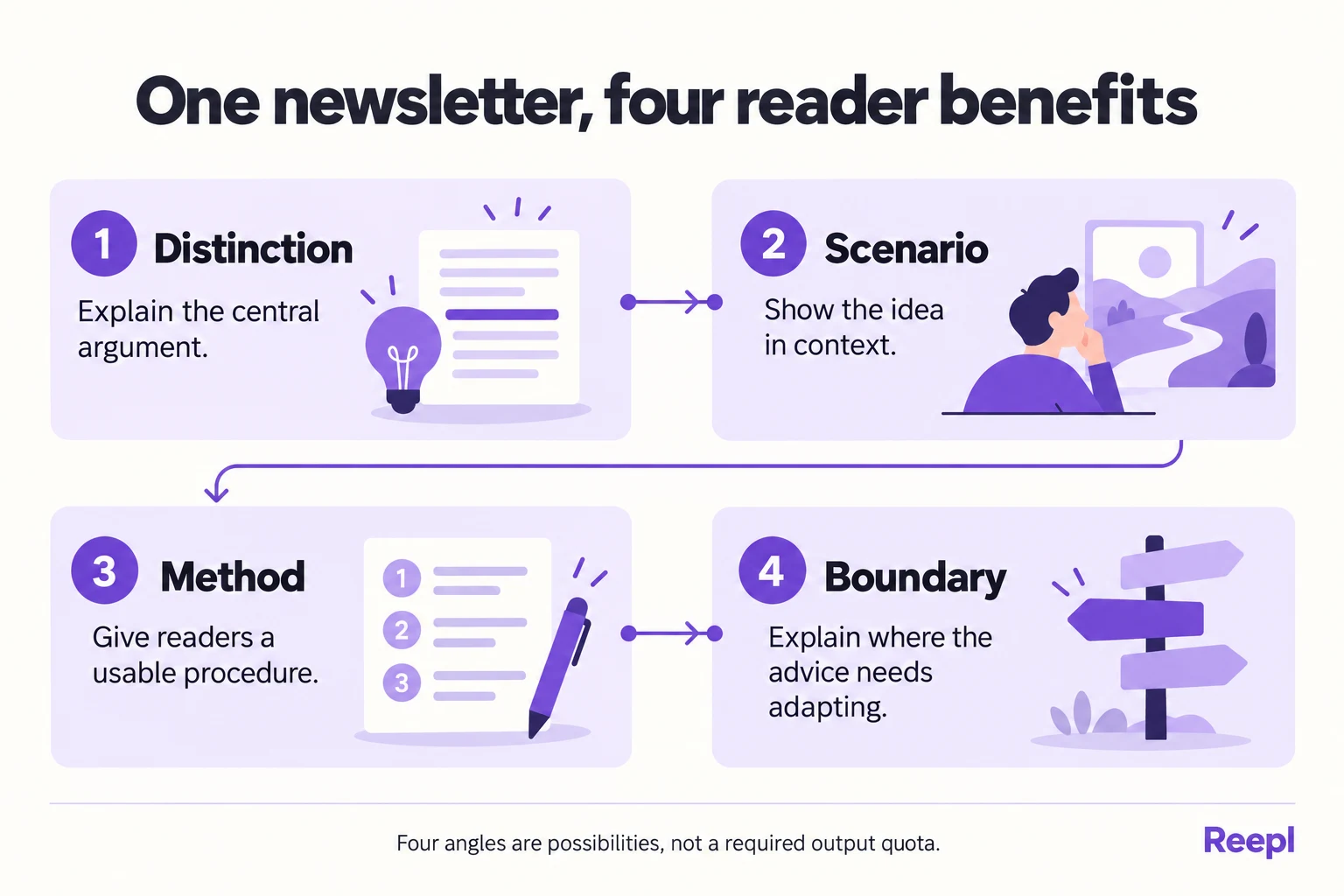
Four native posts from one issue can each do a different job and still read completely on their own. Each example below is complete. The posts share a source but deliver different value: a distinction, a scenario, a reusable interview plan, and a boundary case.
Post 1: explain the central distinction
An interview request can be precise about the schedule and vague about its purpose.
Panel members, available times, and a deadline describe a meeting. They leave out the evidence the hiring team still needs.
A useful interview plan connects those two things:
“We need this information so this person can make this choice.”
That sentence is a drafting aid. Early recruiting conversations may need a learning goal before a hiring decision is possible.
For an additional interview, try completing it before adding another panel member.
If the team cannot name the missing evidence, review the notes already available. The answer may confirm the need for another conversation.
You can then give the interview a clear purpose and explain that purpose to the candidate.
This version makes sense without the fictional recruiter story and gives the reader a practical preparation question.
Post 2: use the source scenario without inventing results
A fictional hiring team asks a recruiter for an extra interview.
The request includes panel members, available times, and a deadline. It looks ready to schedule.
The recruiter asks what information would change the hiring decision. The team needs evidence about how the candidate prioritizes competing customer requests.
That gives the team a starting point: review existing interview notes, then decide whether another conversation is needed to fill the gap.
The example stops before we learn whether another interview happens or whether the candidate is hired.
Its lesson is about preparation: a request for another conversation can arrive before the missing evidence has been identified.
Before scheduling an extra interview, name the evidence you need and check whether the existing notes already contain it.
Post 3: give readers a reusable interview plan
Before scheduling an additional interview, answer three questions:
- What decision will this conversation support?
- Who will make that decision?
- What evidence is still missing?
Here is an illustrative example for a customer support role:
Decision: Decide whether to advance the candidate.
Decision owner: The hiring manager responsible for this role.
Missing evidence: How the candidate prioritizes competing customer requests and explains the tradeoffs.
The questions come from a fictional newsletter example. The filled-in plan is an illustration of how to apply them, not a report about a real team.
Use the same role-relevant criteria across candidates. Add your actual process requirements. For exploratory conversations, state a learning goal.
Try the plan on one interview request. Use the answers to prepare relevant questions before sending an invitation.
This post adds a filled-in asset instead of repeating the source’s questions alone. The added details remain explicitly illustrative, so the reader can distinguish method from evidence.
Post 4: discuss where the method needs adapting
Some recruiting conversations begin before a specific vacancy exists.
Early exploration may be about understanding someone’s interests, explaining a team’s work, or discussing possible future roles.
A fictional newsletter about interview planning makes room for that case: name the learning goal when a hiring decision is not yet possible.
For example, an exploratory plan might say: “Understand the candidate’s preferred work and explain our likely hiring needs.”
That is an illustrative plan. Tell the candidate whether a current opening exists, so both sides understand the purpose of the conversation.
The difficult judgment is deciding when an exploratory conversation has enough purpose to justify asking for someone’s time.
What do you explain to a candidate before an exploratory call? Describe the purpose you share and how you set expectations for any next step.
The fourth post uses the source’s caveat as the main idea. It gives the batch a different direction while preserving the newsletter’s original limits.
How can you repeat the workflow with your own issue?
Use the source map to write one sentence describing the reader benefit of each proposed post. Then draft each post from that sentence, returning to the newsletter for evidence and context.
That sentence keeps the issue’s paragraph order from controlling every adaptation. Fill it in for each row of the source map: “This post helps [reader] [do or decide something] by [the claim, example or method from the issue].”
Follow this sequence:
- Select one issue with a useful idea that still holds up today.
- List its claim, example, method, and qualification in separate rows.
- Give each row a reader task, such as “prepare an interview.”
- Write a fresh opening that names the problem without email context.
- Add only the source material needed to complete that task.
- End with one action or one specific discussion question.
- Compare the draft with the issue and record any additions.
If you use an AI writing assistant, give it the checked excerpt and this reusable instruction:
Create separate LinkedIn® drafts for the argument, example, method, and qualification in this source. Make each understandable without the newsletter. Preserve uncertainty and label hypothetical material. Add no experiences, quotations, numbers or outcomes that the source lacks. Identify any sentence that needs more source evidence. Keep source attribution separate from your proposed editorial additions.
Read the drafts aloud after checking their meaning. Remove language that sounds unlike you and restore expressions you would naturally use.
Our voice training workflow explains how to build a practical voice brief for that review.
Before approving a batch, compare its opening lines, examples, and final instructions in one view. Two posts can use different words and still make the same promise.
Combine overlapping drafts into one post, and give the freed date to a new idea.
How should you link, schedule, and review the posts?
Link to the newsletter when the full issue supplies useful depth, a source, or an additional resource. The link should extend a complete post.
“Read the newsletter for the answer” leaves the social post unfinished when you have promised an explanation.
If subscriber value matters, decide the boundary before publishing. You might share the core idea publicly while reserving an extensive worksheet or detailed analysis for subscribers.
Explain accurately what the full edition adds. Give the conclusion away in the post; the full edition earns the click with depth.
Choose a sequence that suits your ordinary publishing rhythm. For this example, the distinction could come first, followed by the scenario, then the practical interview plan, with the exploration caveat later.
Separate them with other subjects if the repetition feels heavy.
Keep the original issue date and source link in your internal record. Recheck time-sensitive references before each scheduled post appears.
A draft about a current offer, deadline, or product feature can become inaccurate while it waits.
Review results according to the post’s job. Useful replies may show that the interview plan needs another question.
Reader misunderstandings may reveal missing context. Newsletter visits can show interest in the longer explanation.
Treat those observations as feedback on this batch, and use them to plan the next one.
A post can also introduce an idea before a fuller issue. Keep any time-sensitive information consistent and describe the additional value of subscribing accurately.
How do you preserve meaning when the newsletter is heavily compressed?
Keep the condition that makes the advice true, even if it costs you a cleaner opening. Newsletter arguments often unfold gradually: the headline states a principle, the middle develops an example, and the final section explains an exception. A social adaptation that copies only the headline can lose the author's actual position.
Use a claim-and-boundary pair for each draft. In the fictional interview example, the claim is to identify missing evidence before adding another interview. The boundary is that exploratory conversations may have a learning goal before a hiring decision exists. Either include that boundary in the post or choose wording narrow enough that the exception no longer changes the meaning.
GOV.UK's note-taking guidance distinguishes observation from interpretation. The same distinction helps when adapting an issue: “The hiring request did not name the evidence” describes the fictional source; “The team was wasting candidates' time” adds an interpretation the source never made. Label the added interpretation or leave it out.
Keep a comparison view with the newsletter passage, adapted sentence and reason for changing it. This need not be elaborate. A brief note such as “Removed the subscriber greeting; restored the subject of ‘this’; retained the exploratory-call exception” is enough to explain why the adaptation remains faithful.
How can you protect subscriber value without making the posts incomplete?
Define what the newsletter offers beyond the public explanation. It might provide a fuller worksheet, a detailed source review or regular analysis in one place. Then make the post useful on its own and describe that extra value accurately.
| Newsletter material | Public adaptation | Check |
|---|---|---|
| A general distinction | Explain it completely with a short example. | Keep its necessary qualification. |
| A detailed worksheet | Show one usable step and describe the full asset. | State any subscription requirement. |
| A reader's private reply | Discuss the underlying question only with appropriate permission. | Remove identifying details. |
| A paid guest contribution | Link or summarize within the agreed reuse terms. | Confirm rights before reproducing it. |
GOV.UK's privacy guidance for research data emphasizes explaining intended uses and controlling access. Newsletter replies are less formal than research data, and the editorial lesson still applies: a private contribution needs the sender's agreement before it becomes public marketing material. Ask before using a recognizable reader story, and record the agreed wording.
Call a public post “the complete method” only if it contains the necessary steps. Describe the full issue as what it is: if it holds a longer explanation, say so, with no hint of secret evidence. Clear expectations protect the relationship with both subscribers and new readers.
How do you use AI and measurement for a reusable adaptation process?
Give the assistant the approved issue, your reader description and the distinct job for each proposed post. OpenAI's prompt engineering guidance describes supplying relevant context and examples. Here, the issue supplies facts, while your voice examples supply expression. Tell the assistant to take stories and results only from the issue.
Ask for a source map before complete drafts. Review whether each proposed post corresponds to a real passage and whether the added interpretation is clear. This intermediate review is often more useful than comparing several polished versions of the same unsupported summary.
For each approved post, record its purpose and the relevant response you will look for. A method post might invite implementation questions. A distinction post might reveal confusion about the terms. A subscription invitation might lead to recorded visits and subscriptions. Those outcomes are different, so rank each post against its own purpose; reactions are one signal among several.
Google's campaign URL guidance explains parameters such as source, medium, campaign and content. Where your analytics supports them, assign consistent labels to newsletter links in different posts. That lets you inspect recorded traffic paths while earlier exposures and private recommendations stay out of view.
Review links and wording before each scheduled adaptation. W3C recommends link text that describes its destination. “Read the interview-planning issue” is clearer than “more here,” especially if the link leads to a public archive instead of an immediate subscription form. State when an asset requires registration.
Finally, compare the batch as a whole. Remove a post that repeats another's reader task, even if its wording differs. Pause adaptations when a correction changes the source. A small set of accurate, distinct posts is a better use of an existing newsletter than a quota filled by progressively weaker paraphrases.
Choose one recent issue, build the source map, and draft the post with the clearest reader benefit. Expand the batch only when the remaining ideas earn their own space.
Turn your ideas into useful posts
Draft from your own knowledge, check the facts and keep control of what you publish.