Find the right subreddits by searching for your audience's tasks, problems and current workarounds, then reading recent conversations and each community's rules. Judge three things separately: whether the audience fits, what you can contribute and whether the rules allow it. Then give each community on your shortlist a role: observe, contribute or skip.
Key takeaways
- Describe your audience's roles, tasks and difficulties before you search for community names.
- Open each candidate community and read recent conversations, because a title or subscriber count tells you little about fit.
- Judge audience fit, contribution fit and rules fit separately, and write the evidence beside each judgment.
- Give each community one role (observe, contribute or skip) so a research list never quietly becomes a distribution list.
- Recheck the shortlist when rules, your planned format or your audience change, or after moderator feedback.
Why does choosing the community matter?
A contribution can be useful in one community and irrelevant in another. Advice about negotiating a client contract might belong in a freelance discussion, while a detailed explanation of contract software may not answer the question anyone there is asking.
Reddit's guidance on getting posts noticed explicitly recommends choosing an appropriate community and following its rules. Relevance includes the topic, format and expectations of the people participating. It is more specific than finding somewhere with a familiar industry label.
This matters for research as well as posting. A community of professionals doing the work can reveal practical constraints. A community of vendors selling to those professionals may discuss the same industry while offering a very different perspective on its problems.
Start by deciding what you want to do: learn about a task, answer questions, discuss your experience or share something original. Different communities may suit different purposes. Plan on using different communities for different purposes.
A small, relevant conversation can be worth your attention even when it cannot send much traffic. Conversely, a large community may be unsuitable if your knowledge adds little to its discussions. Choose based on the work you can do there, not a promise of exposure.
What should you search for first?
Begin with three lists: who your audience is, what they do and what makes that work difficult. These lists produce better starting points than your company's product category alone. People may discuss the problem without using the terminology your website uses.
Fill in four short lists:
- Roles: [three ways your audience describes their job]
- Tasks: [three things they do that your product touches]
- Difficulties: [three things that make those tasks hard]
- Alternatives: [what they use today instead of a product like yours]
For an invoicing product, roles might include freelance designers, independent consultants and small agencies. Tasks might include collecting deposits, issuing invoices or following up on late payments. Difficulties might include unclear approvals, disputed scopes or clients who pay late.
Those are illustrative terms, not claims about search volume. Their purpose is to give you different routes into the subject. A conversation about late payment could lead to a community you would never find by searching only for “invoicing software.”
Add the alternatives people already use. Spreadsheets, email reminders, accountants and written payment policies may all appear in the workflow. Exploring those alternatives helps you discover communities discussing the underlying task, beyond the people shopping for software.
Keep the first list broad enough to reveal surprises, then narrow it through inspection. If a term mostly produces unrelated discussions, change the vocabulary or add context. Search is an iterative way to locate relevant conversations, not a test you pass with one perfect keyword.
How can you discover candidate communities?
Use Reddit's native discovery tools as a starting point. The official community discovery guide describes Explore Communities in the app and Explore on desktop. It includes topic-based browsing and communities related to those you already follow.
Search for your task and problem phrases, then note which communities contain relevant discussions. Open the community itself before adding it to your shortlist. A single search result can be an exception, so read a page of recent posts to see the usual conversation.
Read community descriptions and any public resources that explain who the space is for. Check whether an apparently relevant name refers to a profession, a hobby, a specific location or a particular point of view. Names alone leave those distinctions ambiguous.
Reddit Pro's Trends documentation describes another way to find communities discussing keywords. It also lists coverage and reuse restrictions. Treat it as a distinct Reddit product with limits, not an unrestricted directory or an exportable collection of other people's content.
Discovery will always be incomplete. Reddit's community visibility documentation distinguishes public, restricted and private communities. A community's existence, visibility and participation permissions are different things. If a community is restricted or private, ask to join only with an honest reason for wanting access.
How do you decide whether a community fits?
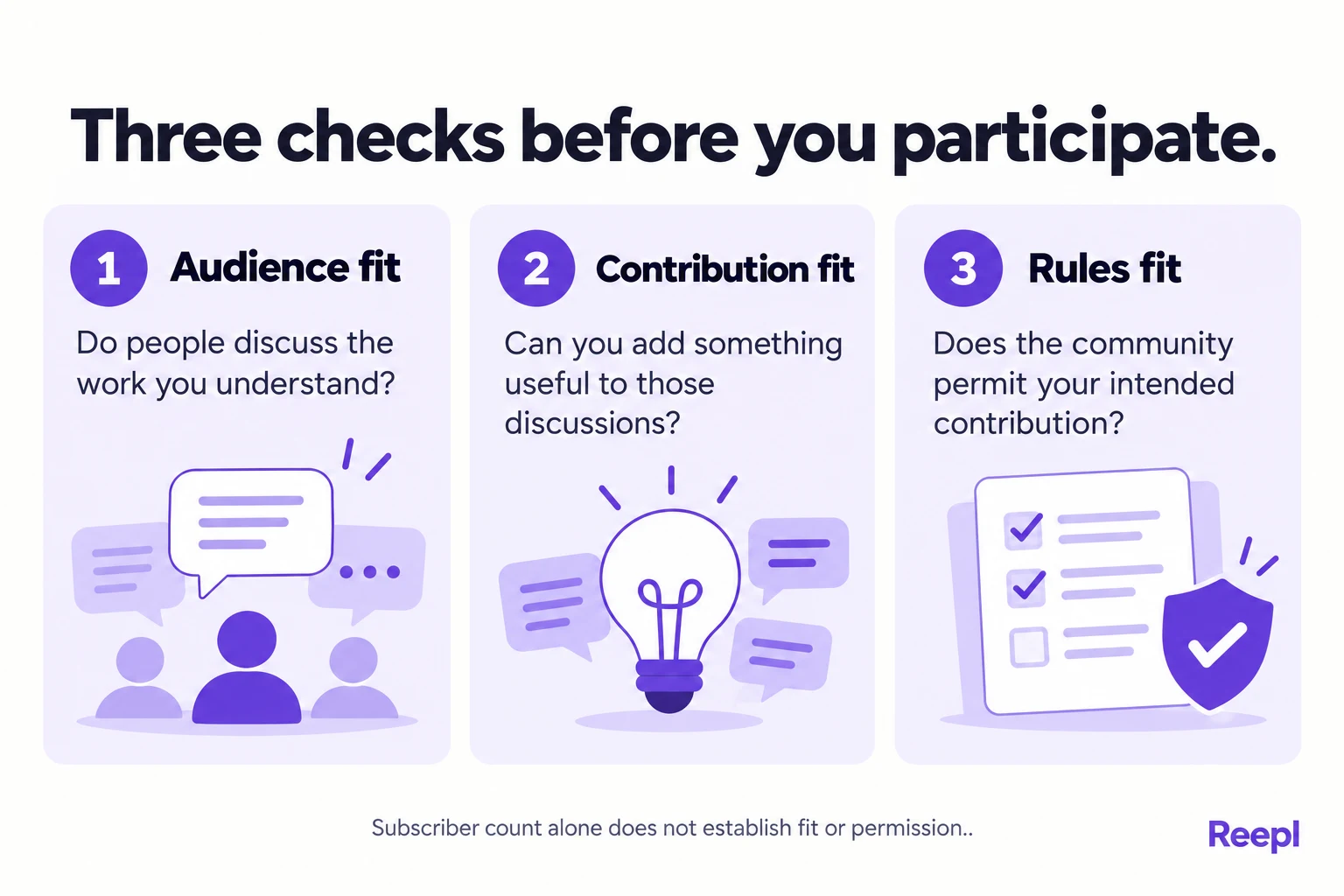
Evaluate three questions separately: does the audience fit, can you contribute and do the rules permit that contribution? A community should not pass simply because one answer is attractive. A relevant audience does not override a prohibition on the kind of post you planned.
Audience fit comes from the discussions you inspect. Look for the work, decisions and circumstances you understand. Avoid making strong assumptions about a user's job or buying power from a username, a single comment or membership in a community.
Contribution fit asks what you can add. Perhaps you can explain a technical tradeoff, share a documented process or ask a well-informed question. If the only useful sentence you can imagine is “Try our product,” you may need to learn more before participating.
Rules fit requires reading the current rules and relevant pinned guidance. Communities may distinguish discussion, support, feedback requests, resource sharing and promotion. A post that fits one category is not automatically permitted under another. Check the specific post you plan against the rules, not just its category.
Write the fit as one sentence you could show a moderator: “This community fits because [evidence from recent discussions]. I can add [a specific answer or experience]. The rules allow it because [rule text or pinned guidance].” If you cannot fill a bracket, the community is not ready for a post.
Use a simple comparison table instead of an unexplained score:
| Check | Evidence to look for | Reason to pause |
|---|---|---|
| Audience | Relevant tasks and circumstances in current discussions | A familiar industry name but unrelated conversations |
| Contribution | A question you can answer with specific knowledge | Your only planned contribution is a product link |
| Rules | Explicit guidance supporting the intended format | Promotion or research requests are prohibited |
| Context | Discussion norms you understand | You cannot tell what participants expect |
Use the table as a thinking aid and write down the evidence beside each judgment. That makes it easier to revise your decision when you notice a misunderstanding or when the community changes.
How much activity should you look for?
Judge activity by what recent conversations contain and how recently they happened; a raw count of posts tells you less. A specialist community may have fewer posts but detailed answers. Another may move quickly while offering little discussion relevant to the work you understand.
Look at whether questions receive useful replies and whether participants develop the discussion. Read what people actually ask. A stream of links or repeated promotional posts may create the appearance of activity without providing many opportunities for learning or contribution.
Read the newest page of posts and answer five questions:
- Do recent questions get replies that actually answer them?
- Do participants ask follow-up questions and add detail?
- How much of the page is links or promotion?
- Are the newest discussions recent enough that a reply would still help someone?
- Would your knowledge add something to at least one current discussion?
Subscriber totals cannot tell you how many people will read your particular post, whether those people match your audience or whether they welcome commercial content. Those are separate questions requiring different evidence.
Also consider whether you have enough context to participate responsibly. In a community discussing sensitive experiences, an outsider's commercial interest may be particularly unwelcome. A correct decision can be to leave the space alone, even when the topic overlaps with your business.
How should you organize your shortlist?
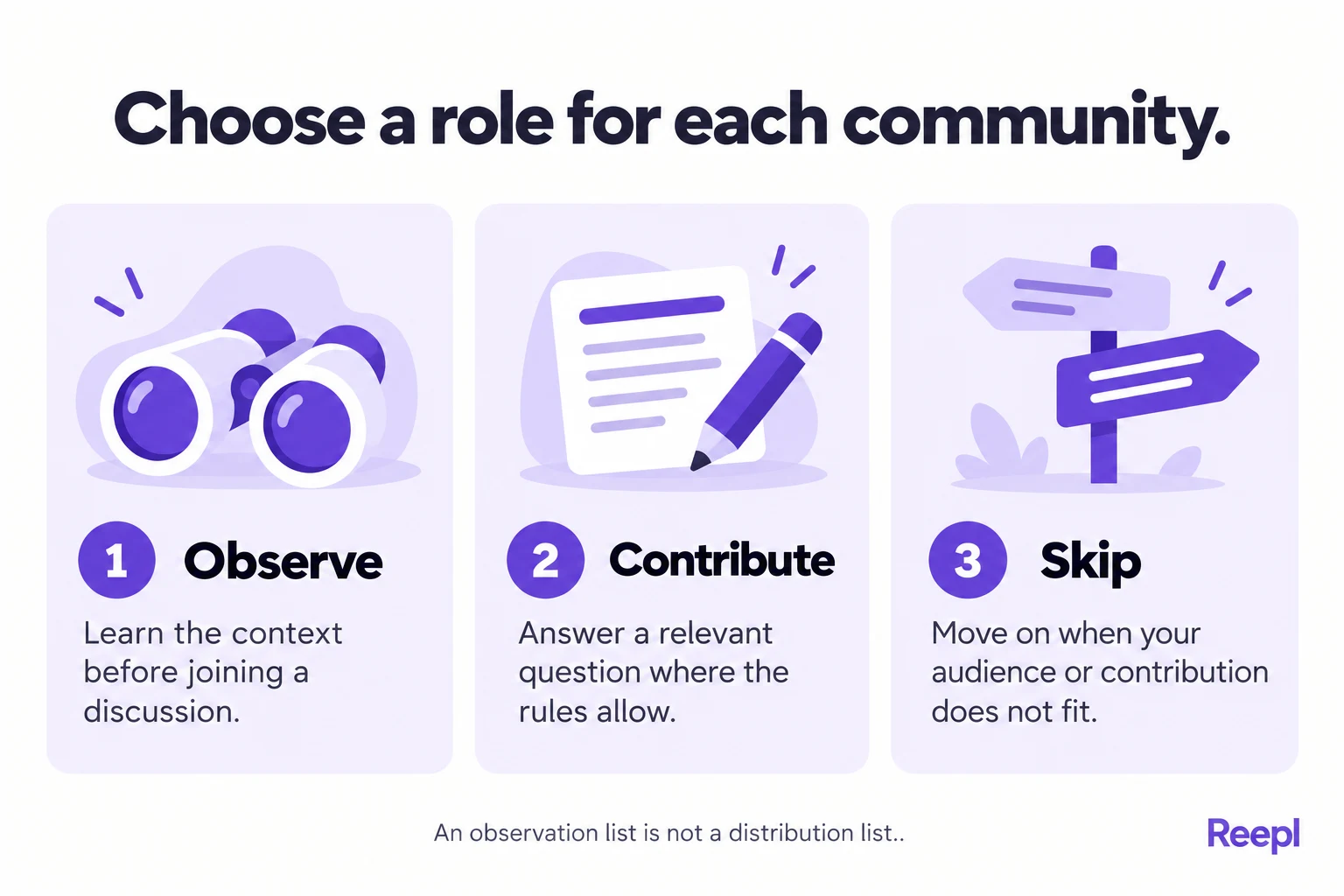
Give each community a role: observe, contribute or skip. These roles prevent a research list from silently becoming a distribution list. A community can be valuable for understanding vocabulary while being unsuitable for any post you would currently make.
For observation, record what you want to learn and review discussions in place. Keep notes focused on themes and tasks, and leave out personal details the research has no use for. Respect applicable terms, including Reddit Pro's limits if you use its tools to discover conversations.
For participation, identify an actual contribution before scheduling time to write. It might be answering a current question or sharing an experience where that format is welcomed. A calendar slot is no reason to post in a community; a useful contribution is.
For communities you skip, record a brief reason. “Not our audience,” “no useful contribution” and “intended format prohibited” are all sufficient. This helps a teammate understand the decision without reopening the same unsuitable option during every planning session.
Use this copyable shortlist template:
Community and link:
Date reviewed:
Purpose: observe / contribute / skip
Relevant audience task:
Examples of current discussion topics:
Rules that affect my intended contribution:
What I can usefully add:
What I should not post here:
Questions or uncertainty:
Next review trigger:
What does a worked shortlist look like?
Imagine an independent bookkeeping consultant looking for places to discuss cash-flow problems. This is an illustrative example using fictional community profiles. It does not describe the current rules or membership of any named subreddit.
The first candidate is a large general business community. Recent conversations focus on broad entrepreneurship stories, and the consultant has no specific answer to the current questions. The consultant marks it “observe” while learning more, since size alone does not make it the best place to post.
The second candidate is a smaller community for independent service professionals. People ask concrete questions about deposits and payment schedules. Its rules permit practical discussion but prohibit service promotion. The consultant can answer relevant questions without mentioning a paid service, so this becomes a possible contribution community.
The third candidate focuses on bookkeeping software development. It contains technical discussions about integrations, while the consultant's experience is mainly with client communication. Despite the shared bookkeeping vocabulary, the planned advice does not fit. The consultant marks it “skip.”
The result is not a ranked list of lead sources. It is a clearer decision about where the consultant can learn and where their experience might help. That distinction keeps the activity useful even if no one visits a website or asks about services.
What mistakes make a shortlist less useful?
The first mistake is choosing communities by subscriber count and then trying to force a contribution to fit. Reverse that sequence: identify the discussion and the useful thing you can add, then decide whether participating is appropriate.
The second is treating one accepted post as lasting permission. Rules and moderation decisions are contextual. Read the current guidance each time the topic or format changes. Check promotional links, surveys and repeated announcements against the current rules each time, even if a similar post appeared before.
Reddit's Spam policy explicitly addresses repeated and unsolicited actions, including mass repetitive promotional content. A shortlist should help you make selective decisions, not provide targets for sending the same pitch with minor wording changes.
The third mistake is assuming participation must include a business mention. Reddit's Reddiquette encourages useful contributions and reading community rules. You can answer a question without directing the conversation toward what you sell. Sometimes that is the entire appropriate contribution.
How do you build a search map for an unfamiliar market?
Build a map from work situations, not just industry labels. A business category describes what you sell; a work situation describes why someone would ask a question. The latter often reveals useful communities that your first product search misses.
For an illustrative service helping freelancers manage invoices, start with an audience phrase such as independent designer. Add a task, such as requesting a deposit, and a complication, such as a client delaying approval. Search combinations separately so you can see which part of the vocabulary leads to relevant discussion.
| Search route | Illustrative language | What to inspect |
|---|---|---|
| Role | Freelancer, consultant, designer | Whether participants discuss the work you understand |
| Task | Deposit, invoice approval, payment reminder | The actual process and constraints |
| Alternative | Spreadsheet, bookkeeper, email template | What already solves the problem |
| Situation | First client, late payment, disputed scope | When the problem becomes urgent |
Use words you encounter in relevant discussions to refine the map. If people say “chasing payment” while your site says “accounts receivable workflow,” keep both as possible search terms. The less formal phrase is the language of that conversation and tells you little about the buyer.
Record why a search result led you to a community. A note such as “recent questions about deposit policies for project work” is more useful than “good audience.” It lets a teammate check the reasoning and spot a mismatch before investing time in participation.
Revisit failed routes too. A search that produces irrelevant software promotion tells you something about the term, not necessarily about demand. Change the task phrase or inspect an alternative before concluding that your audience has no community.
How do you check local norms beyond the rules list?
Read the rules first, then inspect how useful discussions are actually conducted. Local norms help you understand tone, context and the amount of explanation expected. Norms never override an explicit prohibition, and an apparently tolerated post is not a promise that yours will be accepted.
Read a mixture of recent questions and developed discussions. Notice whether people include technical details, ask narrow questions or share complete process notes. A community may prefer a concise factual answer over a polished essay. Another may require enough context that a short answer would be irresponsible.
Inspect what the author and respondents do after the opening post. If the value comes from clarifying questions and follow-up detail, participating requires availability to respond. Scheduling a post and disappearing can leave a discussion unfinished, especially when readers need clarification before using the advice.
Check how affiliation is handled, and state your own business connection plainly when it matters to the answer, even if other posters leave theirs out. Transparency helps readers assess your perspective even where mentioning a service is permitted.
Identify topics where your expertise is insufficient. A bookkeeping consultant can explain a general invoicing process without offering jurisdiction-specific tax advice. If a community question requires licensed or specialist judgment, contribute only within what you can substantiate or leave it to someone qualified.
Keep sensitive communities out of a commercial participation plan unless there is a clear, legitimate and permitted reason to be there. A topic can overlap with your product while the setting remains inappropriate for business research or promotion. Choosing to skip can be a sign that your fit assessment is working.
What does a sustainable participation plan look like?
A sustainable plan identifies useful contributions you can make with the time and knowledge you actually have. It does not promise a posting quota across every community on the shortlist. Start with fewer places where you understand the rules and can follow the discussion.
For each contribution community, write one current question you can answer and the evidence or experience behind your answer. If no such question exists, leave the community in observation. Time spent finding a community is no reason to start a discussion there.
Keep one plan entry per contribution community:
- Community: [name and link]
- Question I can answer: [a current discussion, linked]
- Evidence or experience behind my answer: [what I actually know]
- Follow-up time: [when I can return to answer clarifying questions]
- Review trigger: [rule change, format change or moderator feedback]
Set review triggers instead of treating the list as permanent. Recheck when the rules change, when your planned post format changes, when the audience shifts or when moderation feedback exposes a misunderstanding. The date on a research note is useful only if someone knows when to revisit it.
Evaluate learning and contribution separately from referral traffic. You might learn vocabulary that improves your documentation, answer a question accurately or discover that your proposed resource is unnecessary. Those outcomes are different from a website visit and should not be disguised as acquired customers.
If a post is removed, update the shortlist with the stated reason. The issue may be your format, timing or promotional purpose. If the intended activity is prohibited, move the community to observe or skip. A removal is a signal to change the contribution or stop, never to find a less recognizable way to promote.
An agency should maintain client-specific judgments. Two clients in the same industry may have different expertise, relationships and permitted contributions. A shared list of names cannot replace the review of each proposed post. Keep the useful research process reusable while making participation decisions individually.
Finish the first pass with a practical decision: one community to understand better, one suitable contribution to prepare, or a documented reason to stop. A shortlist is valuable when it changes where you spend attention.
Where does a writing tool fit into this process?
A writing tool can help organize ideas after you understand the community. It cannot substitute for reading the discussion, interpreting its norms or deciding whether you have something useful to add. Those judgments depend on context and should remain visible in your process.
Reepl is an AI writing platform that puts your social media on autopilot in your own voice: it finds what to post about, drafts your posts, and keeps your calendar full, and you decide how much it does without asking. As of October 2026, Signals requires Pro or higher; its Reddit source can help surface material to review when your Reddit account is connected.
Use that material as an invitation to investigate, not a recommendation to post everywhere it appears. Keep the shortlist small enough to understand its entries, revisit the relevant rules and prepare contributions individually. The useful outcome is better judgment about where your attention belongs.
Continue with our guides to researching audience questions and writing a useful Reddit reply.
Put your next idea into words
Draft in your voice, review the details, and choose what to publish.