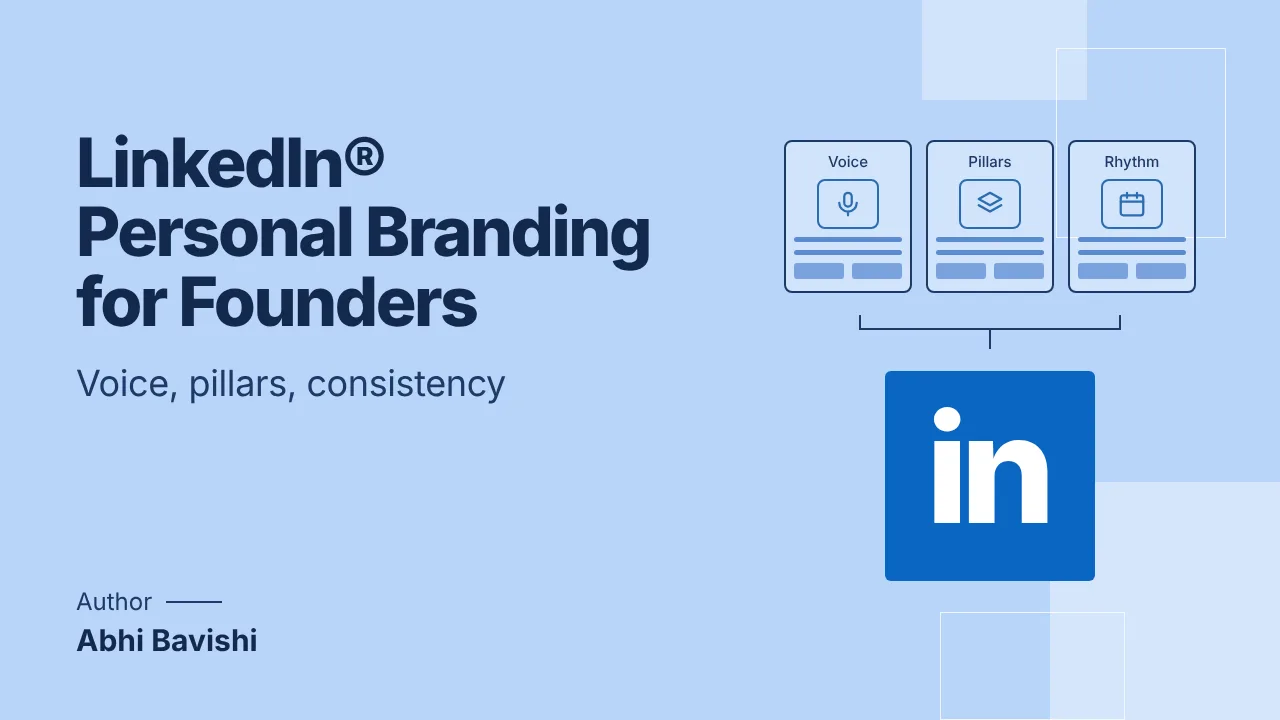
A founder's LinkedIn® personal brand is the reputation relevant readers form after seeing several pieces of your work. Build it with one positioning statement you can support, a profile that explains it, an inspectable proof item, a short voice note, three or four recurring subjects, and comments that show your judgment. Then check how readers describe you.
Key takeaways
- A useful founder brand connects a specific audience, a problem, and evidence of relevant judgment, such as “She explains how mid-sized warehouses decide what to automate first.”
- The headline, About section, proof item and next step each answer a different reader question, so give each one a single job.
- Early founders can prove judgment with demonstrations, worked explanations and permitted case studies; none of those needs a dramatic customer metric.
- A short voice note built from your own writing guides both a human collaborator and a writing assistant better than copying another creator's sentence patterns.
- The clearest test of a brand is how relevant readers describe your work back to you, so record their words alongside follower counts.
What is a founder's personal brand in practical terms?
A personal brand is the set of expectations people associate with your professional identity. For a founder, those expectations should help relevant people understand what you know, how you make decisions, and why they might trust you with a problem. It is not a requirement to turn every private experience into public material.
A recognizable brand can be quiet and specific. A founder known for explaining difficult implementation tradeoffs may be more useful to buyers than a founder known for broad motivational posts. The appropriate reputation depends on the business and audience, not on a universal creator style.
The platform's profile guidance describes a profile as a professional landing page and recommends representing your experience and interests accurately. That supports a practical approach: make your work understandable before trying to make it memorable. A clever headline that obscures the problem you solve creates unnecessary work for the reader.
A personal brand also differs from a company identity. The founder can explain judgment, tradeoffs, and experience that a product page cannot fully convey. The company can document product behavior, service terms, and support. Keep the connection clear without making every personal post sound like a press release.
Start with the reputation you want a relevant reader to describe after encountering several pieces of your work. For example, take an illustrative founder of a warehouse automation consultancy and integration business. “She explains how mid-sized warehouses decide what to automate first” is actionable. “She is an inspiring thought leader” is difficult to prove and gives little guidance for the next post.
How do you choose a credible positioning statement?
Choose a position at the intersection of the reader's problem, your experience, and the work you want to do. A strong statement is specific enough to guide decisions and modest enough to support with evidence. It should not depend on a grandiose title.
Write three notes before drafting the statement. First, identify the person you serve and the situation they face. Second, identify the decisions you can explain from experience or well-supported research. Third, identify the outcome your work is designed to help, without promising a specific result.
An illustrative statement for that founder is: “We help mid-sized warehouses decide what to automate first, and we share the decisions behind that work.” It names the audience and subject while leaving room for practical lessons, project explanations, and informed disagreement. It stays modest: it never says the founder is the best or has solved every automation problem.
Test the statement against your evidence. Can you show a method, a product, a relevant project, or a well-reasoned explanation? If the only support is a phrase in your biography, narrow the claim. A new founder can honestly say what they are building and investigating.
Also test the statement against the work you want more of. A founder who publishes mainly about fundraising may attract investor conversations while hoping for operational buyers. Neither audience is inherently wrong, but the choice should be deliberate. Your recurring subjects teach people what to approach you about.
Ask a few relevant people to paraphrase the statement. If their understanding matches your intent, keep it. If they describe a different service or cannot name the audience, simplify. This comprehension test is more useful than asking whether the wording sounds impressive.
How should you rewrite the headline, About section, and proof?
Use each profile section for a different job. The headline identifies your professional focus. The About section explains your approach and fit. Proof items let readers inspect the work, and the next step tells them how to continue.
| Profile element | Reader's question | What to include |
|---|---|---|
| Headline | Is this person relevant to my problem? | Role, audience, or specific area of expertise |
| About section | How does this person approach the work? | Problem, method, experience, and boundaries |
| Experience | What supports the claimed expertise? | Accurate roles and relevant responsibilities |
| Proof item | Can I inspect the work? | A guide, demonstration, talk, or permitted case study |
| Next step | What should I do if this is useful? | One clear resource or appropriate contact route |
An illustrative headline is: “Founder helping mid-sized warehouses choose what to automate first.” An illustrative About opening is: “The hard part of warehouse automation is often choosing where to start. Our work focuses on making that choice explicit before any equipment is ordered. We publish practical methods and project examples for operations teams weighing their first automation step.”
Follow with evidence you actually have. If you have delivered relevant work, explain the scope without inventing a result. If you are early, link a demonstration or a detailed guide. A public artifact gives the reader something to evaluate. Avoid replacing evidence with a stack of vague adjectives.
Keep the next step aligned with the post that brought the reader there. If you publish educational material, a useful checklist may fit better than an immediate sales form. If you sell a specific consulting service, a clear description of fit and an inquiry route can be appropriate. Remove competing calls to action that make the choice harder.
Review the profile on the devices your readers use. A headline may be truncated, and a long paragraph can hide the central point. Put the essential information first. This is a readability recommendation, not a promise that a particular profile structure changes feed ranking.
What counts as credible proof when you are early?
Proof is material that lets a reader evaluate a claim. It does not have to be a dramatic customer metric. A new founder can show how a method works, why a decision was made, and where the current product has limits.
A demonstration is useful when it accurately represents current behavior. Use fictional data if necessary and label it. Walk through the decision the reader cares about instead of showing every feature. Name what the demonstration leaves unmeasured, such as outcomes in actual customer use.
A worked explanation is useful when it exposes your reasoning. Show the options, the tradeoff, and the condition that would change your recommendation. This allows readers to judge your competence even when you cannot share confidential projects. It also avoids implying that a client approved a public story when they did not.
A case study requires more care. Record the starting situation, intervention, time period, and what was actually observed. Get permission for identifying details. Name any other factors that contributed alongside your product. If the evidence is anecdotal, present it as an account of that one situation.
The Professional Community Policies require accurate information and prohibit misleading claims. That applies to credentials, achievements, and affiliations as well as posts. Avoid customer logos that imply an endorsement beyond the permission granted. A prospect discovering an exaggerated claim can undermine the trust created by otherwise useful work.
Google's people-first content guidance emphasizes clear sourcing, authorship, and evidence of experience for web content; apply it to the linked proof page on your own site, as a reference separate from LinkedIn®.
How do you develop a voice that sounds like you?
Voice is the pattern of choices in your writing: what you notice, how directly you state a claim, which examples you use, and how you handle uncertainty. Formatting contributes, but it cannot substitute for a point of view. Copying another creator's rhythm may make your writing recognizable as imitation.
Collect a few pieces of your own writing that feel natural and appropriate for the audience. They might be emails, internal explanations, or earlier posts you still stand behind. Identify concrete preferences: short opening sentences, practical examples, plain terms, and explicit exceptions. Replace vague labels such as “authentic and engaging” with preferences you can edit against.
Write a short voice note. An illustrative version is: “Use direct language and explain the decision before the background. Prefer a practical example to a motivational slogan. Say when the evidence is limited. Never invent personal stories or emotional reactions.” This helps both a human collaborator and a writing assistant.
Then edit a draft against the note. Replace broad statements with the detail you would use in a customer conversation. Remove repeated stock phrases. If the model writes “we discovered,” confirm that you actually investigated the issue. If it writes a dramatic founder story, check whether every event and feeling is yours to claim.
A consistent voice can use different structures. A technical walkthrough and a personal reflection can sound like the same person while using different forms. Preserve judgment and vocabulary, not a rigid hook-and-three-bullets template. Readers should recognize the perspective without predicting every sentence.
Our founder post ideas guide helps connect that voice to recurring subjects. The combination matters: consistent wording around unrelated topics may still confuse the audience, while useful recurring subjects become stronger when the writing carries your actual reasoning.
Which recurring subjects should support the brand?
Choose subjects that repeatedly demonstrate the reputation you want to build. Each subject should help a relevant reader make a decision and give you room for new evidence. Avoid treating every interest or trending topic as a required pillar.
For the illustrative warehouse founder, recurring subjects could include choosing where to start, process exceptions, integration tradeoffs, and lessons from building the business. A post about which process to automate first and a post about turning down an oversized project can both support the same professional identity.
Include disagreement when it is useful, and keep contrarianism a tool, never the brand. Explain the strongest case for the alternative before stating why it fails under a particular condition. This shows judgment more clearly than announcing that everyone else is wrong.
Include personal material only when you want to and when it serves the reader. A lesson about changing your mind can reveal values without exposing family details or private distress. You owe the audience no continuous emotional narrative to be credible.
Keep a source list for each theme. If you cannot find new examples or questions, the theme may be too narrow or detached from your actual work. If almost any business topic fits, it is probably too broad. Adjust the boundaries before you force weak ideas into the calendar.
Review the subjects against your offer periodically. A founder's work evolves, and the public identity should evolve with it. Explain meaningful changes so existing readers understand the connection. Be open about a change of focus; your public record shows it anyway.
How do comments and conversations support a personal brand?
Comments show how you think when someone else sets the agenda. A useful response can add a relevant example, clarify a distinction, or ask a precise question. It should serve the conversation in front of you without steering it toward your product.
Before replying, read the full post and enough context to understand the claim. If you disagree, identify the specific point and the conditions behind your alternative. Avoid attributing motives to the author. Professional disagreement can reveal judgment without becoming a performance of certainty.
When you know too little, ask a real question. “How does this work during the holiday peak?” is more useful than praise followed by an unrelated sales pitch. If the answer changes your view, say so. A public correction shows care for accuracy and strengthens the record you are building.
The community policies prohibit artificial engagement and prearranged reciprocal activity. Do not build a brand around people obligated to praise every post. A genuine peer group can review drafts and challenge reasoning privately without becoming a mechanism for manufacturing public approval.
A writing assistant can help phrase a response, but you should inspect the context and send it yourself. The User Agreement addresses prohibited automated methods, and account behavior deserves its own review. Your professional reputation is expressed through the actual interaction, not just the polish of the sentence.
How do you handle commercial relationships and mistakes?
Make relevant commercial relationships clear and correct mistakes visibly enough to avoid leaving readers with a false impression. A founder's personal identity does not remove the commercial nature of a recommendation. Readers may encounter one post without knowing the rest of your history.
The FTC's social-media disclosure guidance explains that material connections can include employment, payment, free products, and other relationships. Disclosures should appear with the endorsement and be difficult to miss. Do not rely solely on an About section to explain a relationship relevant to a particular recommendation.
For your own product, make ownership apparent. For a partner or advised company, state the relationship in plain language when it matters. Keep the recommendation truthful and based on experience you actually have. A disclosure does not permit unsupported claims about performance.
When a factual error is identified, check the source and correct the material. Acknowledge the correction when readers might otherwise retain the wrong conclusion. Avoid silently changing a substantial claim while continuing to defend the original wording in replies. The aim is an accurate record, not a flawless appearance.
When criticism concerns judgment and your facts hold, explain the tradeoff. You can disagree calmly and still identify where the other approach works. If the conversation becomes abusive or irrelevant, use the platform's available controls. You are not required to continue every exchange to prove openness.
How should you measure whether the brand is becoming clearer?
Measure understanding and relevance, not just size. Ask whether the right people can describe what you do, whether inquiries fit the work you want, and whether your posts prompt informed questions. Follower growth can accompany that progress; it cannot replace it.
Keep a record of inbound conversations and ask what made the person contact you. Note their language. If people repeatedly describe your work in terms you did not intend, inspect the profile and recurring subjects. The mismatch may be more informative than a rise in impressions.
Review several posts together. Do they form a coherent picture of your judgment, or do they look like disconnected attempts to win attention? Does the linked proof support the profile claim? Can a new reader find a useful next step without contacting you for basic information?
A weekly routine that keeps the brand clear
Brand work fits into a founder's week as four small habits. A suggested shape:
- Monday: draft one post that demonstrates the judgment your positioning statement promises.
- Daily, in a short block: comment on posts from the readers named in your statement.
- Midweek: add one new example or question to the source list for a recurring subject.
- Friday: fill in the brand check below for any conversation from the week.
- A reader described my work as: [their words]
- My positioning statement says: [your statement]
- Match or mismatch: [what differs]
- Proof item they saw: [link or none]
- Change for next week: [profile line, subject or proof item to adjust]
The platform's dwell-time engineering article explains that passive reading is part of the feed's engagement picture, so some relevant readers will leave no public trace. Treat silence as unknown, and combine available metrics with actual conversations.
What should you do in the next working session?
Choose one positioning statement and make the profile match it. Replace an unsupported superlative with a concrete explanation. Add one inspectable proof item and one appropriate next step. Then draft a post that demonstrates the judgment promised by the profile.
Use the solo founder playbook to fit this work into a sustainable routine. Keep an evidence note with each draft and a small collection of writing samples that reflect your voice. A personal brand becomes clearer through repeated accurate work, not through a single polished declaration.
If drafting is the bottleneck, Reepl is an AI writing platform that puts your social media on autopilot in your own voice: it finds what to post about, drafts your posts, and keeps your calendar full, and you decide how much it does without asking. The useful role is carrying your actual ideas into consistent drafts while you remain responsible for the claims and professional judgment.
Make room for better writing
Build a writing routine with your voice and your review controls.