A solo founder can run LinkedIn® as a focused weekly habit: choose one audience and one business job, make the profile explain the offer, turn notes from customer work into a small batch of useful posts, reply to people personally, and keep a busy-week version of the routine. Judge it by the conversations and inquiries it produces.
Key takeaways
- Pick one primary job for the channel, such as discovery conversations or qualified inquiries, before you choose a posting schedule.
- A reader statement plus an exclusion ("We write for... We are not trying to teach...") keeps a one-person content plan from drifting.
- A five-field source note (situation, decision, reason, evidence, sharing permission) turns ordinary customer work into posts without a second job.
- Plan a normal week and a busy-week version of the routine in advance, so a heavy delivery week shrinks the routine instead of ending it.
- Measure the job you picked, record what each prospect remembers, and compare the result with the time the routine costs.
Is LinkedIn® the right channel for your business?
LinkedIn® is worth testing when the people you need to reach discuss professional problems there and your experience can help them make decisions. It is not automatically the best channel for every founder. A business selling a local consumer service may find stronger demand elsewhere, while a specialist consultant may benefit from a small professional audience.
Start with the business job. You might want customer discovery conversations, qualified inquiries, distribution for an educational resource, or relationships with potential partners. Pick one primary job for the initial test. Trying to sell, hire, raise funds, and become a broad creator at the same time makes the content difficult to evaluate.
The platform's profile guidance describes the profile as a professional landing page. That is a useful starting point for a founder: people should be able to understand who you help, why your experience is relevant, and what to do next. A large audience is not required for that basic communication to be useful.
Consider the opportunity cost honestly. Writing competes with product development, delivery, sales conversations, and rest. Set a time limit, so the feed never becomes an open-ended research task. If you cannot name what the activity is supposed to accomplish, the routine will be hard to defend during a busy month.
Choose a review horizon long enough to publish a coherent set of posts and have conversations. Your sales cycle, existing network, and offer maturity all affect how long that is. Set the review date yourself and record what evidence would justify continuing, changing, or reducing the effort.
Who should you write for first?
Write for a specific person facing a specific professional decision. A solo founder usually has more useful material when describing a customer problem than when trying to speak to everyone who might admire entrepreneurship.
Describe the reader in working terms: role, situation, obstacle, and decision. For example, an illustrative solo founder selling a client onboarding tool to small accounting firms might write for “an office manager at a small accounting firm deciding how new clients should submit their documents.” That is more actionable than “business leaders.” You can picture the question that person would ask and the example that would help.
Use actual conversations as research, with appropriate permission and privacy. Note the language people use to describe the problem, the alternatives they consider, and the misunderstanding that delays a decision. Do not turn a private call into a public quotation without consent. A paraphrased lesson can still reveal someone when the context is distinctive.
Build a short reader statement: “We write for office managers at small accounting firms who want to stop chasing clients for missing documents.” Then add an exclusion: “We are not trying to teach tax rules or general career advice.” The exclusion protects your limited time and keeps the audience from drifting toward whatever earns easy reactions.
A founder can discuss personal experiences within this focus. A story about learning to delegate can help the reader if it explains a decision about who owns a task. The same story becomes less useful when it only asks the audience to admire persistence. Connect the experience to a choice the reader can make.
Our founder post ideas guide helps turn that reader statement into recurring themes. Start with the customer decision, then choose the categories.
What should your profile say before you post?
Your profile should make the promise of your posts easy to understand. A reader who finds one useful idea should not have to investigate several unrelated titles to discover what you do. Use plain language and evidence you can support.
For the headline, combine role and problem. The illustrative founder above might use: “Founder helping small accounting firms collect client documents without the chasing.” It is less elaborate than a list of grand claims and easier to understand. If you serve a narrow industry, name it when that helps the right reader recognize themselves.
For the About section, explain the situation you work on, the approach you take, and the next step. An illustrative draft is: “Asking a client twice for the same document wastes a small firm’s time. We build an onboarding tool and share practical methods for making requests clear. If you are redesigning your client intake, start with the checklist linked below or send a specific question.”
Add relevant experience and a proof item. Proof can be a public guide, a product demonstration, a talk, or a permitted case study. A new founder without customer results should not manufacture them. Explain the method you are testing and show the work available for inspection.
The Professional Community Policies require accurate information and authentic identity, so keep employment, qualifications, affiliations, and outcomes truthful, and never imply that customers or partners have endorsed you when they have not. A modest, verifiable profile holds up when a prospect checks it.
Test the profile with someone near the intended audience. Ask what problem they think you solve and what they would do next. If their answer differs from your intention, simplify the wording. This is a comprehension check, not a request for a flattering opinion.
How do you capture ideas without becoming a full-time creator?
Capture source material while doing the work you already need to do. The goal is a small record of decisions, questions, and explanations that can become posts later. Keep it small enough that documenting never turns into a second job.
Keep a note with five fields: situation, decision, reason, evidence, and sharing permission. For the illustrative founder, a source note might say that a firm's client could not tell which document was still missing. The useful lesson may concern how a request is worded, while the permission field says that the firm's name and the client's request cannot be shared.
Use several kinds of material. A support answer can become a checklist. A product tradeoff can become an explanation of when a feature is useful. A changed opinion can become a post comparing two approaches. An unsuccessful experiment can become a lesson if you explain its limits and avoid pretending the outcome applies everywhere.
| Source from ordinary work | Potential post | Check before publishing |
|---|---|---|
| Repeated customer question | A direct answer with an example | Remove identifying details and avoid invented frequency |
| Product decision | Options considered and the reason for choosing | Separate shipped behavior from future plans |
| Delivery mistake | What changed in the process | Protect colleagues and customers from unnecessary exposure |
| Industry document | A practical implication for the reader | Link the primary source and retain its qualifications |
| Public demonstration | A step-by-step walkthrough | Show current behavior and label illustrative data |
Save a link only when you can write one sentence on why it matters to your reader. Write that sentence when saving the idea. Otherwise, the next writing session becomes another round of browsing.
If a source depends on a statistic, preserve the original scope and date. If you cannot verify the number, explain the operational lesson without it. Specificity can come from a concrete decision or example, and the reader needs something credible to use.
What weekly routine can one person sustain?
One person can sustain a routine with two versions: a normal week and a busy week. The normal version includes capturing ideas, drafting, review, publishing, conversation, and a short evaluation. The busy-week version keeps only the pieces that preserve usefulness and continuity. Write both down before you need them, for example like this:
| Task | Normal week | Busy week |
|---|---|---|
| Capture | One line after each customer call or support answer | Same; this is the step to keep |
| Draft | One focused session for a small batch, for example an hour on Monday | One post, or none |
| Review | Facts, permission, voice and next step, read aloud | Same; never skipped |
| Publish | Check the destination and queue for each post | Check the one post |
| Replies | Two short windows a day on posting days | One window a day |
| Evaluate | A short Friday note: who replied, what repeated | Roll into next week's note |
As an editorial starting point, reserve one focused session to draft a small batch and separate short periods for replies. The exact duration depends on the complexity of your work. A technical explanation requiring source checks deserves more time than a brief update. Treat any time estimate as your own scheduling choice.
During drafting, choose the strongest source note and write the answer before the hook. Explain the decision, give the example, and state where the advice does not apply. Then write an opening that accurately promises that material. This reduces the temptation to create a dramatic claim and struggle to support it afterward.
During review, check facts, permission, voice, and the next step. Read the post aloud. Remove words you would never say to a customer. Confirm that a product statement describes something available now. If a sentence says “we learned,” make sure the lesson comes from actual work; software can produce a plausible story that never happened.
During publishing, verify the destination and queue. Publishing your own posts through an authorized connection is different from activity involving other members: the Share documentation covers publishing on behalf of an authenticated member, and the User Agreement sets the broader rules to check when you choose a tool.
On a busy week, publish fewer items or skip a slot. An empty post written to fill the calendar helps nobody. Reply to meaningful questions when you can. A sustainable routine should survive customer work, not compete with it through guilt.
What should a founder actually write?
Write a complete useful idea, grounded in your work and relevant to the reader. The form can vary, but the post should offer more than a mood, a slogan, or a product announcement with no practical context.
An illustrative decision post from the onboarding founder could say: “We removed a configuration option because it made requests harder to follow. The option let every firm invent its own document status. That flexibility looked useful, but clients could not tell whether a request was waiting on them or already received. We now keep the status fixed and let firms add explanatory notes. This would be too restrictive for firms with genuinely different review steps.”
The example is fictional and should not be copied as a claim about your company. Its structure is usable: decision, reason, consequence, limitation. Replace the facts with your own. If you have not measured the consequence, say what you expect or what you are investigating instead of declaring an improvement.
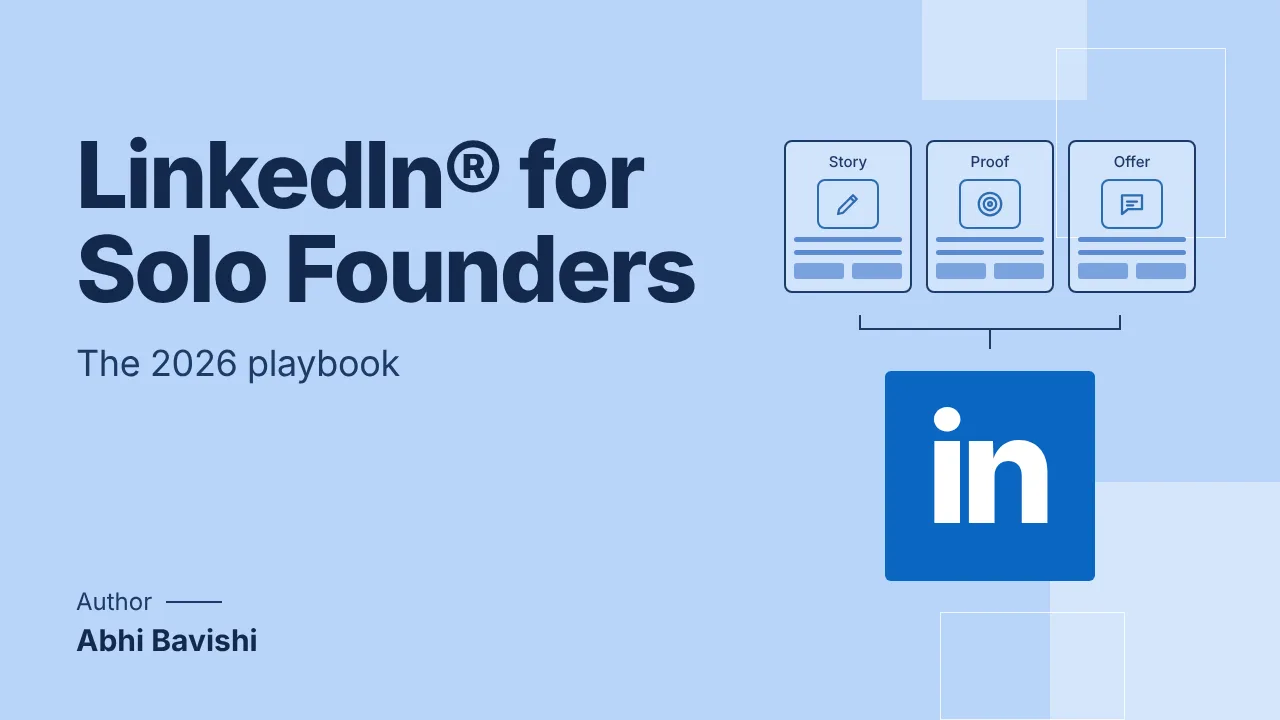
A teaching post might offer a checklist for a decision your buyer faces. A point-of-view post might explain why a common recommendation fails under a particular condition. A founder story might show how your judgment changed. Rotate these forms according to the evidence available, and treat any mix you choose as your own editorial plan.
When you recommend a product with which you have a material relationship, disclose it in the same post. The FTC's social-media endorsement guidance explains the importance of clear disclosure with the endorsement, because a reader of one post may never see the ownership or advisory relationship stated elsewhere.
End with the next useful action. That may be checking a process, trying a worksheet, or answering a specific question. A lesson can stand without a sales pitch. Make the commercial next step available on the profile and use it when it fits the reader's stage.
How do you handle replies and turn interest into conversations?
Handle replies as conversations with people, and ask before turning interest into a sales conversation. Read what the person actually asked. A thoughtful answer can clarify the original post and reveal the next useful topic, even when the conversation never becomes a sale.
If someone asks for an example, provide one or point to the relevant resource. If they disagree, identify the condition under which their experience differs. If they describe a private account problem, ask them to use an appropriate support channel and keep sensitive details out of public comments.
When interest becomes commercial, ask permission before changing the mode of the conversation. “Would a walkthrough of the intake checklist be useful?” is clearer than treating every reaction as consent to a pitch. A like or a profile visit on its own says little about purchase intent.
Keep follow-up notes minimal and legitimate. Record the agreed next action, the context the person provided, and the date when you should respond. Leave out unrelated personal details. A solo founder benefits from simple continuity more than from an elaborate system of speculative lead scores.
The community policies prohibit unwanted or repetitive spam and artificial engagement. Avoid arrangements where people promise to react to each other's posts regardless of substance. A small set of genuine peers can provide feedback on a draft without becoming a distribution scheme. Ask for criticism, not compulsory applause.
How do you know whether the effort is worthwhile?
Measure the job you selected at the beginning. If the goal is discovery, record useful customer conversations and what they taught you. If the goal is inquiries, record qualified inquiries and ask what prompted them. If the goal is resource distribution, measure whether the intended audience uses the resource.
Impressions describe exposure; customer value shows up in conversations and actions. The platform's dwell-time engineering article treats reading and public interactions as distinct behaviors, so a buyer may read without commenting while an enthusiastic commenter may never need your offer.
Keep a simple review note for each planning period: what you published, who responded, what questions repeated, what business action followed, and how much time the routine required. Include uncertainty. A prospect who remembers several posts may have been influenced by the broader presence, so record it that way.
Compare results with the opportunity cost. If posts create useful conversations at a manageable workload, continue and refine. If attention comes mainly from unrelated founders while your buyers remain absent, adjust the audience and subject. If the channel repeatedly distracts from more productive work, reduce the commitment or test another channel.
Treat a quiet period as a prompt to inspect the offer, the profile, and the clarity of the posts. Some businesses also need direct customer research before there is enough useful material to publish. Content cannot substitute for understanding the problem you want to solve.
Where can writing assistance help without taking over your voice?
Writing assistance can organize source notes, suggest structures, and help produce a draft. It cannot supply experience you never had or make a customer result true. Give the system your facts, examples of your writing, and explicit boundaries about what must not be invented.
Reepl is an AI writing platform that puts your social media on autopilot in your own voice: it finds what to post about, drafts your posts, and keeps your calendar full, and you decide how much it does without asking. Keep your review focused on factual claims, confidentiality, and whether the draft expresses your actual judgment.
For engagement, you remain the sender: review suggested comments or messages and decide whether they belong in the conversation. For your own content, choose publishing controls that match the consequence of a mistake. A routine educational draft and a sensitive company announcement deserve different handling.
Start this week by writing one reader statement, collecting a few source notes, and drafting one complete lesson. Update the profile so the next step is clear. Our personal branding guide can help connect that profile to your recurring subjects. Build the smallest useful routine, then expand only when the work earns its place.
Make room for better writing
Build a writing routine with your voice and your review controls.