A LinkedIn® hook is the first line or two of your post, the roughly 140 characters visible before the "see more" cut. It decides whether anyone reads the rest. Strong hooks create a curiosity gap, name a specific tension, or promise a payoff. Reepl generates hooks in your voice and scores each one for virality.
This guide breaks down what a hook actually is, why it decides your reach, the anatomy of openers that stop the scroll, 12 reusable formulas, a categorized swipe bank of examples, and a repeatable way to write hooks that still sound like you, not like a generic AI template.
What is a LinkedIn® hook?
A hook is the opening of your post that earns the click on "see more." On the LinkedIn® feed, only the first line or two show before the text is truncated, so those characters carry almost all the weight. If the opener does not stop the scroll, nothing else in the post gets a chance.
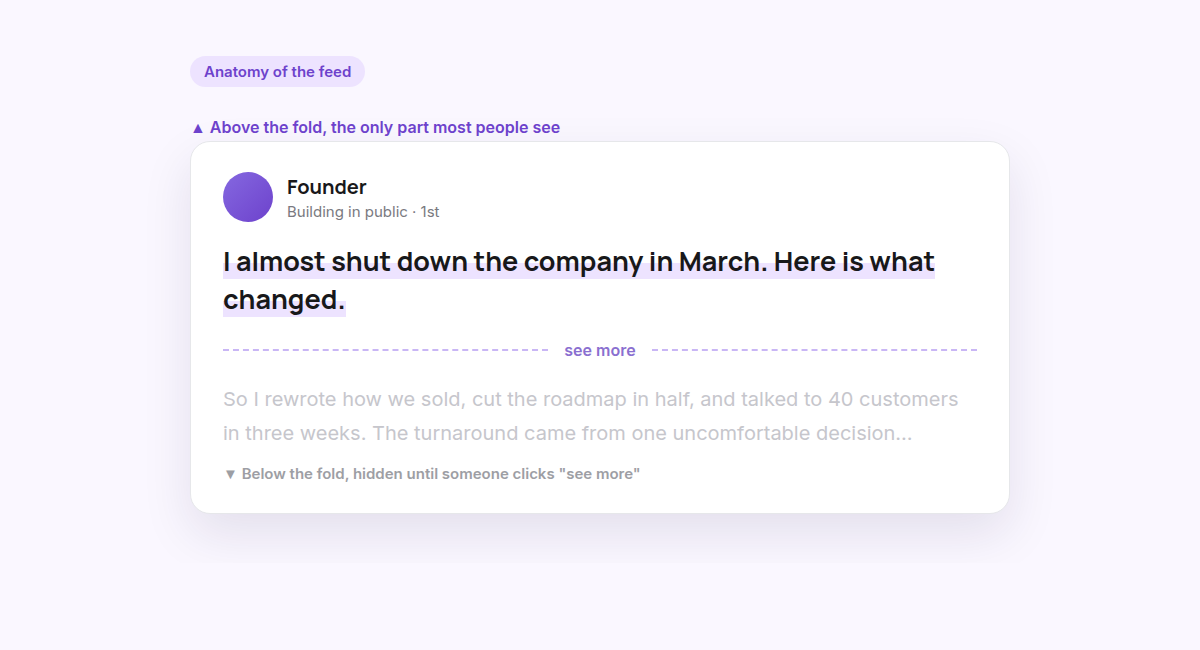
The "see more" line: why the first ~140 characters do all the work
The visible portion before truncation is roughly 140 characters on most devices. Everything that matters, the tension, the promise, the reason to keep reading, has to live above that fold. Treat the first line as the whole ad and the rest of the post as the landing page.
Hook vs headline vs first comment
A headline sits on an article. A first comment is where you place a link so it does not sit in the post body above the fold. A hook is the opening line of the post itself. They are three different jobs, and only the hook decides whether the feed stops scrolling.
What a hook is not
A hook is not clickbait. Clickbait promises something the post never pays off, which trains your audience to scroll past you next time. A good hook makes a specific promise and then keeps it in the body.
Why LinkedIn® hooks decide your reach
Reach on LinkedIn® is decided early. The feed watches how people respond to your post in its first stretch of life and uses that signal to decide how widely to show it. A weak opener gets a weak early response, and the post quietly dies.
The scroll-stop test and the dwell-time signal
When someone pauses on your post, that dwell time is a quality signal. The hook is what buys that pause. If the first line reads like a warm-up, the reader keeps scrolling and you never earn the dwell.
Early engagement and the first 60 to 90 minutes
Many practitioners observe that the first 60 to 90 minutes after posting tend to matter most for early engagement, though LinkedIn® has not published an official window and we treat this as a working convention rather than a fixed rule. The practical takeaway holds either way: a stronger hook earns faster early engagement, and faster early engagement helps the post travel.
Shorter posts, sharper openers
Posts are trending shorter. AuthoredUp's analysis of 621,833 posts found that 800 to 1,000 characters is the current sweet spot (AuthoredUp, Algorithm Insights 2024). When the whole post is tighter, the opener has to carry even more weight than it used to. AuthoredUp also found that save and repost are now among the strongest drivers of reach, which rewards openers that set up genuinely useful, save-worthy content.
The anatomy of a high-performing hook
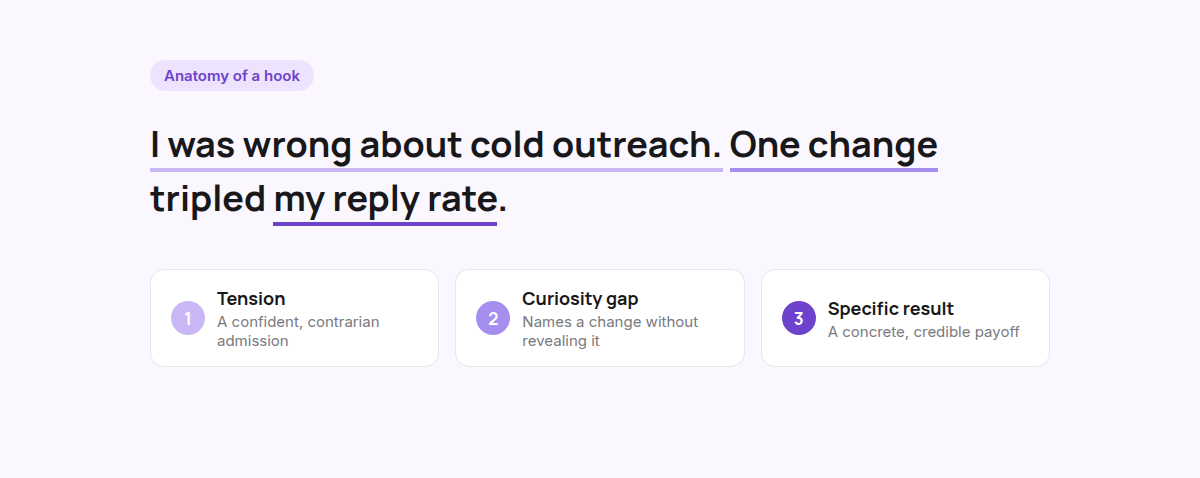
The curiosity gap
Open a loop the reader needs closed. Say enough to create a question in their head, and hold the answer for the body. "I almost shut down the company in March. Here is what changed." makes you want the rest.
Specificity beats cleverness
Numbers, names, and concrete stakes outperform clever wordplay. "We closed a 12,000 dollar deal from a comment" beats "engagement really pays off."
Tension or stakes in line one
Put something at risk in the opener: a cost, a mistake, a contrarian stance. Tension is what makes a reader stop.
The one-idea rule
Never bury the hook under a preamble. One idea, one line. If your real hook is the second sentence, delete the first.
Line breaks and the visual shape
White space is part of the hook. A short first line with a break beneath it looks easy to read, which itself invites the click.
12 LinkedIn® hook formulas (with templates)
- The contrarian take: "Everyone says X. They are wrong."
- The specific-result story: "I did X and Y happened in Z days."
- The confession: "I almost [failure]. Here is what changed."
- The "I was wrong" open: "I was wrong about X. Completely."
- The listicle promise: "7 things I wish I knew before X."
- The bold claim: "In 18 months, X will be true. Here is why."
- The direct question: "What if your best post is the one you are scared to publish?" (use sparingly)
- The how-to promise: "How to X without Y."
- The pattern interrupt: "Stop doing X."
- The surprising stat: "[Number]. That single figure changes how you should post."
- The insider open: "Here is what nobody tells you about X."
- The before/after: "18 months ago I had X. Here is what changed."
100+ LinkedIn® hook examples by category
Swipe these openers and adapt them to your own story. Each is kept under roughly 140 characters so it doubles as a "see more" demonstration.
Contrarian / myth-busting
- "Posting daily on LinkedIn® is terrible advice for most founders."
- "Your 'authentic' morning-routine post is why nobody engages."
- "Engagement pods do not grow your reach. They quietly shrink it."
- "Hashtags are not helping you. They have not for a while."
- "The advice to 'just be consistent' is why most people quit."
- "Consistency is overrated if every post sounds the same."
- "Going viral once will do less for you than 50 useful posts."
- "You do not have a reach problem. You have a first-line problem."
- "Most 'personal brand' advice is just permission to sound fake."
Specific-result story
- "One post brought in 3 sales calls last week. Here is the exact structure."
- "I rewrote my headline once. Profile views went up 40% in a month."
- "We closed a 12,000 dollar deal from a comment. Not a DM. A comment."
- "Two sentences got me 4 inbound demos. I still cannot believe which two."
- "I posted less and grew faster. Here is the count that changed."
- "A 4-line post booked my calendar for two weeks. Here it is."
- "I changed one word in my call to action. Reply rate tripled."
- "300 followers, 3 clients. Reach is not the metric that pays."
- "My worst-written post got my best client. Here is why."
Confession / vulnerability
- "I almost shut down the company in March. Here is what changed."
- "I faked confidence for two years. It cost me more than the truth would have."
- "Nobody read my posts for 6 months. I kept every one of them up."
- "I lost my biggest client on a Tuesday. It was the best thing that happened."
- "I was embarrassed to post this. That is exactly why I am posting it."
- "I deleted 2 years of 'safe' posts. My reach thanked me."
- "The post I was sure would flop got me a keynote invite."
- "I have written 500 posts. I still feel sick before I hit publish."
- "I spent 3 years sounding like everyone else. Nobody remembered me."
Mistake / "I was wrong"
- "I was wrong about cold outreach. Completely."
- "For years I optimized the wrong metric. Do not repeat my mistake."
- "The advice I gave 200 founders was backwards. Let me fix it."
- "I built the feature nobody asked for. Twice."
- "I ignored LinkedIn® for a decade. That was a five-figure mistake."
- "I chased followers for a year. Revenue did not move once."
- "I hid my opinions to seem professional. It made me invisible."
- "I automated my engagement. It nearly got my account restricted."
- "I copied a viral template word for word. It bombed. Here is why."
Listicle promise
- "7 things I wish I knew before I posted my first LinkedIn® update."
- "5 hooks that outperformed everything else I wrote this year."
- "3 questions that turn a lurker into a lead."
- "6 sentences that do more than most cold emails."
- "4 posts I would delete if I could start over."
- "9 openers I stole from posts that stopped me mid-scroll."
- "4 things your best client wishes your posts said."
- "5 sentences that outperform a 30-line post every time."
- "3 edits that turn a boring update into a hook."
Bold claim / prediction
- "In 18 months, generic AI posts will get zero reach. Here is why."
- "Most LinkedIn® 'gurus' will be irrelevant by next year."
- "The next great B2B channel is already here. It is your comments section."
- "Personal brands will outsell company pages 10 to 1 this decade."
- "The era of the polished corporate post is ending. Good."
- "By 2027, 'I used AI to write this' will be a selling point, not an apology."
- "Comments will matter more than posts within a year."
- "The best salespeople this decade will look like teachers."
- "Your next 10 clients are already reading and not commenting."
Direct question (use sparingly)
- "What if your best post is the one you are too scared to publish?"
- "Why do your competitors get comments and you get silence?"
- "Is your LinkedIn® headline costing you clients right now?"
- "What would you post if you knew nobody could screenshot it?"
- "When did 'professional' start meaning 'forgettable'?"
- "What is the one post you keep drafting and never publishing?"
- "If your profile is a landing page, what is it converting?"
How-to / actionable
- "How to write a week of LinkedIn® posts in one 20-minute sitting."
- "How to turn one podcast into five posts without sounding repetitive."
- "How to open a post so people actually hit 'see more'."
- "How to get comments without begging for them in the caption."
- "How to sound like yourself when you let AI help you write."
- "How to find your voice when every tool wants you to sound the same."
- "How to write a hook before you write the post."
- "How to make a slow week of posting still count."
- "How to turn a client win into a post without bragging."
Pattern interrupt / one-liner
- "Stop ending posts with 'Thoughts?'"
- "Delete your first sentence. The second one is your real hook."
- "Nobody cares that you are 'excited to announce'."
- "Your intro is the reason no one reads your best paragraph."
- "Read your first line out loud. If you would not say it, cut it."
- "Write the boring version first. Then delete the boring parts."
- "Your hook is too long. Cut it in half. Now cut it again."
- "One idea per post. That is the whole strategy."
- "If it could be anyone's post, it is nobody's."
Data / surprising stat
- "800 to 1,000 characters. That is the length that wins now."
- "Most posts get their reach decided in the first hour or two."
- "Save and repost now drive more reach than likes do. That changes everything."
- "One number on your profile decides half your inbound. Guess which."
- "The average post is read for seconds. The great one earns minutes."
- "Links in the body still cost you reach. Put them in the comments."
- "Your first 60 minutes decide the next 6 days of reach."
- "Shorter posts are winning. Your intro just got more important."
- "The feed reads your first line before your audience does."
Insider / "nobody tells you"
- "Here is what nobody tells you about going viral: it is mostly the first line."
- "The ghostwriters charging 5,000 dollars a month use this one move."
- "There is a reason your best posts felt the easiest to write."
- "The quiet accounts booking calls are not posting more. They are posting sharper."
- "Most 'overnight' LinkedIn® wins took 200 boring posts first."
- "The best hooks are not clever. They are specific."
- "Every 'lucky' viral post had a boring first draft."
- "The accounts you envy are just braver in line one."
- "Nobody tells beginners this: your voice is the moat."
Before / after transformation
- "18 months ago I had 400 followers and no inbound. Here is what changed."
- "From invisible to 3 inbound leads a week. Same person, different opener."
- "I went from dreading Mondays to booking calls from them. One habit did it."
- "Zero comments to a full calendar in one quarter. No ads."
- "I stopped writing for everyone. My reach doubled."
- "I was posting into the void. One change filled my inbox."
- "From 'who is this?' to 'we have been following you' in a quarter."
- "Silent audience to 40 replies a post. Same me, sharper openers."
- "I stopped sounding like a brand. My leads went up."
How to write hooks in your own voice (not ChatGPT's)
The fastest way to sound like everyone else is to let a single "professional" template write your openers. The fix is not to write without help, it is to make the help sound like you.
Start from your own story, then compress
Write the messy version first: what actually happened, in your words. Then cut it down to one line that carries the tension. The compression is the craft.
Build a voice profile so AI drafts sound like you
Reepl trains a voice profile on your past LinkedIn® posts, so when it drafts openers they read like you rather than a generic tone. That is the difference between AI that flattens your voice and AI that amplifies it.
Generate, then score
Reepl's Copilot drafts multiple hook options from your voice profile, and the built-in virality checker scores each one so you can pick the strongest instead of guessing. You review and send every post yourself, nothing is auto-posted, so you keep full editorial control.
Keep a swipe file
When an opener stops you in the feed, save it. Your own swipe file of hooks that worked on you is the best training data for the ones you will write.
How to write a LinkedIn® hook in 5 steps
- Pick one specific reader and one specific tension they feel.
- Draft the payoff first so the promise is real, then write the opener that sets it up.
- Write five openers, not one. Use different formulas from the list above.
- Cut each to under 140 characters and read it against the "see more" fold.
- Score them, pick the sharpest, and make sure the body keeps the promise.
9 hook mistakes that kill reach
- Burying the hook after a warm-up sentence.
- Vague openers like "Excited to share" or "Thoughts?".
- Over-promising and under-delivering on the payoff.
- Putting an external link in the body above the fold.
- Leaning only on question hooks.
- Emoji-stuffed or all-caps openers.
- Writing for everyone, so no specific reader sees themselves in line one.
- Recycling the same three formulas until they go stale.
- Letting AI flatten your voice into a generic "professional" tone.
Generate hooks in your voice
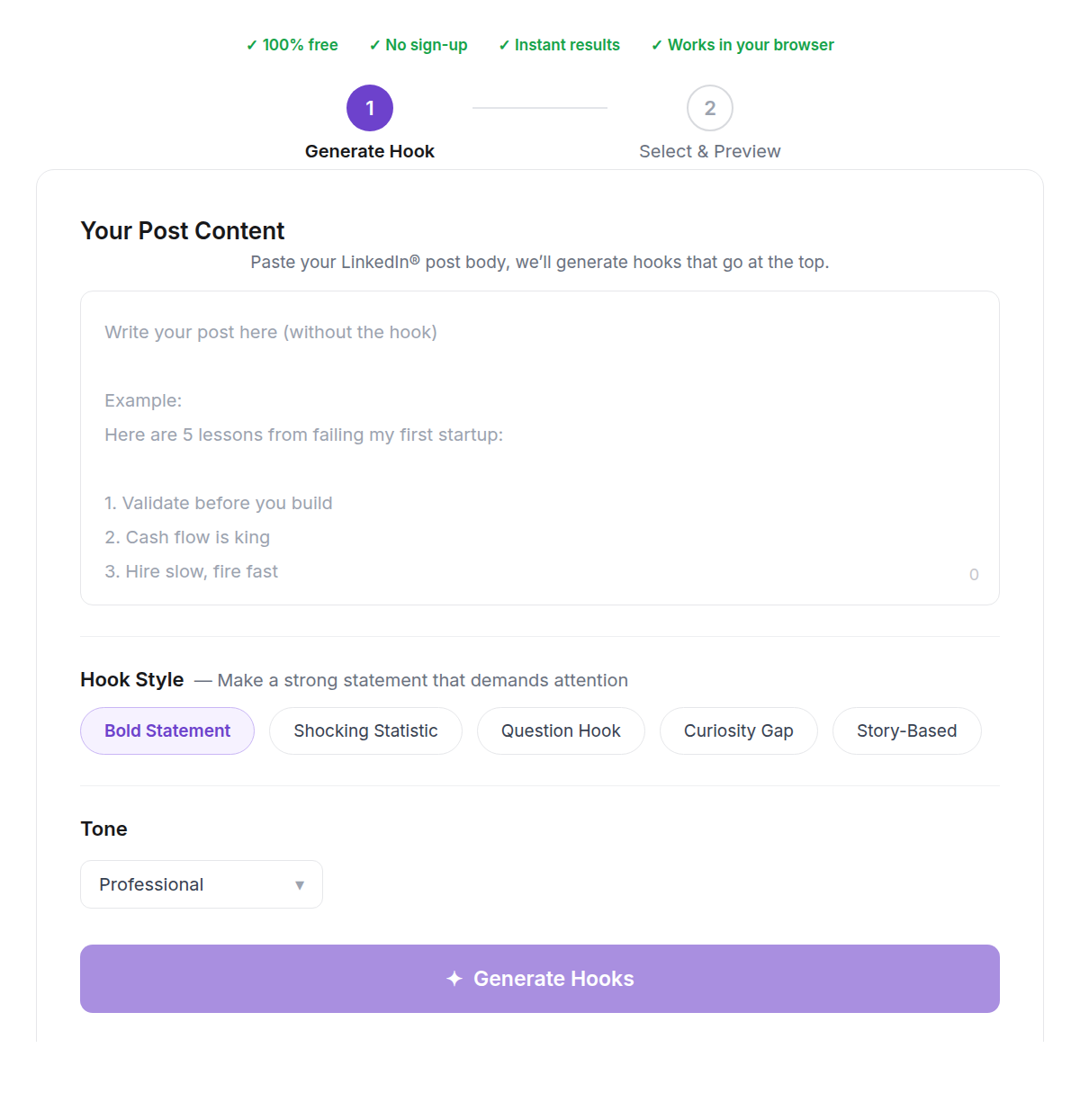
Stop guessing which opener works. The free Hook Generator writes hooks in your voice and scores each one for virality, so you pick the strongest and publish with confidence. Generate my hooks free.
Want every hook, post, and carousel to sound like you? Reepl trains on your past posts and keeps you in control of every send. Start free on Reepl.
Generate LinkedIn® hooks in your voice
Reepl drafts hooks in your voice and scores each one for virality. You pick and publish.