Use Reddit for customer research by starting with one decision, reading relevant communities, and logging what people say separately from what you think it means. Compare workarounds, look for counterexamples, and turn the patterns into better interview questions. Then test demand, budget and buying authority in interviews with people who agree to take part.
Key takeaways
- Start with one business decision, such as how independent instructors handle late cancellations, and look for evidence that could change it.
- Search for tasks, workarounds and alternatives, including spreadsheets and manual texts, as well as product names.
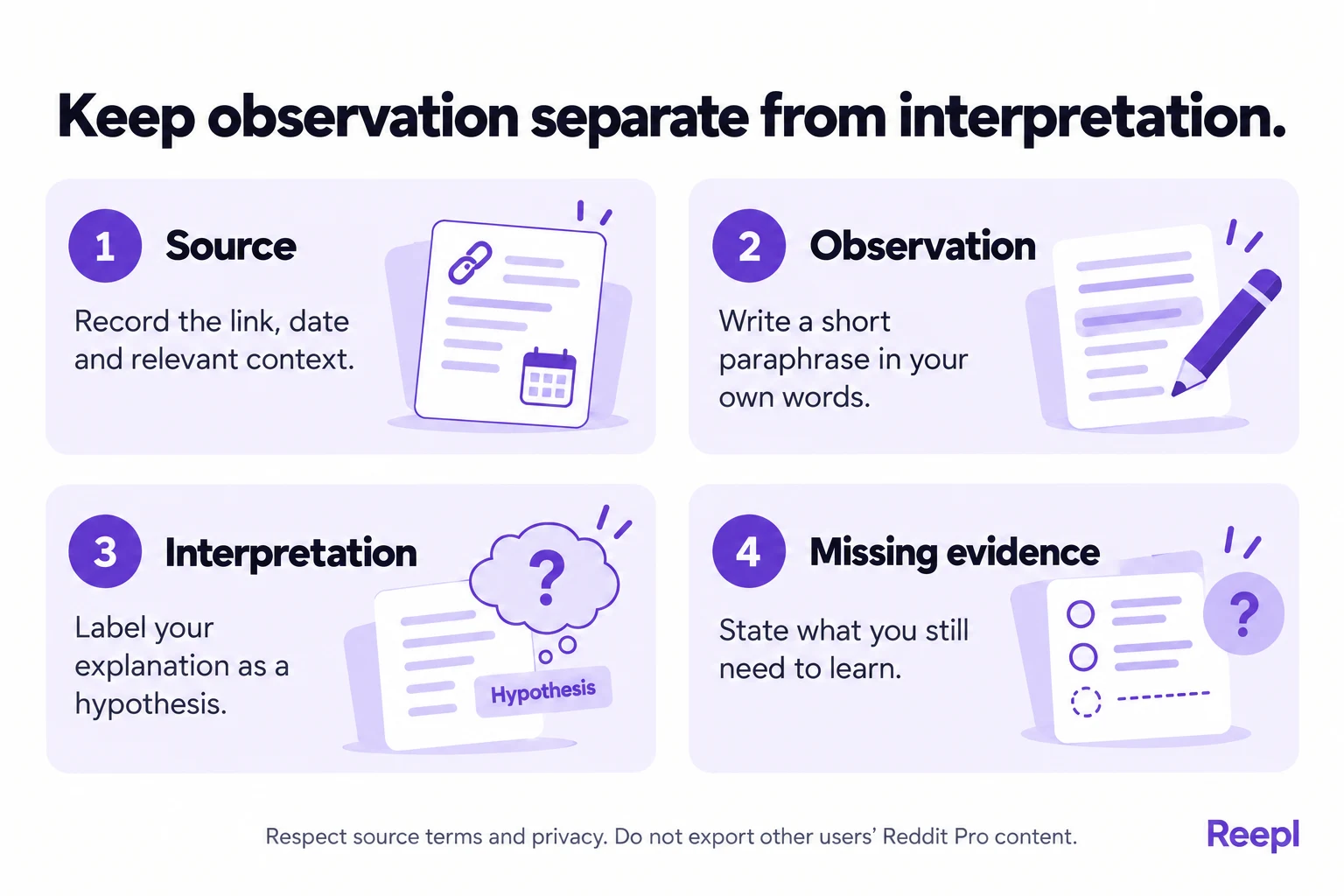
- Log each observation with its link, review date and context, and keep your interpretation in a separate field.
- Look for counterexamples, such as people satisfied with a simple calendar, before you call something a pattern.
- Reddit conversations shape interview questions; demand, budget and buying authority need interviews and other evidence.
What can Reddit tell you about your customers?
Reddit can help you understand how people describe a problem when they are talking to one another. That language can improve interview questions, explain unfamiliar workflows and reveal alternatives you would not have included in a competitive analysis.
A discussion about appointment scheduling might mention spreadsheets, reminder texts and asking an assistant to call people. Those are all possible alternatives to scheduling software. Looking only for named software competitors would miss part of the actual workflow.
However, someone complaining about a task might have no budget, no authority to buy and no interest in changing their approach. Even an enthusiastic reply to a product idea leaves those questions unanswered. Record those unknowns as questions for your interviews.
Reddit also reflects the particular people who choose to join particular communities. A highly visible thread is not a representative survey, and its participants may differ from the customers you intend to serve.
Use a conversation to identify a question worth investigating. For example, “People describe losing appointments when reminders are handled manually” can lead to an interview about reminder workflows. It cannot support “Most small businesses need our reminder product.”
What should you decide before searching?
Write down the business decision that the research should inform. A useful question is narrow enough that the evidence could change what you do next. “Understand small businesses” is too broad; “Understand how independent instructors handle late cancellations” is workable.
Specify the role, task and situation. An independent instructor arranging recurring lessons faces different constraints from a clinic handling urgent bookings. Both might discuss scheduling, but combining their problems too early can produce a product brief that fits neither.
Also record your current assumption. Perhaps you think instructors need more reminders. Put that assumption somewhere visible so you can notice when you search only for evidence supporting it. Include a competing explanation, such as unclear cancellation policies or unpredictable customer schedules.
Choose what would count as useful progress. You might want a clearer vocabulary list, a map of existing workarounds or questions for customer interviews. These are concrete research outputs. A large folder of saved posts is an activity record, not necessarily a useful result.
Set a time boundary for the first pass, such as one working session, and review what you learned before continuing. The right depth depends on the decision, the range of situations and the cost of being wrong.
Write the brief in six lines before you open a search box:
- Decision: [what you will do differently depending on the answer]
- Role and situation: [for example, independent instructors with recurring lessons]
- Current assumption: [what you believe now]
- Competing explanation: [another reason the same complaint could appear]
- Output wanted: [vocabulary list, workaround map or interview questions]
- Time box: [one session, then review]
How do you find relevant conversations?
Build searches from the task people perform, the difficulty they describe and the workaround they use. For appointment research, possible phrases include “late cancellation,” “reminder texts,” “booking spreadsheet” and “reschedule lessons.” These are illustrative searches, not verified popular queries.
Combine three parts into each search: [the task] plus [the difficulty] or [the workaround]. “Reschedule lessons spreadsheet” and “late cancellation policy text” each pair a task with a concrete detail. Swap one part at a time, and note which searches surface useful discussions.
Start with communities related to the work. Reddit's community discovery guide explains its Explore features, including topic-based and related-community discovery. Treat these as starting points: open each community and check who actually posts there.
Read a community's description, rules and recent discussions before interpreting a search result. The same complaint can mean something different in a professional forum, a hobby community or a place created primarily for venting. Context belongs beside the observation.
If you later ask the community a research question, make it appropriate to that space. Reddit's guidance on getting posts noticed recommends relevant communities and following their format and content rules. A research purpose does not exempt your question from those expectations.
Keep reading separate from recruiting. You can learn that a topic deserves further investigation without asking the original participant to become an interview subject. When you do seek participants, use a permitted method, explain the purpose and let people decide whether they want to take part.
Look for discussions about alternatives and situations where the problem does not occur. If you search only “scheduling frustration,” you will mostly collect frustration. Search for working approaches too, including people who are satisfied with manual methods or simple existing tools.
Reddit Pro is another distinct research option. Its Trends documentation describes keyword conversations and communities discussing those keywords. It also describes coverage limits, including excluded communities and currently English conversations. Never treat its results as a complete view of Reddit.
What should go in your research notes?
A useful note lets another person distinguish what you observed from what you inferred. Record the source link, the date you reviewed it, relevant context and a short paraphrase. Then place your interpretation and unanswered questions in separate fields.
Collect only the details that help the research question. You usually need the task and circumstances, not a user's identity or unrelated history. Public visibility does not make every piece of information appropriate to reproduce in a report or marketing asset.
Reddit's Reddiquette guidance emphasizes remembering the person, reading context and protecting personal information. Apply that spirit to research notes: capture what helps you understand the work without exposing people or turning them into prospect records.
If you use Reddit Pro, follow its specific restrictions. The Trends documentation says it is intended for internal use and limits publishing its information, screenshots and other users' content. It also prohibits downloading other users' posts and comments or other information displayed there.
So build your method around reading in place. Review conversations on Reddit and keep appropriately limited notes in your own words, consistent with applicable terms. For a published example, prefer an explicitly fictional scenario over reproducing someone's experience without permission.
Use this template for an individual observation:
Decision this research informs:
Source link and review date:
Relevant role, task and circumstances:
Observation, paraphrased in my own words:
Current workaround described:
Possible consequence of the problem:
My interpretation, labeled as a hypothesis:
Alternative explanation:
What I still need to ask:
Reuse or permission limits:
How do you turn a conversation into a research question?
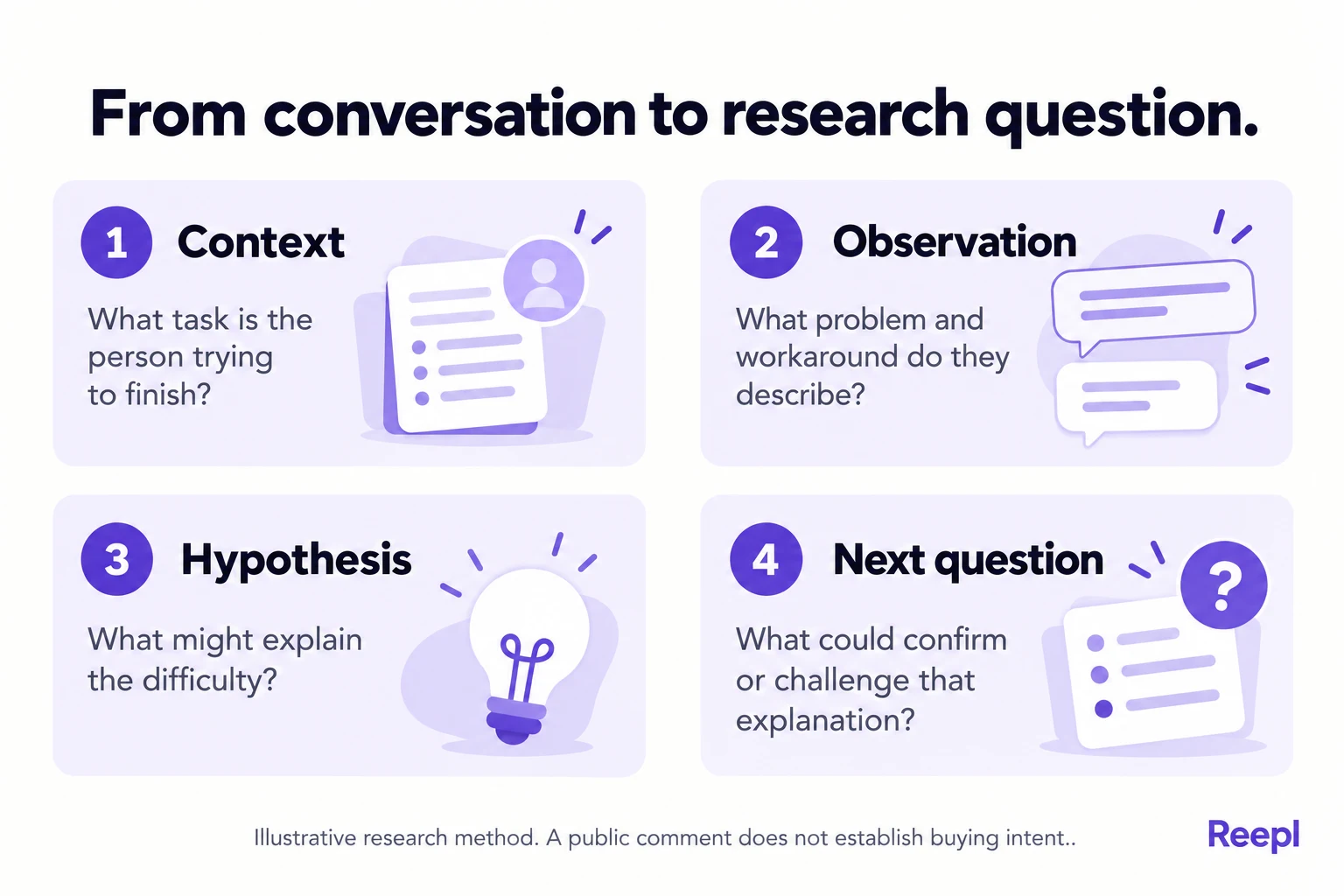
Move through four steps: context, observation, hypothesis and follow-up question. Each step should make the uncertainty clearer. Resist collapsing the sequence into “a person complained, therefore we should build this feature.” That removes the part research is supposed to investigate.
Suppose an instructor describes sending reminder texts manually. The observation is that reminders require manual work. Your hypothesis might be that this work is costly enough to change. An alternative is that manual messages are quick and help maintain a personal relationship.
A useful interview question would be, “Walk me through what happens before a lesson.” Follow with questions about the last time someone missed an appointment, what the instructor did and what consequences followed. Ask about actual experience before presenting a solution.
Avoid leading questions such as “Would automatic reminders save you lots of time?” They introduce both your proposed feature and its supposed benefit. A respondent can agree politely without telling you whether the problem matters or how they currently solve it.
If you want to recruit participants through Reddit, first check whether that community allows research requests. Reddit's Spam policy covers repeated or unsolicited actions, including mass messages. Finding someone with a problem does not grant permission to contact them repeatedly.
How do you recognize a pattern without exaggerating it?
A pattern is a recurring observation across relevant contexts, not simply a memorable comment with many votes. Write down what appears to repeat and what varies. Keep separate categories when different roles, circumstances or consequences could explain the same wording.
For example, “reminders are difficult” could refer to remembering to send them, choosing suitable wording or managing replies. Those are different problems. A single category called “needs automation” would hide the distinction and prematurely select a solution.
Look for counterexamples deliberately. A person who uses a calendar and finds it sufficient can teach you about the conditions under which a new product is unnecessary. That may help you narrow the audience or avoid competing against an adequate free workflow.
Report what your reviewed material suggested, with your method, and leave market percentages out. You chose the people, communities and search terms, so the collection is a convenience sample.
Finish the synthesis with decisions and questions. Which assumption became less convincing? Which situation deserves an interview? What evidence would justify changing a feature priority? The practical value comes from improving the next investigation, not making the current notes sound conclusive.
What would this look like in a small business example?
Consider an illustrative founder exploring scheduling software for independent music teachers. The founder starts with an assumption: teachers want automatic reminders. Instead of asking Reddit to validate the feature, the founder reviews discussions about bookings, cancellations and recurring lessons.
Imagine the notes reveal several possible issues: students forget lessons, parents request changes through different channels and teachers disagree about cancellation policies. These are fictional observations for the example. They are not findings from a study or testimonials from actual Reddit users.
The founder separates the issues instead of filing them all under reminders. Forgetting an appointment might call for a reminder. Conflicting rescheduling requests might require a shared record. Disagreement about fees might need a clearer policy and no new software at all.
The next interviews therefore examine recent cancellations from beginning to end. The founder asks which tools were used, who communicated with whom and where the process became difficult. Product ideas wait until the existing workflow is understood well enough to evaluate them.
The research output is a revised interview guide and a narrower set of assumptions. The founder has reduced confusion about what to ask next, which is useful progress on its own.
How do you code observations without losing their context?
Coding is assigning a short descriptive label to a research observation so related observations can be compared. Start with labels for the task, obstacle and workaround. Avoid labels that name your preferred solution before you have understood the problem.
For the illustrative music-teacher research, “rescheduling across channels” is a better initial label than “needs scheduling automation.” The first describes the work. The second assumes what should be built. You might later discover that a clearer policy or a shared family calendar solves the difficulty adequately.
| Fictional observation | Descriptive code | Question still open |
|---|---|---|
| Parent changes a lesson by text while the teacher uses email | Schedule changes across channels | How is the final time confirmed? |
| Teacher sends a personal reminder before each lesson | Manual reminder routine | Is the routine burdensome or valued? |
| Student disputes a late-cancellation charge | Policy understanding | When was the policy explained? |
| Teacher reports no problems with a simple calendar | Adequate existing workaround | Which conditions make it sufficient? |
Keep the original context beside the code in your own appropriately limited notes. A reminder sent to an adult student is different from coordination among a teacher, parent and child. Combining those cases may erase the very distinction that should guide your research.
Revise the code list when new context changes your interpretation. If “missed reminders” includes both messages never sent and messages ignored, split it. Preserve the earlier interpretation in a brief note when it affected a decision. The point is to improve understanding, not defend the first categories you created.
If another teammate reviews the material, compare interpretations before combining notes. Disagreement can expose an ambiguous observation or an assumption hidden in the label. Resolve the ambiguity with a better question in the next interview.
How do you turn notes into an interview plan?
Translate each promising observation into an open question about a recent real event. The interview should investigate what people did, what constraints they faced and what consequences followed. Avoid starting with whether they like your proposed feature.
For rescheduling, begin with “Tell me about the last lesson that had to move.” Follow the sequence: who requested the change, where the request arrived, how availability was checked, who confirmed it and what was recorded. Ask for context when an answer uses a broad word such as difficult or frustrating.
Then explore the current workaround. Ask what the person would lose if they stopped using it. A manual message may be useful because it expresses care or allows a sensitive conversation. If you record only time spent, you may miss the benefit that makes the workaround hard to replace.
Separate user and buyer questions. A teacher may experience the scheduling issue while a studio manager chooses and pays for software. Reddit conversations can suggest those roles, but interviews need to establish them. Ask how a similar purchase was approved last time to learn who controls the budget.
Seek permission through a community-approved route if you recruit there. The Reddit Rules require authentic participation and respect for community rules. A business research objective does not create an exception. Make your role and purpose clear. If someone stays silent, leave it there; silence is no invitation to send reminders.
Finish with a question about what you misunderstood. “What would someone outside this work get wrong about the process?” can reveal context your initial searches missed. Keep the interview plan flexible enough to follow that answer instead of pushing the conversation back toward the original feature idea.
When is Reddit research insufficient for a product decision?
Reddit research is insufficient when the decision depends on evidence the conversations cannot supply. Pricing, representative prevalence, legal constraints and procurement behavior usually require additional investigation. A coherent story assembled from comments can still be wrong about the business you intend to build.
Use a decision table in your research brief. Discussion vocabulary may be a useful input when the decision is which words to test on a landing page. When the decision is whether to hire a team to build a new product, you need much more evidence about demand, alternatives, feasibility and purchasing conditions.
| Decision | What Reddit conversations can add | What else you need |
|---|---|---|
| Which words to test on a landing page | The vocabulary people use for the problem | A test on the page itself |
| Which situations to explore in interviews | A first map of roles, tasks and workarounds | Interviews with people who agree to take part |
| What to charge | Little beyond mentions of current tools | Pricing conversations and tests |
| Whether to build a new product | Early context and competing hypotheses | Evidence on demand, alternatives, feasibility and purchasing |
Track where the material is missing. A community may discuss personal workflows while your product targets enterprise teams. Search results may favor dramatic complaints over ordinary days. Reddit Pro's documented coverage limits add another boundary if you use that product. A problem missing from your results may still exist in the market.
An illustrative synthesis could say: “Our reviewed conversations suggest that schedule changes across channels deserve investigation. We have not yet learned how often this affects independent music teachers, whether they would pay to change it or whether existing calendars are sufficient.” That statement is narrower than “Research validates our product,” but it creates a clear next step.
Define a stopping rule for the discovery pass. Stop when you can explain the main competing hypotheses and design the next investigation, or when the material is too remote from the audience to be useful. Endless reading can feel productive while delaying the interviews or prototype work the decision actually needs.
Keep a brief record of what changed in your plan. Perhaps you abandoned a reminder feature, narrowed the target audience or rewrote the interview guide. Those are legitimate research outcomes. The value is a better decision, and deciding not to build counts.
Where can Reepl help with the research routine?
Reepl is an AI writing platform that puts your social media on autopilot in your own voice: it finds what to post about, drafts your posts, and keeps your calendar full, and you decide how much it does without asking. As of October 2026, Signals requires Pro or higher and can use Reddit sources you choose when your Reddit account is connected.
That can help you notice discussions worth reading, but you remain responsible for evaluating the source and its relevance. A surfaced discussion is an input to judgment. It does not certify a customer need, provide a representative sample or establish permission to reuse someone's words.
Keep your research decision separate from the pressure to publish something. Sometimes the right result is a better interview question or a discarded assumption. Not every conversation needs to become a post, a product mention or an outreach opportunity.
Continue with our guides to choosing relevant subreddits and turning observations into useful content ideas.
Put your next idea into words
Draft in your voice, review the details, and choose what to publish.