LinkedIn® ranks a personalized feed for each viewer. Its published engineering work describes retrieving candidate posts, then ranking them against several objectives, including active interactions and passive reading. To work with that, make each post clearly relevant to a specific professional reader, deliver the answer it promises, and test one change at a time.
Key takeaways
- The feed is ranked per viewer, so the same post can be highly relevant to one reader and irrelevant to another.
- LinkedIn®'s October 2024 engineering article describes a two-pass funnel (candidate retrieval, then ranking) with multiple objectives, and it gives no public points table for reactions or comments.
- Passive reading is one of the behaviors that article discusses, so a reader who never reacts is not necessarily invisible to the system.
- Test one variable at a time with a written hypothesis and a fixed observation window, and use the result to guide your own decisions.
- Track relevant questions, inquiries, and conversations next to impressions, because impressions alone cannot show whether a post helped the right reader.
What do we actually know about the algorithm?
We know selected mechanisms from platform documentation, but not the complete current model or its weights. This October 2026 guide uses dated primary sources and labels our own recommendations as editorial, so you can see which is which.
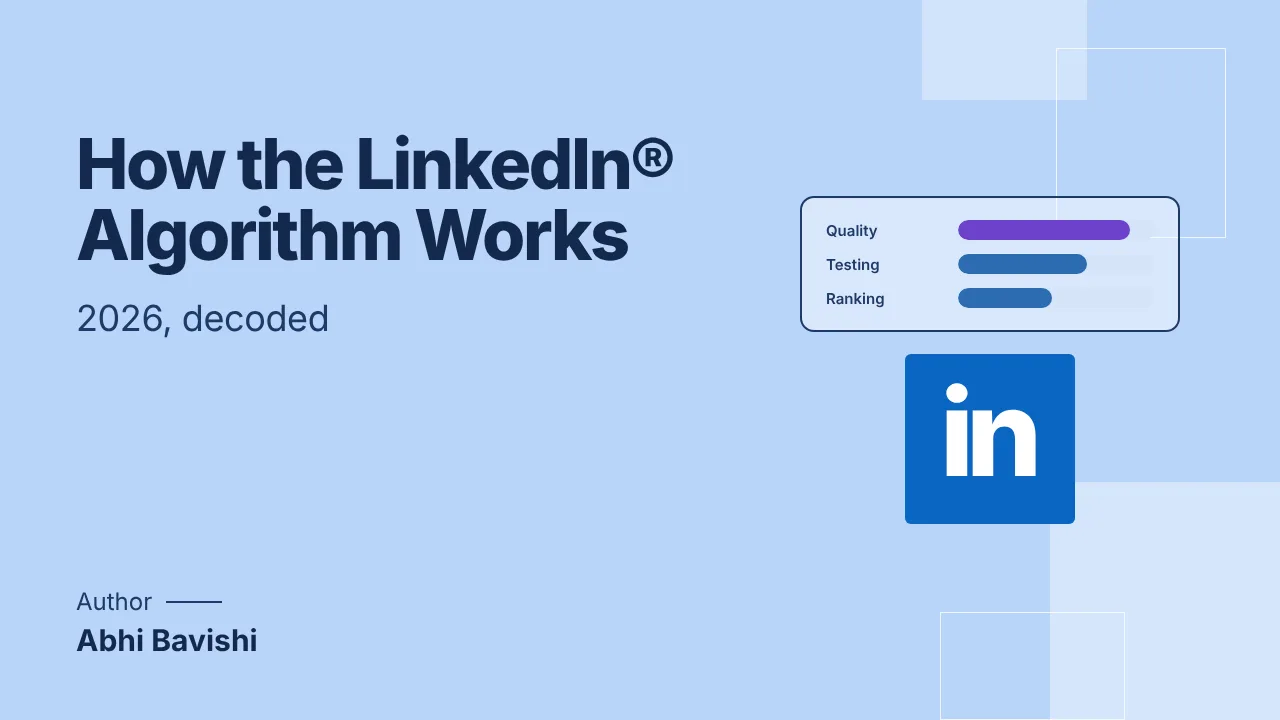
The most useful technical source is the platform's October 2024 engineering article on dwell time. It describes a two-pass funnel: first-pass systems retrieve candidate updates, then a second-pass system ranks candidates together. Candidate sources include content from a member's network and out-of-network recommendations.
That architecture differs from the popular story that every post passes through a fixed quality test, a golden-hour test, and then a universal expansion stage. Such stories can be teaching shortcuts. The cited source does not support the precise time windows and engagement weights they attach, so treat each one as a hypothesis you can test on your own posts.
The engineering article describes a multi-objective framework that balances viewer value, downstream effects, and creator feedback. It also discusses passive and active behavior. A viewer who reads carefully without reacting is therefore not necessarily invisible to the system. A creator looking only at public likes has an incomplete picture of consumption.
The practical implication is modest but useful: make your post relevant to a recognizable professional problem, deliver the promised answer, and give readers a reason to stay because the material helps them. Skip artificial delays, oversized introductions, and forced suspense added to increase time on screen. The same engineering article explicitly discusses limiting clickbait and dwell bait.
How does candidate retrieval affect who sees your post?
Candidate retrieval determines which possible updates enter a viewer's ranking process. Ranking then compares those candidates for that viewer. This is why “the algorithm likes my account” is less useful than “which readers could find this topic relevant?”
Imagine an illustrative fractional CFO writing about monthly cash reviews. The post may be relevant to a founder preparing for a board meeting, less relevant to someone looking for graduate jobs, and occasionally useful to a finance lead outside the author's network. The content has not changed; the viewer's context has.
You cannot directly control candidate retrieval. You can make the subject legible. Use the terms your intended readers use, describe their decision, and connect your example to professional work. A vague opening such as “Everything changed last week” provides little context until the reader invests more effort. “We named one owner for every line in the cash forecast” gives a clearer reason to continue, if that statement is true.
Your profile can help a person understand why you are discussing the topic. The platform's profile guidance recommends a representative headline, About section, and relevant experience. Treat that as a reader-trust step: a clear headline tells a visitor why your post on this subject is worth reading.
Network quality also has a practical meaning beyond ranking. People who understand your subject can offer useful corrections and examples. Build those relationships through real work and relevant conversation. Accumulating unrelated contacts to enlarge a number may make your audience harder to understand even if the profile looks more popular.
Before drafting, finish this sentence: “This post helps a specific kind of professional make a specific decision.” If you cannot name either part, refine the idea before adjusting timing or formatting. Our founder post ideas guide provides a way to keep those decisions consistent across a series of posts.
What can comments, shares, and impressions tell you?
Visible interactions show what readers did, and that is useful on its own. A comment proves that someone commented. The weight assigned to that comment for each viewer, and whether it caused additional distribution, stay inside the model.
| Observation | What it can tell you | What it cannot prove |
|---|---|---|
| Relevant questions in comments | Readers recognized a problem and wanted more detail | A fixed ranking bonus per comment |
| A shared post | Someone chose to distribute the idea | A universal reach multiplier |
| High impressions with little response | The post was displayed but public response was limited | That nobody read or benefited from it |
| A useful inquiry after publication | The post may have contributed to a conversation | Sole attribution without asking the reader |
| A quiet opening followed by later responses | Attention developed over time | A secret delayed-distribution rule |
The dwell-time article explains why passive consumption deserves attention. It describes the limitations of universal thresholds and the use of normalization across attributes such as content type. That does not translate into “make every post longer.” A long video and a short text post naturally create different consumption patterns.
Work with the data your analytics actually show, because they may not expose the signals used inside ranking. Reading time estimated from word count is a planning tool, and it measures nothing about dwell time. A save, when visible in analytics, indicates a reader action; it does not tell you the reader's future behavior or the model's exact interpretation.
Read comments qualitatively. A detailed disagreement from a potential customer may be more useful to your business than broad praise from unrelated readers. That is a business judgment. Record the question and consider whether the next post should answer it.
If a post receives few comments but prompts informed conversations elsewhere, count those conversations. Some buyers avoid public discussion of operational problems. Ask how they found you and what they found useful, and log each answer in the same shape:
- Post: [link]
- Who: [their role, without a name]
- What they found useful: [their own words]
- What they asked next: [the follow-up question]
A few answers are context for your own account. Keep them as notes for the next post.
Do links, length, hashtags, and timing change reach?
Their effects depend on content, audience, purpose, and the comparison being made, so start from what helps the reader and test one question at a time on your own account. This table gives a starting point and a test for each choice:
| Choice | Start from | Test question |
|---|---|---|
| Links | Include the link where the reader needs it to verify a claim or finish the task. | Does a link in the post change qualified visits compared with your recent resource posts? |
| Length | Enough material to deliver the claim, and no more. | Does a complete short example get more relevant questions than a longer explainer? |
| Hashtags | Only terms that identify the subject for a reader. | Does removing labels change any metric you care about? |
| Timing | A slot when your readers are available and you can reply. | Does moving to [day and time] change relevant replies at the same checkpoint? |
For links, start with the reader's task. If the post explains a new regulation, links to the actual text help verification. If it invites a reader to use a worksheet, hiding the worksheet may add friction. The official Share documentation explicitly describes sharing URLs. That confirms link sharing is a supported publishing capability; how each placement affects your reach is a question for your own test.
For length, include enough material to deliver the claim and remove sentences that add nothing. A short operational lesson may need a single example. A nuanced comparison may need more room. Cutting essential qualifications to meet a supposed sweet spot can make a post misleading, while stretching a simple point wastes attention.
For hashtags, select terms only when they genuinely help identify the subject. Be wary of advice built on an exact hashtag count unless its source shows how it was measured. If a label adds nothing to the reader's understanding, remove it. The same editorial test applies to mentions: tag someone because they have a real connection to the discussion, never to borrow attention.
For timing, choose a slot when your intended readers are plausibly available and you can handle meaningful replies. A global audience will not share one working day. A schedule that fits your life is often more sustainable than chasing a generic chart that does not represent your buyers.
None of these choices compensates for an empty premise. Review the opening and supporting evidence first. A specific, useful post published at an imperfect time still gives a reader something to use. A generic post at an allegedly optimal minute remains generic.
How should you design an algorithm experiment?
Design the experiment around a decision you can actually make. “Does a direct link help people reach the worksheet?” is better than “Does the algorithm hate me?” The first question has a measurable behavior and an actionable result.
Choose one main variable. If you change the topic, format, time, length, and call to action together, you cannot tell which difference mattered. You also cannot recreate identical audiences across ordinary organic posts, so call the exercise a practical comparison: it is not a controlled platform experiment.
Write your hypothesis before publishing. For example: “A complete short example may lead to more relevant questions than a teaser that sends readers elsewhere.” State the audience, the outcome, and the comparison period. Use several comparable posts instead of treating one unusually successful item as a general law. Fill in this card before you publish:
- Decision: [what you will do differently if the result is clear]
- Variable: [the one thing you change]
- Hypothesis: [I expect this change to lead to more of this outcome for this reader]
- Comparison: [which recent posts, same format, same intended reader]
- Checkpoint: [when you collect results, kept the same for every post]
- Outside events: [launches, mentions, or reshares that happened in the window]
- Decision rule: [the result that makes you keep, drop, or retest the change]
Keep the observation window consistent. Comparing a new post with a week-old post creates a predictable measurement problem. Record when each result was collected. Save the post text as well as the metrics because an edit, a new image, or a changed link can affect what you are comparing.
Account for outside events. A product launch, conference mention, or large account sharing your post can alter exposure. Mark these observations and keep them in the log, even when they complicate the story. They may be useful business outcomes while being weak evidence for the specific variable you intended to test.
Decide in advance what would change your behavior. If putting the resource link in the body improves qualified visits while reducing impressions, you might keep it for resource posts. If the difference is unclear, keep the simpler reader experience and collect more observations. “No useful conclusion yet” is a valid result.
How can you tell whether an algorithm claim is worth testing?
Turn the claim into a prediction before changing your workflow. “The feed rewards expertise” is too broad to test directly from your own analytics. “Posts explaining a decision in my field prompt more relevant questions than broad motivational posts” is a narrower editorial hypothesis that your own results can answer.
Ask what evidence would contradict the claim. If a creator explains every strong result as confirmation and every weak result as an exception, the theory cannot help you make reliable decisions. Look for a defined comparison, a collection date, the accounts or formats included, and an explanation of unusual results. Missing details are a reason to withhold confidence, even when the advice sounds plausible.
Finally, consider the cost of being wrong. Trying a clearer opening on the next post is inexpensive and can improve comprehension independently of reach. Removing every useful source link, changing your entire subject, or buying a service to manufacture interactions has much larger consequences. Start with changes that serve readers even if the ranking hypothesis turns out to be false. Keep the original explanation in your decision log so later results cannot quietly rewrite what you thought you were testing.
What does a worked example look like?
Consider an illustrative fractional CFO who advises seed-stage founders. The CFO has a draft that opens, “The future of finance is strategic.” It ends with “Agree?” and offers no concrete example. The first improvement is the substance; format tricks come later, if at all.
A revised draft might read: “A cash forecast is unfinished when nobody owns the numbers in it. Before your next monthly review, assign one person to each line that can move your runway: payroll, your largest customer payment, and any annual renewal. If a line has no owner, another spreadsheet will not fix it. This approach is less useful in a cash emergency, where daily tracking may matter more than a monthly review.”
This is an illustrative teaching example, not a reported client outcome. It names a problem, gives a usable action, and states a limit. The reader does not need to click a link to understand the idea. A link to a fuller forecast template can still be included if it helps complete the task.
The CFO can compare this approach with another post that explains a different forecasting gap at a similar level of detail. The review asks whether intended readers recognized the issue, whether questions revealed confusion, and whether any inquiries mentioned the template.
Suppose the post gets fewer impressions than a personal story but more relevant questions. The appropriate conclusion is that the practical lesson served a different purpose. The personal story may build familiarity, while the lesson demonstrates judgment. Both can belong in a strategy without one being declared the algorithm's preferred format.
The next draft should answer the most useful unresolved question. If readers ask who should own the forecast in a two-person founding team, write that post. This creates a reason for a relevant audience to return. It also gives the CFO a source of ideas grounded in actual discussion, which copied viral formulas cannot supply.
What behavior should you avoid?
Avoid manufacturing activity, misleading readers, and treating platform rules as puzzles to evade. The Professional Community Policies prohibit artificial increases in engagement and prearranged agreements to like or reshare each other's content. A reciprocal arrangement is not made more authentic by carefully varying its wording.
The User Agreement separately addresses prohibited automated methods. Do not combine a writing workflow with software taking unrelated actions on other members and assume the entire package is authorized. Drafting assistance, authorized publishing, and engagement are distinct activities that require distinct scrutiny.
Avoid claiming the algorithm has definitively punished you because one post is quiet. Check the audience setting, publishing status, and any actual notices before inventing an account-level explanation. If you need a diagnostic sequence, our low-views troubleshooting guide starts with observable evidence.
Keep useful qualifications even when they weaken the hook. If your advice applies only to small service teams, say so. If your example is fictional, label it. A post that draws attention through a false premise can damage the professional trust that made publishing worthwhile in the first place.
AI assistance does not remove these responsibilities. Check facts, rewrite generic language, and remove invented experience. A draft should express your judgment, not manufacture authority you have not earned. The platform's authenticity policies apply to the published content regardless of how the draft was produced.
How do you build a useful review loop?
Review a small collection of comparable posts and decide what to keep, change, or investigate. Separate content quality, audience fit, distribution, and business outcomes. Mixing them into one score makes it difficult to diagnose why something worked.
For content quality, ask whether the post delivered a complete idea and whether anyone misunderstood it. For audience fit, inspect the professional relevance of responses. For distribution, compare impressions over a consistent observation window. For business outcomes, note inquiries, resource use, and conversations that the reader attributes to the post.
Keep a short decision log, one row per post:
| Field | What to write |
|---|---|
| Topic | [the reader problem the post answered] |
| Intended reader | [role and decision] |
| Evidence used | [source, example, or your own records] |
| Result | [the metric and responses at your checkpoint] |
| Uncertainty | [outside events, small sample, changed text] |
| Next action | [keep, change, or investigate] |
This protects you from rewriting your theory after every result. It also makes it easier to stop repeating a format whose apparent success comes from irrelevant attention.
A useful writing routine can reduce preparation time without pretending to predict reach. Reepl is an AI writing platform that puts your social media on autopilot in your own voice: it finds what to post about, drafts your posts, and keeps your calendar full, and you decide how much it does without asking. You still supply judgment and review the claims that matter.
The strongest next step is to choose one recurring reader problem and publish a complete answer supported by a concrete example. Record what happened, listen to the questions, and revise the next answer. That process works with the information you can observe. It does not require a secret formula to be valuable.
Make room for better writing
Build a writing routine with your voice and your review controls.