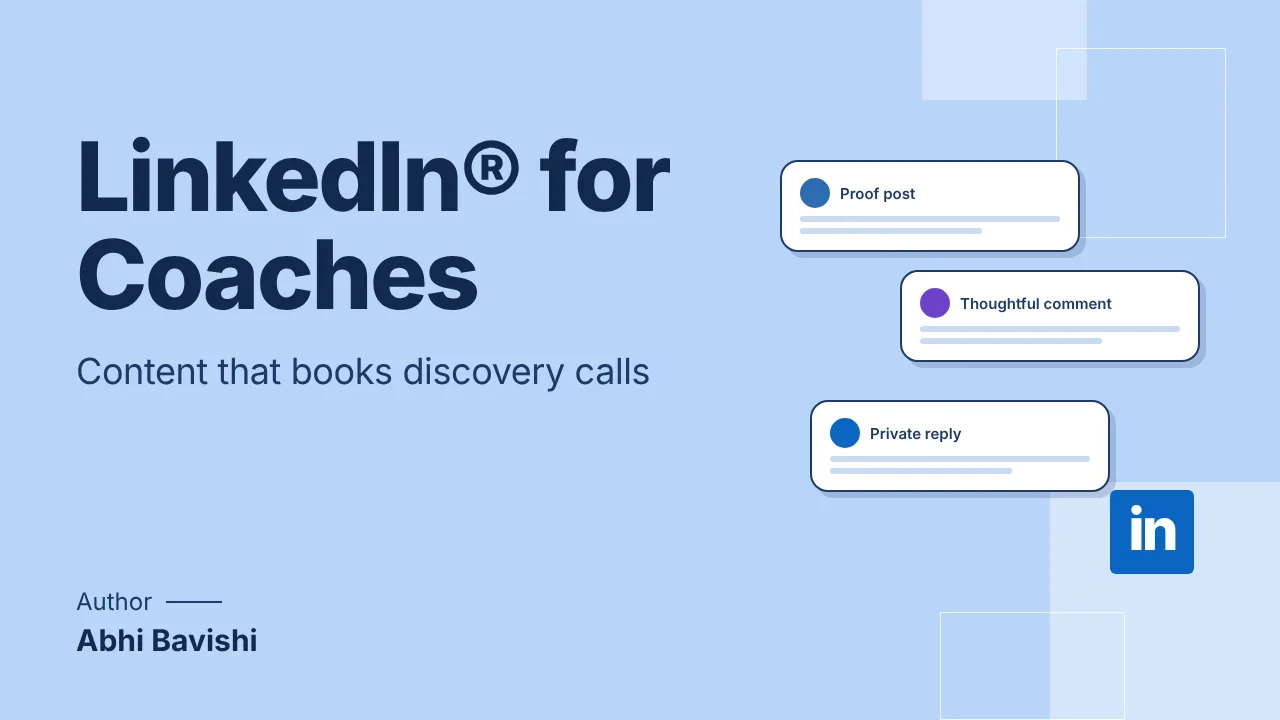
Coaches book suitable calls on LinkedIn® by showing their method at work: post anonymized patterns, frameworks applied to a fictional or permissioned situation, and honest limits, comment usefully on ideal clients' posts each day, then move to a private message only after a real signal and invite a call once, with an easy way to decline.
Key takeaways
- Proof for a coach is visible thinking: a pattern you keep seeing, a framework walked through a situation, a belief you changed, or what a first session looks like.
- Your headline, About section and Featured booking link carry the call to action, so individual posts can stay useful.
- A light weekly rhythm fits around sessions: two-minute notes after each session, a short daily comment block and a Friday review of who replied.
- The path from post to call stays manual: you notice a signal, reply privately with context, and invite once. Reepl can draft a reply, but you read it, change it and send it.
- Client stories need permission for the specific wording and channel, and a renamed client can still be recognizable, so fictional teaching scenarios are often the safer choice.
Most coaches fall into one of two extremes: silence, or a feed full of "DM me to learn more" pitches. The middle path below covers content, a weekly rhythm and the manual route from post to message to call, for business, executive, career and health coaches.
Why most coaching content never books a call
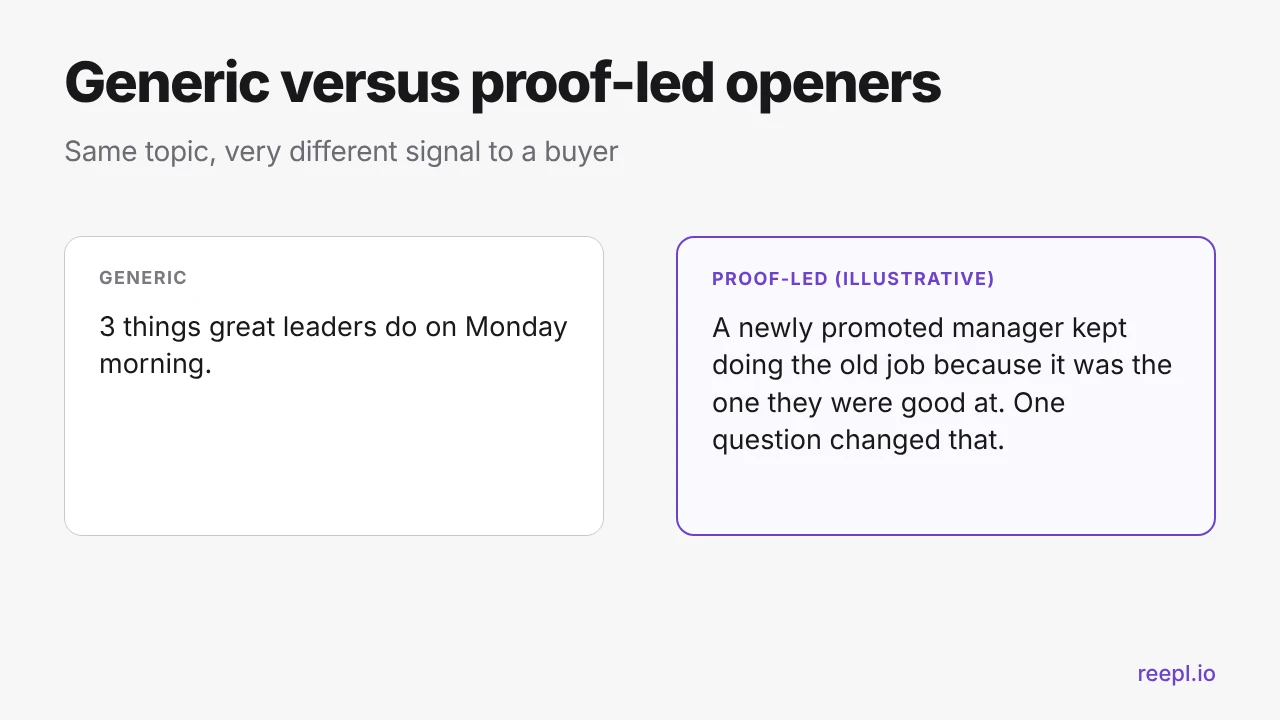
Most coaching content never books a call because it is interchangeable: a buyer reading it learns nothing about how you work. Open the feed and you will see the same coaching post again and again: "3 things great leaders do on Monday morning." It is accurate enough, and it gives the reader nothing to trust and nothing to act on.
Coaching is a high-trust purchase. A prospect is deciding whether to let you into their calendar, their team, or their habits. They are not shopping for tips. They are asking one question: "Does this person understand my situation, and can they help me move?" Content that books calls answers that question without announcing it.
Two other traps:
- Writing for other coaches. Write for the person who has the problem you solve.
- Counting followers instead of conversations. The metric that matters is how many relevant conversations you started this month.
Make your profile ready to receive the traffic
Every post and comment sends people to your profile, so fix that first. It multiplies everything below.
- Headline: say who you help and with what, in plain words. "Executive coach for first-time VPs moving from doing to leading" beats "Coach | Speaker | Author."
- About section: open with the problem your clients arrive with, not your credentials.
- Featured section: link your booking page or intake form here. This is where the call-to-action lives, so your posts can leave it out.
Proof-led content: show how you help without selling
Proof-led content shows your thinking in action. It does not claim results you cannot back up. It demonstrates the quality of your questions, the clarity of your frameworks, and what working with you is actually like. Here are five post types that do that.
1. The pattern post
Describe a pattern you keep seeing across client work, with identifying details removed. Readers see themselves in patterns. The permission rules in the client story section below apply to anything drawn from a real engagement.
An illustrative opener: “A pattern I keep seeing with new managers: in their first month, they take back the hardest task on the team. It feels like support. To the team, it can read as a vote of no confidence.”
2. The framework in use
Walk your framework through a situation instead of posting it as a graphic. Use a fictional or permissioned case: what the person believed, which question from the framework unlocked it, and what they decided to do next. The framework becomes proof because the reader watches it work.
3. The changed-mind post
Share something you used to advise and no longer do. It signals experience and honesty at once. "I used to tell every client to set quarterly goals. Now I ask a different question first" is a post people remember.
4. The session walkthrough
Prospects hesitate because they cannot picture the first call. Describe what happens in a first session: the questions you ask, what you do not do, what a person walks away with. Removing uncertainty is one of the most direct ways to make booking feel safe.
5. The honest limit
Say who you are not the right coach for. "If you want someone to hold you accountable by shouting, I am not your person" filters out poor fits and makes your real clients feel seen.
What proof looks like for different kinds of coach
The same five formats work across coaching niches, but the evidence differs. Match the proof to what your buyer worries about.
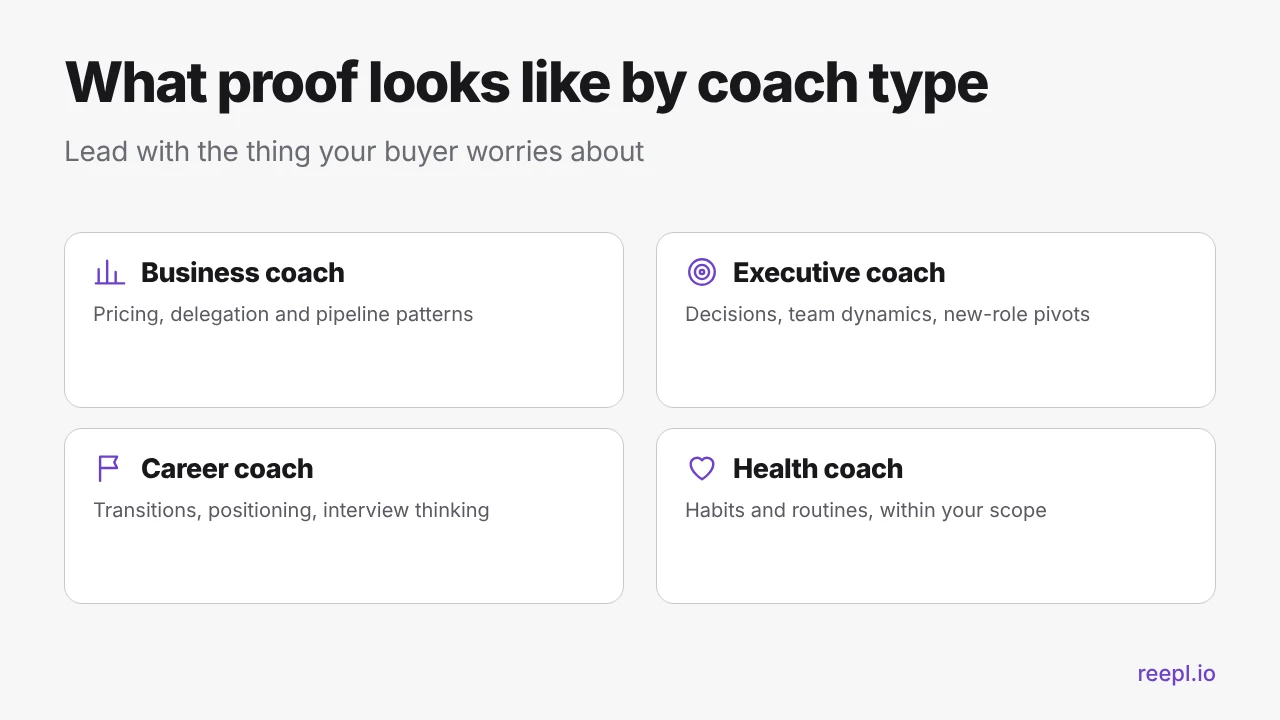
Health and wellness coaches should take extra care. Stay inside your scope of practice, follow your certifying body's guidance, and avoid promising medical outcomes. Process stories are safer than transformation claims.
A weekly rhythm that fits around client hours
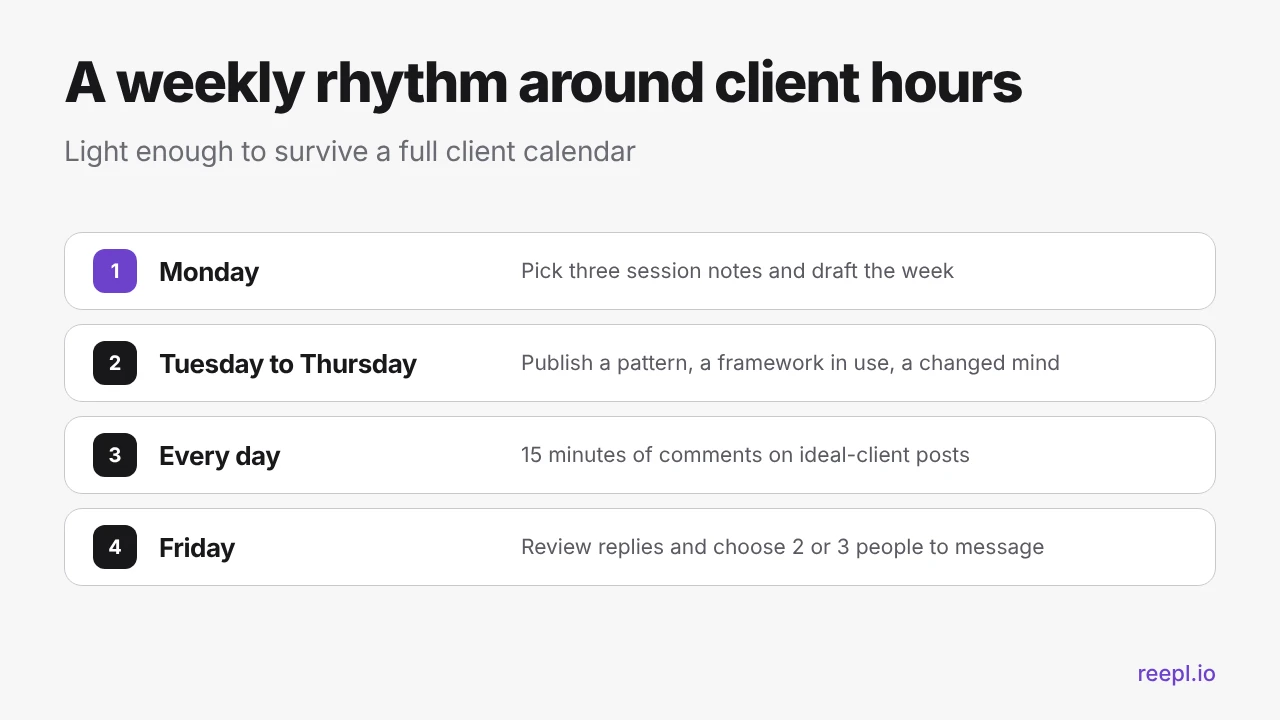
A coach's week needs three habits: capture notes right after sessions, comment in a short daily block, and review signals on Friday. Coaches rarely lack ideas. They lack protected time, because the best material arrives right when the next client is about to join the call.
For example, take a hypothetical executive coach with a solo practice serving newly promoted managers, with client sessions clustered on Tuesday to Thursday. Here is a routine that fits around that calendar:
| Day | LinkedIn® task | Suggested time |
|---|---|---|
| Monday | Turn last week's session notes into three post drafts and read each one against your scope | One hour |
| Tuesday to Thursday | Publish one post before the first session; do the comment block between sessions | 15 minutes a day for comments |
| After each session | Write the capture note before you open email | Two minutes |
| Friday | Review who commented and replied, then pick two or three people to message | 20 minutes |
Use the same capture note after every session, so anonymization happens at the moment you write:
- Pattern I noticed: [the situation, described without names]
- Question that landed: [the exact question you asked]
- Belief that shifted: [what the person thought before and after]
- Details removed: [role, employer type, timing, anything unusual]
- Usable as: [fictional teaching scenario, or needs specific permission]
Here is how each part works, whatever your calendar looks like:
- Capture right after sessions. Spend two minutes writing a note: the pattern you noticed, the question that landed, the belief that shifted. Remove names and details at the moment you write it. These notes are your raw material.
- Comment daily. A short block, ideally at a fixed time, replying on posts from ideal clients and referral partners. More on this below.
- Review on Friday. Look at who commented, who replied, and who you should message. Pick two or three people, not twenty.
Where can drafting assistance help a coach?
Reepl is an AI writing platform that puts your social media on autopilot in your own voice: it finds what to post about, drafts your posts, and keeps your calendar full, and you decide how much it does without asking.
For coaching content, use AI to organize a nonconfidential idea or refine an explanation. You supply the actual method, the limits of your practice, and the experience you are permitted to discuss. Read every draft for implied diagnoses, promises, and invented client details before approving it.
Reepl can help draft in your voice and schedule your own approved posts with you choosing the review settings. For comments and messages, Reepl drafts; you review, edit, and send. Keep sensitive session records out of drafting prompts unless your agreements and data handling permit that use. A public-safe summary is often enough.
Try the Hook Generator with a short explanation of your method, or use the hook examples to write the opening yourself. The goal is an accurate invitation to understand your work, not a stronger claim than the work supports.
Comments as discovery: where calls start before you post
Build a short list of 20 to 30 people worth watching: ideal clients, their leaders, HR and talent professionals who hire coaches, and advisers who could refer to you. Then spend 15 minutes a day adding something useful to their posts.
A strong comment does one of these things:
- Adds a distinction. "This works for teams under ten. Past that, the bottleneck is usually decision-making."
- Asks a real question. "How did you handle the first month, when the old habits were still easier?"
- Names what the author did well, specifically. Not "great post," but the exact move that worked.
The goal is to show how you think so that your name already means something later. For formulas and more examples, read our guide on writing meaningful LinkedIn® comments, or the wider LinkedIn® comment strategy.
The post-to-DM-to-call path, done by hand
Once content and comments warm people up, you need a calm way to move from public to private. Every step of this four-step path involves you.
Step 1: Publish something useful
Your proof-led posts and comments do the first job. No call to action in the post body is required.
Step 2: Notice a real signal
A signal is a specific, relevant human action: someone comments with their own situation, replies to your comment with a question, or says "this is exactly my team." A like is a weak signal. A comment that describes a problem you solve is a strong one.
Step 3: Reply privately, with context and no pitch
Reference what they said and add one useful thing. Ask permission before going further.
Your comment about managers who stay in the weeds stuck with me. I have been thinking about that exact problem this month. If it would be useful, I can share the three questions I ask clients to find where it starts. Want me to send them over?
That example is illustrative, not a template to paste. Rewrite it in your own words and about their actual comment. Reepl can draft a reply for you in a message thread, but you read it, change it, and send it.
Step 4: Invite once
If the conversation shows real need, offer a call once and make it easy to decline.
It sounds like this is live for you right now. If you want to talk it through, I keep a few discovery calls open each week. Here is my booking page. No pressure either way.
Share the link in the message, never in your public post. If there is no reply, one polite follow-up after a week or two is plenty.
Why this stays manual
The first message stays yours. Automated sequences are the fastest way to look like everyone else in a prospect's inbox. LinkedIn® prohibits unauthorized tools that scrape or automate activity, as its help page on automated activity explains, so there is account risk too. But the bigger cost is trust. A coach who sells attention and judgment cannot outsource the first hello to a script.
Measure conversations, not impressions
Measure a coach's LinkedIn® work by relevant conversations and suitable calls. Impressions tell you who saw a post; these three numbers tell you whether it is working:
- Relevant conversations started: private threads with people who fit your ideal client.
- Discovery calls booked: and how each person first found you, such as a post, a comment, or a referral.
- Which post types trigger replies: if pattern posts bring more useful comments than frameworks, write more of them.
Common mistakes to avoid
- Inventing or inflating proof. Never invent testimonials or round up results. If you cannot share an outcome, share your method.
- Presenting a fictional scenario as a client result. Label teaching scenarios as fictional and keep improvements out of them.
- Pitching in the first message. Start with relevance. The call is a later step.
- Stepping outside your scope. A post that reads like a diagnosis or a treatment plan attracts the wrong inquiries.
How do you show proof without exploiting a client story?
Show proof through your process, and share a client's story only with permission for that exact story. Show the quality of your process before showing somebody else’s vulnerability. Coaching often involves disclosures that a client would never expect to see repackaged as marketing. Permission should cover the particular story and proposed wording, not merely a general testimonial clause the client may have forgotten.
The International Coaching Federation Code of Ethics addresses confidentiality, agreements, accurate representation, and professional responsibilities. Its requirements apply to ICF professionals within its stated scope; it is not a universal legal rule for every person using the title coach. Use your own professional body’s rules and client agreements to decide what you can share.
Changing a name does not necessarily make a story anonymous. A role, unusual promotion, employer type, and recent timing can identify someone together. If those details are necessary to the lesson but cannot be shared, create an explicitly fictional teaching scenario. Explain the decision process without presenting a fictional improvement as an actual client result.
Testimonials introduce another question: what impression does the reader take away? The FTC’s endorsement guidance says endorsements must be honest and not misleading, and discusses material connections and atypical outcomes. For US-facing marketing, a glowing client quotation should not imply results you cannot substantiate. Other jurisdictions and regulated professions may have additional rules.
A practical permission record names the exact text, the channel, whether the client is identified, any image permission, and the approved use. Keep the approved version. If the story changes substantially, seek approval again. When permission is uncertain, publish a method explanation instead.
What does a complete coaching post look like?
The following is an illustrative post for an executive coach who works with newly promoted managers. It describes a fictional scenario and claims no client outcome. Adapt it only if the method reflects your actual practice.
“Your first management role changes what a good working day looks like. A full task list can feel productive while your team waits for decisions. Before taking back a difficult assignment, ask: what decision is the person missing, what support have we agreed, and when will we check progress? You stay responsible either way. The questions help distinguish a skill gap from an unclear handover. Use them as a reflection exercise when you keep rescuing work. Staffing gaps and urgent delivery risks still need their own fix.”
The opening names a recognizable transition. The body demonstrates the questions a coach might ask. The limitation protects the advice from being read as a rule to avoid helping a team. The post does not need a fabricated transformation, a private session transcript, or a claim that all managers have the same problem.
A suitable invitation could be: “If you are preparing for your first management role, my profile explains how an introductory conversation works.” That invitation is optional. A post that answers a genuine question can stand alone. If you include a booking link, make the destination and purpose clear, and keep it where readers need it whatever anyone promises about hidden links and reach.
Now compare a weaker version: “Stop rescuing your team and become the leader you were meant to be.” The statement assumes a diagnosis and supplies no method. Improving it requires more substance, not merely a warmer tone. Add the situation, the question, and the condition under which the advice fails.
How should you qualify a call without turning content into pressure?
Make the call’s purpose visible before someone books. State who the conversation is for, whether it is a fit assessment or a coaching session, what preparation is needed, and whether there is a fee. A prospect should not discover midway through the call that “free coaching” meant a sales presentation.
Use a short intake form that asks about the work situation and desired change. Avoid requesting unnecessary health, financial, or employer information. If the person discloses something outside your scope, explain the boundary and, where appropriate, suggest seeking a qualified professional. Content should not position coaching as a replacement for medical treatment, legal advice, or employer processes.
Follow the prospect’s pace in public conversations. A relevant comment is not consent to an ongoing sales sequence. The LinkedIn® Professional Community Policies prohibit unwanted promotional or repetitive messages. Continue publicly when the question can be answered publicly; ask before moving into a private exchange about a sensitive problem.
LinkedIn®’s guidance for AI-assisted content, reviewed in October 2026, asks members to preserve their perspective and review what they publish, which for a coach means checking that the draft shows your real approach and makes no unsupported claim about a client’s wellbeing.
Track the path with care. Note whether inquiries match your scope, whether booked calls attend, and whether the conversation is useful to both sides. Record declined fits as useful information about positioning. A month with fewer calls can still be better if fewer people arrive expecting a service outside your practice.
What should you do next?
LinkedIn® works for coaches when you treat it as a place to show your thinking. Write proof-led posts three times a week, spend 15 minutes a day adding to conversations your ideal clients are already having, and move to private messages only when someone gives you a real signal. Then invite once and make declining easy.
What should a coaching inquiry page clarify?
A coaching inquiry page should tell the person who you serve, what the first conversation is for, and what happens after it. Match it to the public content that brought them there. If the call is a fit assessment, say so instead of implying it is a complete coaching session.
Keep preparation proportionate. Ask for the context needed to make the conversation useful without inviting unnecessary sensitive disclosures. Let the person explain their situation in their own words. If the content suggested a narrow leadership transition but the form appears designed for therapy or broad life advice, the mismatch can create inappropriate expectations before you speak. Review the post, profile, and inquiry page together as one explanation of your service.
| Coaching context | Useful public explanation | Off limits |
|---|---|---|
| Career transition | How you help clarify role criteria and interview preparation. | Promising an offer, or revealing a client’s search. |
| Leadership transition | Questions for delegation and decision ownership. | Diagnosing a team from a public comment. |
| Business decisions | How you examine priorities and tradeoffs. | Implying guaranteed revenue from coaching. |
| Health-related habits | Your process within your actual qualifications. | Presenting coaching as medical diagnosis or treatment. |
Turn a useful idea into a clear draft
Bring your own context, review the draft, and keep the final wording yours.