LinkedIn® ranks each member’s feed with personalized predictions that use signals such as dwell time, comments and reshares, and the documentation cited here gives creators no complete formula or fixed weights. Write useful posts for a specific reader, then test one change at a time on comparable posts of your own to learn what works for your audience.
Key takeaways
- LinkedIn®’s October 2024 engineering article documents dwell time as a ranking input, using a normalized approach, and sets no universal number of seconds to hit.
- The feed ranks posts for each viewer, so the same post can be highly relevant to one reader and irrelevant to another. Write for a recognizable reader.
- Fixed comment multipliers, a universal link penalty, a single best hour and a required length all lack primary-source support. Treat each as a hypothesis to test.
- The Professional Community Policies prohibit agreeing in advance to like or reshare each other’s posts, so engagement swaps carry policy risk whatever they do for reach.
- Compare posts of the same type at the same checkpoint, change one thing at a time, and record substantive comments and inquiries next to impressions.
What does LinkedIn® actually document about ranking?
LinkedIn® feed ranking uses personalized predictions about relevance and member behavior. The engineering posts cited here describe parts of that system without giving fixed weights for comments, saves, links or post length, so read it as a description of mechanisms.
The strongest source for this guide is the platform’s October 2024 engineering article, Leveraging Dwell Time to Improve Member Experiences on the LinkedIn® Feed. It explains a two-pass architecture and several objectives used in ranking. It also explains why simple universal time thresholds were inadequate, which is very different from a creator checklist claiming that every post must pass the same timed test.
The policy and help pages cited here were consulted in October 2026, and their wording can change. The engineering article is older: it confirms the documented design at that time, and implementation details may have moved since. Where a current weight or threshold is not public, treat any number you see quoted as unverified.
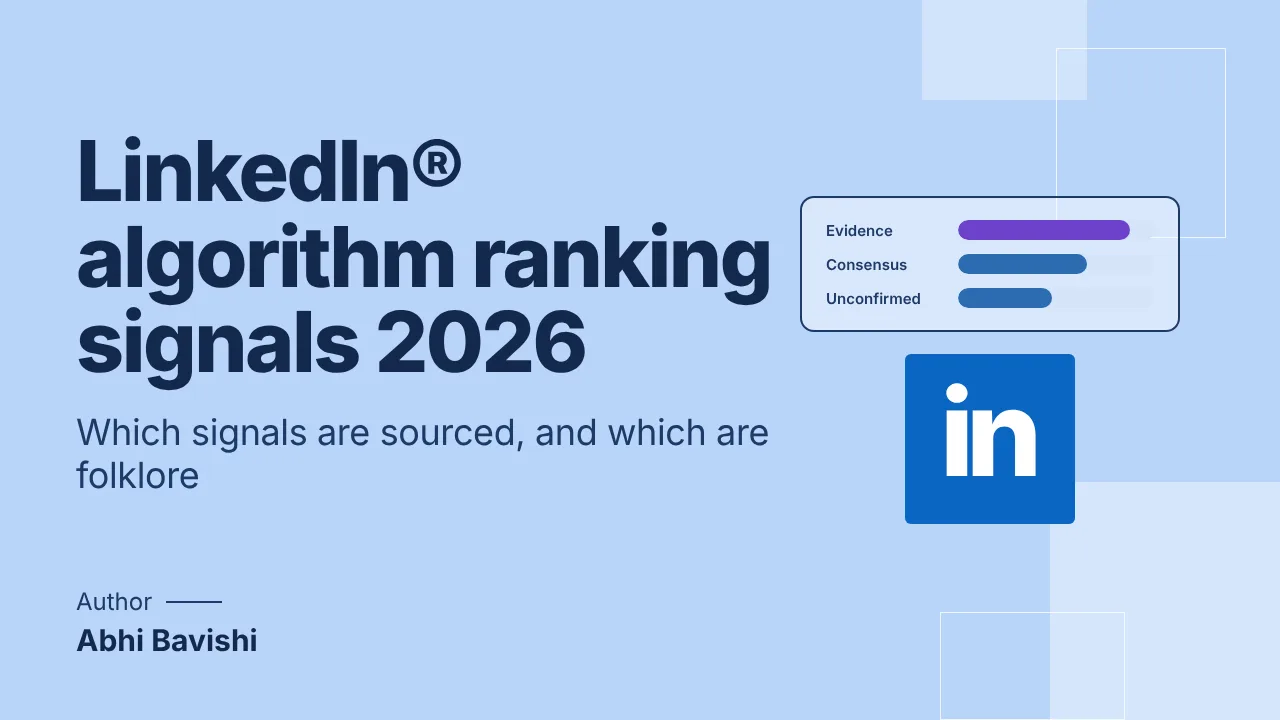
We ran no Reepl dataset study for this article, so it reports no measured reach. The suggestions are editorial recommendations based on the documented mechanisms and on sound measurement practice. Use them to choose better questions to test on your own account. The table sorts common claims by what the evidence supports:
| Claim | Evidence status | Practical implication |
|---|---|---|
| Dwell time contributes to ranking | Documented in the October 2024 engineering article. | Make the post useful to read, including for people who never react. |
| The feed ranks for individual viewers | Documented architecture and objectives. | Write for a recognizable reader and professional interest. |
| Every comment has a fixed value relative to a like | No fixed creator multiplier appears in these sources. | Plan from reader value; leave invented weights out of your strategy. |
| AI assistance alone creates a universal penalty | The AI help guidance states a quality distinction instead. | Evaluate substance, perspective and review. |
| One length or publishing hour wins everywhere | Absent from these primary sources. | Test your own audience and task. |
How does the documented ranking architecture work?
The October 2024 engineering description says the feed mainly uses a two-pass funnel. First-pass systems retrieve candidates, including content from a member’s network and out-of-network recommendations. A second pass ranks the accumulated candidates using multiple predictive objectives. The output is a personalized order for a particular viewer.
So a post has no single score shared by all readers. A useful technical explanation may be highly relevant to one professional and uninteresting to another. Your job is to make the subject and value clear to the intended reader; the context that decides distribution sits largely outside your control.
The article describes viewer-side objectives, downstream effects on the viewer’s network, and feedback value to creators. Active behaviors include comments and reshares; passive behaviors include clicks and dwell time. It gives no public table for adding those actions together into a reach forecast.
“Quality check, small test audience, wider distribution” can be a useful teaching model, and it is a simplification. The documented architecture is the two-pass funnel above. A teaching model becomes misleading once someone attaches precise minutes or audience thresholds to it.
For your next post, name the reader and the job the post helps them do. Fill in: “This post helps [role] who is [deciding or doing what] by [the one thing they learn].” A security engineer evaluating a migration needs different context from a founder approving the budget. You can explain the same event to both, and a single unclear opening that tries to serve both usually weakens the explanation.
What does dwell time mean for a writer?
For a writer, dwell time means making every paragraph worth the reader’s attention. Dwell time is the time a person spends viewing content before moving on. The engineering article explains how passive consumption helps the system learn from people who read without reacting, and it describes both predicted skipping and a normalized approach to longer dwell behavior.
The normalization matters. Different formats and distribution contexts have different time patterns, and the article explains that a fixed universal threshold can bias recommendations toward content types that naturally take longer to consume. Its approach tries to identify valuable attention within relevant categories, which is different from rewarding the longest possible post.
So skip padding, one-sentence-per-line formatting and a hidden answer. The same article discusses limiting clickbait and dwell bait, and reading time caused by confusion gives the reader nothing.
Use a paragraph check instead. For each paragraph, ask whether it does one of three jobs:
- It advances the reader’s task (a step, a decision, a reason).
- It shows an example of the point.
- It states a condition or exception that stops readers misusing the advice.
If a paragraph does none of them, cut it. A process post may need an example and an exception; a short announcement may need only the change and its consequence. Length follows the explanation required.
Your analytics do not show the platform’s internal dwell predictions, and dividing impressions by reactions measures something else. Judge a format’s usefulness through reader questions, relevant responses and the purpose of the post. Those observations support editorial decisions without revealing the ranking model.
What can reactions, comments, and reposts tell you?
Reactions, comments and reposts tell you how some readers responded, and only part of why the feed distributed the post. A post can receive many impressions before its comments arrive, and more distribution itself creates more chances for comments, so simple correlations are hard to read.
A substantive comment can reveal whether the audience understood the claim, noticed an exception or wants more detail. A repost can show that someone found the post worth sharing with their network. Neither converts into a predictable number of additional impressions.
Read the conversation before deciding a post succeeded. A controversial error can attract many corrections. A relevant buyer may quietly read an explanation and contact you later. If visible activity is your only target, those cases look backwards. Sort the comments on your last few posts into four groups:
- Questions: the reader wants more detail, a sign of a follow-up post.
- Corrections: something was unclear or wrong; fix it in the post.
- Additions: the reader brought an example or exception worth answering.
- Agreement only: pleasant, and the least informative of the four.
Invite discussion when a real question remains. For a decision guide, ask which constraint changes the recommendation in the reader’s situation. For a tutorial, ask where the process breaks down. Leave out demands for a keyword or a ceremonial “agree?” whose only job is to manufacture activity.
You can use the guide to meaningful comments to improve your replies. Reply when you have something to add, as you would in any professional conversation.
Are external links, timing, and post length ranking rules?
Treat all three as choices you make for the reader and test on your own posts. None appears as a rule in the LinkedIn® engineering or help documentation cited in this article. Third-party studies may describe patterns in their samples; before you use a benchmark, check what it measured and what it controlled.
A link changes the reader’s task. A post that summarizes a useful resource and gives its source differs from one that says little except “read this.” If the goal is visits to a research paper, a useful click may matter more than feed impressions, and hiding the link makes the source harder to verify.
Publishing time is a practical question. Your audience’s working hours and your availability to answer can set a first schedule. A global benchmark cannot know whether your readers are shift workers, international executives or practitioners who read after work, so record the time zone in every observation.
For length, separate density from brevity. A short post can be vague, and a long post can be useful. Write enough to explain the decision and its most important limitation, and use a clear opening to make the subject apparent. A character count is a poor objective.
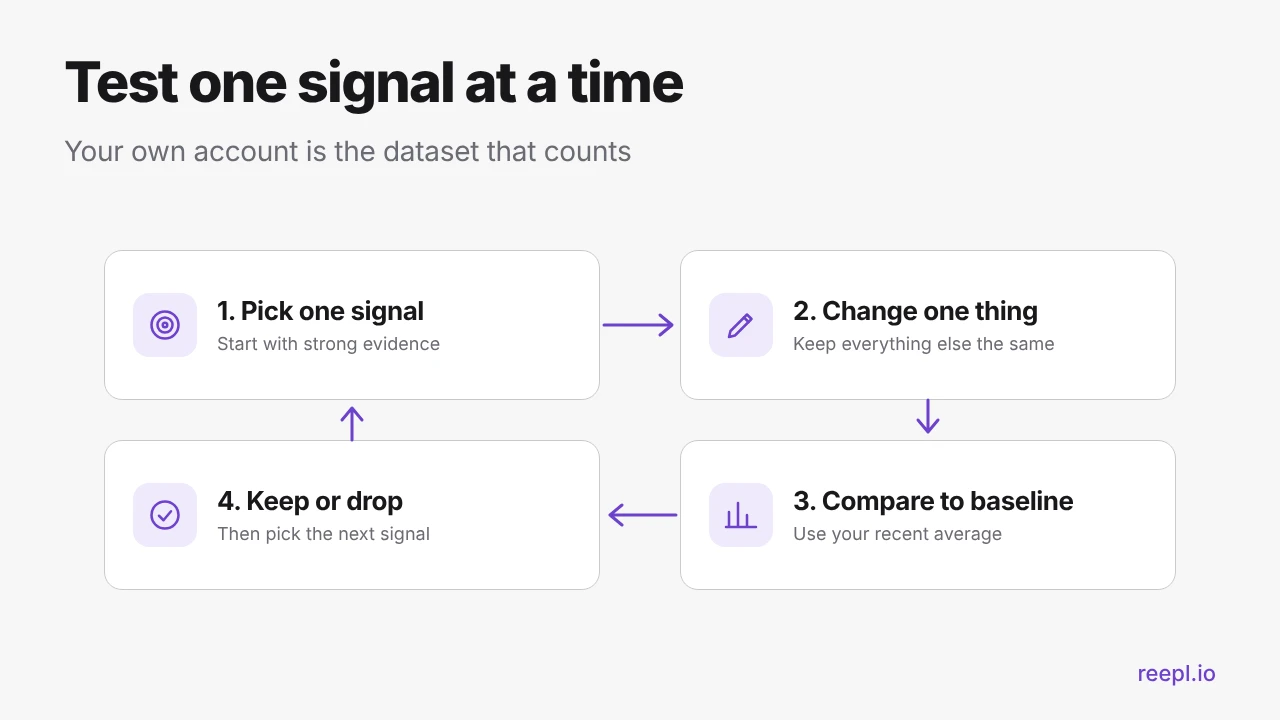
Test one decision at a time. If you change topic, format, timing, hook and link placement together, the result cannot tell you which change mattered. A test plan for each variable:
| Variable | Version A | Version B | Hold constant |
|---|---|---|---|
| Link placement | Link in the post body | Link added in your own first comment | Topic, format, reader |
| Publishing time | Your readers’ morning, in their time zone | After their working day | Topic, format, length |
| Length | Short summary with the source | Full explanation with an example | Topic, opening, reader |
Write the test down before you publish: “On [date] I changed [one variable] from [A] to [B]. I held [topic, format, reader] constant. At [checkpoint] I will compare [metric] with [comparable posts].”
How does AI-assisted content fit the evidence?
AI-assisted posts are judged on substance. The current LinkedIn® AI content guidance, consulted in October 2026, says AI-assisted content is welcome when it reflects real perspective, experience or expertise, and that generic, repetitive content lacking substance is less likely to be widely distributed.
The guidance draws a quality line and publishes no percentage penalty for using a model. It also describes feedback labeled “Seems like AI slop” and says an analytics tip based on community feedback does not itself mean the post was removed or a policy decision was made.
Review the draft’s substance before its style. Check whether the example happened, whether the source supports the claim, and whether the conclusion is yours. A human-written generic post can be weak, and an AI-assisted explanation can be useful. Removing a word associated with AI leaves a false statement false.
Keep third-party detector scores out of your reach analysis; they come from separate tools, outside the platform’s systems. OpenAI’s historical classifier notice records that its classifier was withdrawn in July 2023 because of low accuracy. One withdrawn tool says nothing definitive about every current detector, and it is still a good reason to keep authorship labels away from conclusions about how LinkedIn® ranked a post.
Use drafting help for organizing an idea, producing alternatives or editing repetition. Keep the factual source material and final judgment with you. A voice profile can guide wording; it cannot provide experience you never had.
Which engagement tactics conflict with platform rules?
Prearranged engagement does. The Professional Community Policies prohibit artificial engagement and tell members not to agree in advance to like or reshare each other’s content. The same policy addresses spam and unwanted promotional communication, so a coordinated exchange of reactions is a rules question before it is a content strategy.
The automated activity help page and User Agreement address prohibited third-party behavior. A claimed “safe” daily volume grants no permission: a quota leaves the nature of an action, and the platform’s rules about it, unchanged.
Keep your own content publishing separate from engagement. Authorized scheduling of your own posts is a different workflow from software acting as you in comments, messages, connections or likes. Reepl is an AI writing platform; it can assist with your own content workflow under your chosen controls, and you review and send engagement drafts yourself.
If an account restriction occurs, follow the platform’s stated recovery instructions and check which tools are actually connected to the account. Skip attempts to hide activity patterns or to probe supposed safe limits. The aim is a professional account used within its rules.
What does a defensible account-level experiment look like?
A defensible experiment fixes the question, the post labels and the review checkpoint before you publish. The following plan is illustrative, written for this guide, and reports no real result. Suppose a hypothetical SaaS founder wants to know whether decision checklists produce more useful conversations with buyers than broad opinion posts. The hypothesis is about usefulness to the audience.
- Choose a stable subject area and record the intended reader for each post.
- Keep format and publishing windows reasonably comparable across the posts.
- Label each post by type before publishing, so a successful post cannot be reclassified after the fact.
- Record the question each post answers, the evidence it uses and any unusual event that could affect response.
- Set the review checkpoint in advance and capture impressions at that same elapsed point, plus substantive comments, relevant inquiries and any source clicks you can measure appropriately.
Compare posts at the same age: one checked an hour after publishing cannot stand beside one that has circulated for weeks. Note what the dashboard actually reports, because metrics with similar names can have different definitions.
At review, inspect the individual posts as well as the summary, since one unusually topical post can dominate an average. If the checklist posts seem more useful, ask whether their topic or specificity explains the difference. The reasonable conclusion is “this format deserves more trials.” An organic test like this is observational, because audiences and platform conditions change between posts, so it cannot show that the algorithm rewards checklists.
Set a stopping condition too. If a test makes the posts harder to understand, creates misleading promises or takes too much time, stop. A measurement plan should support better communication, and no experiment is worth publishing weak work.
What should you change first?
Change the problem you can actually observe. If readers misunderstand the post, improve the explanation. If the wrong people respond, sharpen the audience and subject. If the content is accurate but hard to scan, improve structure. If a post gets little attention, list several plausible explanations before blaming one ranking signal.
Keep a short evidence note beside any advice you adopt: the source, its date, what it establishes and what remains unknown. A primary source about a mechanism beats an unattributed multiplier, and a modest experiment on your account tells you more than a dramatic claim you cannot reproduce.
The next action is simple: choose one upcoming post and make its reader, claim, evidence and limitation explicit. Publish through your chosen authorized workflow, answer genuine responses, and review it alongside comparable work. You control that process even while the feed’s exact ranking weights stay private.
How should you read a third-party algorithm study?
Read a third-party study as a pattern in one sample, then check four things before you act on it:
- Population. A study of posts connected to one analytics service may overrepresent active creators, certain industries or particular account sizes. That still makes it useful; it changes the question from “what always works?” to “what pattern appeared in this sample?”
- Unit of analysis. A post-level average and an account-level average can tell different stories, and a few large accounts may contribute many high-reach posts. If the study mixes personal profiles and company Pages, or organic and paid distribution, the combined result may miss your situation.
- Period and metrics. A recent report may analyze older posts. Impressions, unique viewers, engagement rate and link clicks answer different questions, and a rate with an unclear denominator cannot be compared with your own reporting.
- Language of the conclusion. “Posts with documents received more reactions” is an association. “Documents caused the feed to promote those posts” needs stronger evidence, because topic, author reputation, audience size and the effort put into the asset may explain part of the difference.
Keep the useful hypothesis and drop the causal promise. Before adopting a finding, write one sentence about how your account differs from the sample, then choose a low-cost trial that still produces useful content for your readers. Outside research earns its place when you keep its scope intact.
What belongs in a ranking evidence note?
A ranking evidence note holds the claim in the narrowest form its source supports, plus what stays unknown. An engineering paper, for example, can establish that a signal was modeled without revealing its current production weight. Use this template:
- Claim: [the narrowest wording the source supports]
- Source: [title, type and publication date]
- Population: [whose posts or accounts, if relevant]
- Still unknown: [the weight, threshold or cause the source leaves open]
- Action: [the test you will run, and on which posts]
Attach the note when you share advice with a teammate. Without it, “worth testing for this audience” can drift into “the algorithm requires this.” Going back to the note keeps a reasonable experiment from hardening into a rule that later writers repeat as fact.
Turn a useful idea into a clear draft
Bring your own context, review the draft, and keep the final wording yours.