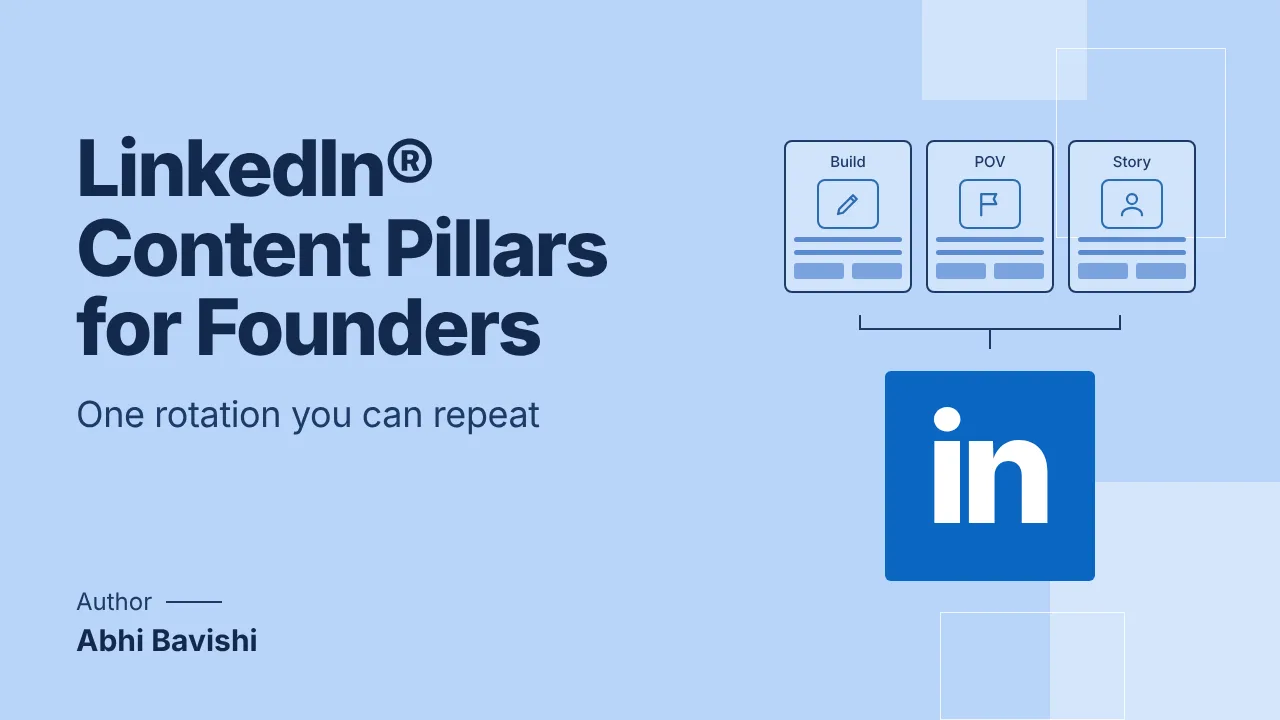
The four LinkedIn® content pillars every founder needs are build-in-public, industry point of view, founder story, and customer proof, rotated roughly 40-30-20-10 across a month. Pick three or four pillars, not more, or your audience never builds a clear picture of what you actually stand for.
Most founders know they should post on LinkedIn®. Almost none of them know what to post once the "share your journey" advice runs out after two weeks. That gap is where content pillars come in: a small, fixed set of themes you return to on purpose, so your feed reads as a system instead of a scramble for a new idea every morning.
What "content pillars" actually means (and why most frameworks fail)
A content pillar is not a topic. "Marketing" is a topic. "Build-in-public updates that show real numbers, customers, and setbacks" is a pillar, specific enough that you can generate a post idea from it in under a minute, and narrow enough that a reader who follows you for a month knows exactly what kind of value to expect next.
Most founder-content advice fails at the specificity step. "Share your journey" or "post about your industry" sounds like a pillar but isn't, there's no rotation, no ratio, and no rule for when a personal post is due versus a product post. Without that structure, founders default to whatever they feel like writing that day, which is how a LinkedIn® presence quietly becomes 80% product announcements and 20% nothing, or the reverse.
The 4 pillars every founder should own (with examples)
These four cover the full range a founder's audience actually wants: trust-building, expertise, relatability, and proof. Skip one and a gap opens that a competitor's content fills instead.
Pillar 1: Build-in-public (40% of posts)
Real numbers, real customers, real setbacks, posted as they happen rather than polished into a highlight reel. This is the pillar that makes a founder's LinkedIn® feed feel alive instead of corporate, and it's the one incumbents with a marketing team can't easily copy.
Example: "We lost our biggest customer this week. Here's the churn conversation, word for word, and what it told us about our onboarding."
Pillar 2: Industry POV (30% of posts)
A clear, sometimes contrarian, stance on how your industry works, posted weekly. This is the pillar that builds authority: readers don't need a personal update from you every day, but they do want a reason to think you understand the space better than the next founder in their feed.
Example: "Everyone tells early-stage founders to 'niche down.' We didn't, and here's the argument for staying horizontal longer than feels comfortable."
Pillar 3: Founder story / personal (20% of posts)
One real personal arc a month, not a highlight-reel humblebrag. A career pivot, a hiring mistake, a moment of doubt that turned out to matter. This pillar is what makes people follow the founder rather than the company page.
Example: "I almost shut this down 8 months in. Here's the one conversation that changed my mind, and what I'd tell that version of myself now."
Pillar 4: Customer / product proof (10% of posts)
Case studies and named-customer results, kept deliberately rare so they read as evidence rather than advertising. This is the lowest-volume pillar on purpose, it's the one most likely to feel like a pitch if it's overused.
Example: "A customer went from a 2% reply rate to 11% after changing exactly one thing about their outreach message. Here's what it was."
The 40-30-20-10 rotation (why it works for founders specifically)
LinkedIn®'s algorithm ranks content in three stages: an initial quality filter, an engagement test with a small slice of your network, then a wider push based on how that test performed. Build-in-public and POV posts tend to earn the comments and shares that clear the engagement-test stage, because they invite a reaction in a way a polished announcement rarely does.
The 40-30-20-10 split isn't arbitrary. Build-in-public and POV together make up 70% of the rotation because they're what a founder's audience actually shows up for before there's a recognizable brand behind the name. Founder-story posts round out the picture without dominating it, and product proof stays rare enough to land as evidence, not a sales pitch, when it does appear.
Post ideas for each pillar
A pillar only helps if you can turn it into a post idea on demand. Here's a starting list for each, enough to fill several weeks before you need to think up a new one from scratch.
Build-in-public ideas
- This week's real revenue number, and the one decision behind the change
- A customer conversation that changed a roadmap decision
- A metric that went the wrong direction, and what you're doing about it
- A hiring decision you got wrong, and what you'd do differently
- The actual churn or refund conversation behind a lost customer
- A screenshot of a real support ticket and how it shifted priorities
Industry POV ideas
- A piece of common advice in your space you think is wrong, and why
- A prediction about where your category is heading in the next year
- A competitor's move you disagree with, argued on substance, not personality
- A "everyone does X, we do Y instead" contrast post
- A framework you use internally, shared publicly
- A trend you think is overhyped, with the reasoning
Founder-story ideas
- The moment you almost quit, and what changed your mind
- A career pivot that led here, told as a real story with stakes
- A mentor or piece of advice that mattered more than expected
- A mistake you made publicly and what it cost
- The origin story, told once, in full, rather than teased across posts
- What you believed at the start that turned out to be wrong
Customer / proof ideas
- A single named customer's before-and-after, with specific numbers
- A quote from a customer, expanded into the context around it
- A case study framed as the customer's problem first, your product second
- An unprompted customer message, shared with permission
- A result that surprised you as much as the customer
- A comparison of a customer's metrics before and after a specific change
How to batch-plan a month of content in 90 minutes
Pillars only save time if you plan in batches instead of staring at a blank composer every morning. A once-a-month planning session, done right, covers 3-5 posts a week without daily improvisation.
The content calendar template
Start from the ratio, not a blank page: rough out how many posts you need for the month, then assign 40% to build-in-public, 30% to POV, 20% to founder story, 10% to proof, and drop one idea from the lists above into each slot. Reepl's content calendar creator automates this split, generating a month of pillar-matched post ideas in the right ratio in one pass instead of a spreadsheet built from scratch.
Weekly posting rhythm (3-5 posts)
Three to five posts a week is the sustainable range for most founders. Daily posting is possible with aggressive repurposing, but it raises burnout risk without a proportional gain, and under three a week makes it hard for the algorithm's engagement test to build any momentum. If timing is a separate question you haven't settled, Tuesday and Wednesday mornings around 8-9 AM are consistently the highest-engagement window.
Repurposing flow: newsletter / blog to LinkedIn®
Founders who also write a newsletter or blog post already have raw material for the POV and proof pillars, they just need reformatting rather than a new idea. Pulling one strong claim or number out of a longer piece and rebuilding it as a standalone hook is the fastest way to keep the calendar full. See how to turn a blog post into a LinkedIn® post for the specific extraction method.
Common mistakes founders make with pillars
Mistake 1: Too broad (5+ pillars)
More than four pillars stops being a system and starts being "I post about whatever." Readers can't build a mental model of what to expect, which defeats the entire point of having pillars in the first place.
Mistake 2: Pillar aimed at the wrong audience
A pillar built around impressing other founders (funding milestones, team headcount) doesn't convert if your actual buyers are the people using the product. Build each pillar around the audience you need to reach, not the audience that's easiest to write for.
Mistake 3: Only POV posts (no vulnerability)
A feed of nothing but confident industry takes reads as a thought-leader account, not a founder. Skipping build-in-public and founder-story content removes the specificity and relatability that make a founder's voice different from a company blog.
Mistake 4: Only build-in-public (no industry voice)
The opposite failure: constant behind-the-scenes updates with no POV ever earns engagement from your existing audience but rarely reaches anyone outside it, since there's no argument or opinion for the algorithm's engagement test to amplify.
Reepl's founder template: pillars, prompts, and voice match
Rotating four pillars by hand every week is exactly the kind of repeatable, structured task that's easy to plan and tedious to execute alone. Reepl's hook generator turns a pillar and a rough idea into a scroll-stopping opener, voice profiles trained on your own past posts keep every pillar's output sounding like you instead of a generic template, and the content calendar tool above handles the 40-30-20-10 split automatically. For founders on Premium, the Andy agent can draft against the same voice profile between planning sessions, you still review and send every post.
Compared to tools like Supergrow, which lean on programmatic content generation without a founder-specific pillar system, Reepl's approach starts from the ratio and your own voice rather than a generic template library. See the full Reepl vs Supergrow comparison for the detailed breakdown. At $19/mo for the Pro plan, it's built to sit well under what a part-time ghostwriter costs, without giving up a structured, repeatable system.
Plan a Month of Founder Content in Minutes
Reepl's content calendar creator splits your posts across all 4 pillars automatically, in your own voice.