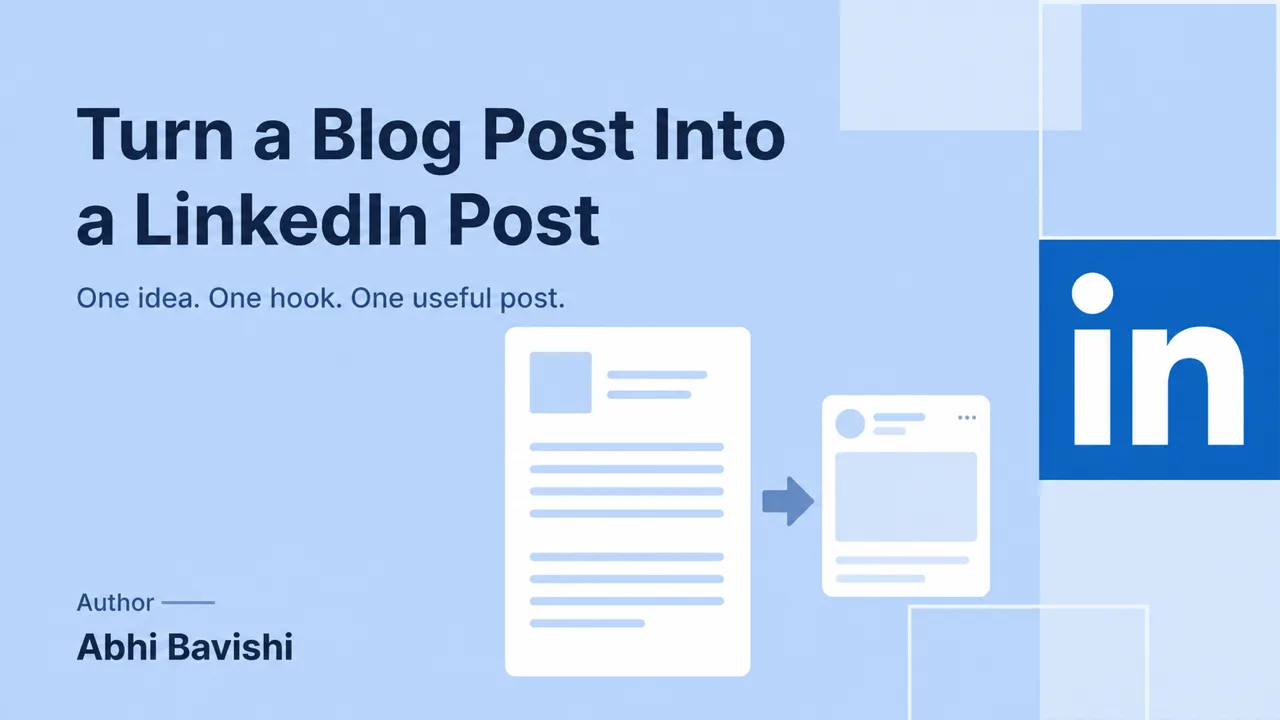
Turn a blog post into a LinkedIn® draft by choosing one useful idea, preserving its evidence, and rewriting it for a reader who has not opened the article. A 60-second pass can produce a rough draft when the source is ready. Fact-checking, attribution, editing, and publication need their own review time.
Key takeaways
- Repurpose one argument rather than compressing every section of the blog.
- Keep the source's qualifications and attribution when shortening its claims.
- Treat 60 seconds as an illustrative drafting exercise, not a guaranteed production time.
- Give the social post standalone value and a clear reason to open the full article.
- Review rights, facts, and destination before scheduling or publishing.
What does repurposing mean here?
Content repurposing is adapting existing material to a different format or audience while preserving its underlying meaning. A blog article may explain several connected ideas. A short social post usually works better when it develops one of them and leaves the rest in the source.Repurposing is not copying the introduction and adding a link. An article introduction often promises what the reader will learn later; a social post needs to deliver something useful immediately. It is also not an excuse to turn a qualified finding into a stronger claim because the shorter version sounds more exciting.
Start with material you own or have permission to adapt. The U.S. Copyright Office's overview distinguishes ideas from protected expression. In practical editorial terms, you can discuss an idea without copying another author's passage or presenting their work as your own. Attribution does not automatically create permission for every kind of reuse.
This guide uses illustrative examples, not a timed product test or measured distribution experiment. The purpose is a repeatable editorial method. It does not promise that repurposing improves reach, earns search citations, or makes every article suitable for every audience.
When is the source ready for a quick drafting pass?
A source is ready when its main claim is clear, its evidence is available, and you know who the new post is for. If the article contains outdated product information, unclear statistics, or an unsupported anecdote, fix those issues before turning it into more content.
Create a source card with the article title, author, URL, publication date, central argument, evidence, and important limitations. Add the specific audience for the social post. Keep this card beside the draft so that shortening does not erase the context that made the original claim accurate.
For your own article, confirm that it still reflects your current view. A post written several years ago may contain advice you would now qualify. You can repurpose the change in your thinking, but say that you are revisiting an earlier position rather than quietly presenting an old claim as current.
For a third-party source, read the relevant section yourself. Do not assume an AI summary captured every condition or that a tool successfully opened the URL. If you cannot inspect the source, do not write as though you have verified it. Use a different source or limit the post to what you can actually support.
How does the 60-second drafting exercise work?
The time boxes below are a practice structure, not a measured promise. They assume you have already read the article and prepared the source card. Stop the timer when a factual question arises; speed is not a reason to publish an uncertain claim.
First, choose the takeaway. Finish the sentence: “After reading this post, the reader should understand…” Pick one decision, distinction, or method. If the sentence contains several unrelated lessons, narrow it. A long article can support several later posts without forcing them into the first draft.Next, write the opening. State the useful point or the problem it solves. Avoid a vague announcement that you have published a new article. The reader should understand the subject before deciding whether the full piece is relevant.Then, add support. Include one example, explanation, or source-backed finding. Preserve the qualification that prevents the claim from being misleading. If the evidence is complex, use the post to explain the question rather than compress the result beyond recognition.Finally, choose the ending. Offer a next step, a focused question, or a link with a reason to read more. Save the result as a draft. The next stage is a separate review for accuracy, attribution, tone, and formatting. A quick first pass is useful because it reduces blank-page friction, not because it completes every editorial responsibility.Which angle should you take from the article?
Choose an angle that fits the reader's immediate problem. The same article can support a practical checklist, a decision framework, a mistake explanation, or a qualified opinion. Those are different posts, and each needs its own opening and supporting detail.
| Source material | Useful social angle | Keep in the draft |
|---|---|---|
| A detailed tutorial | One step people often misunderstand | The condition that makes the step appropriate |
| A comparison | A decision rule for choosing between options | The tradeoff and who each option suits |
| A research discussion | One finding with its scope | The source, sample context, and limitation |
| A personal reflection | A real change in the author's thinking | What actually happened and what remains uncertain |
Do not choose the most dramatic sentence automatically. A striking quote may be incidental to the article's actual argument. Read the surrounding paragraphs and ask whether the sentence still means the same thing when isolated.
Also avoid using the post as a table of contents. A list of every section can be useful for a newsletter announcement, but it usually gives a social reader little to apply. Deliver one idea completely, then explain what additional depth the article offers. That makes the link a continuation rather than a substitute for substance.
What prompt produces a useful first draft?
Give the assistant the source text or approved excerpt, the audience, the chosen angle, and the factual boundary. OpenAI's prompting guidance recommends clear context and iterative refinement. For repurposing, the key instruction is to preserve meaning while changing format.
Copyable prompt: “Turn this approved article excerpt into a LinkedIn® draft for the audience below. Focus on one idea: the angle I specify. Make the post understandable without opening the article. Preserve the source's uncertainty, attribution, and scope. Do not add statistics, personal experience, quotations, or product claims. End with a reason to read the full article only if it adds relevant depth. Return the draft and a list of claims that need my review.”Follow with: “Compare the draft with the source. Identify any statement that became stronger, lost a qualification, or implies the author personally observed something reported by another source.” This second pass helps reveal meaning changes that a general style edit might miss.
If the input includes confidential material, remove it before uploading and review the service's data settings. OpenAI's data-control documentation explains ChatGPT's available controls; your organization's requirements and other providers' terms may differ. A published article can be public while its attached notes remain private.
Example 1: How do you turn a tutorial into a practical post?
This illustrative source is a tutorial about improving customer onboarding documentation. Its central argument is that setup instructions and recovery instructions answer different questions. It recommends organizing the material around the user's current task and checking whether people can find the next action. No measured business result is supplied.
A weak repurposed version says: “Want better onboarding? Our new guide shares everything you need to know about documentation, user experience, and customer success. Read the full article.” It names the topic but gives the reader no useful idea.
A stronger illustrative draft is: “Setup instructions and troubleshooting instructions should not compete for the same space. A new user needs to know what to do next. A stuck user needs to know what went wrong and how to recover. Start by labeling each section of your onboarding guide with the question it answers. If a section answers both questions poorly, split it. The full article walks through a simple review of setup and recovery content.”
The post delivers one method from the tutorial and makes the article's additional value clear. It does not claim that the change reduces churn or support tickets. Those outcomes would need separate evidence. The reader can apply the labeling exercise without visiting the link, which makes the post useful in its own right.
Before publishing, verify that the full article actually contains the promised review. If it does not, change the ending or improve the source. The social post should not advertise a deliverable that the destination fails to provide.
Example 2: How do you repurpose a comparison?
This illustrative source compares a shared project document with a task-management system. It concludes that the right choice depends on whether the team needs a narrative decision record or structured ownership and status. The article does not claim that either option is universally better.
A weak draft says: “Stop using documents for project management. Task tools are the future.” That version may sound decisive, but it reverses the source's conditional argument. A stronger opening names the choice rather than exaggerating the conclusion.
Illustrative draft: “Choose your project workspace by the question it needs to answer. If the team needs to understand why a decision was made, a well-maintained document may be enough. If the team needs to know who owns the next action and whether it is blocked, structured tasks may help. The hard part is deciding which information must stay current. Before switching tools, list the questions people repeatedly ask in meetings. The comparison in the full article starts from those questions.”
This version preserves the tradeoff and gives a practical diagnostic. It also avoids turning a comparison into an attack on one category. Readers can recognize which situation resembles their own and decide whether the detailed article is worth opening.
If you mention named products from the original, recheck their current features and pricing before publication. A source article's historical accuracy does not automatically make every product claim current. You can keep the decision framework while removing stale commercial details.
Example 3: How do you repurpose a reflective article?
This illustrative source describes an author's change in thinking about meetings. The author previously tried to shorten every meeting, then realized some meetings lacked a clear decision. The supported lesson is about purpose, not a measured productivity increase.
A weak draft says: “I cut meetings in half and transformed team productivity.” That introduces a number and an outcome absent from the source. It also changes a nuanced reflection into a success claim that the author may not be able to defend.
Illustrative draft: “I used to edit meetings by duration. Now I start with the decision. A short meeting can still waste everyone's time if nobody knows what must be resolved. Before sending an invitation, I write the decision, the person who owns it, and the information needed to make it. Sometimes the result is a shorter meeting. Sometimes it is no meeting. The article explains the questions that changed how I prepare.”
This example uses first person because the fictional source is explicitly a personal reflection. Your version may use first person only if the underlying experience is yours. If you are discussing another author's reflection, attribute it and explain your own response rather than adopting the story.
The practical check is whether the author of the source would recognize the post as a fair representation. Repurposing can simplify the structure, but it should not rewrite the person's history or turn uncertainty into certainty for a stronger hook.
How do you preserve evidence in a shorter format?
Keep the claim, source, and important qualification close together. If a finding applies to a particular sample or period, do not remove that context merely to make the sentence shorter. If the source reports an association, do not rewrite it as proof of causation.
When the explanation becomes too compressed, change the angle. Instead of reporting a complicated result, explain the question the research addresses and why the reader should inspect the original. A short post does not need to carry every technical detail, but the details it omits must not change the meaning.
Check quotations word for word and use only the excerpt necessary for your point. Distinguish your interpretation from the source's conclusion. A link is useful, but it does not repair a misleading summary. The reader should not have to open the article to discover that the post overstated it.
LinkedIn®'s Professional Community Policies provide context for truthful, authentic participation. Our editorial recommendation is to prefer a narrower accurate claim over a dramatic unsupported one. If you cannot explain the evidence clearly, keep the post as a draft until you can.
Can one blog article support several different posts?
Yes, when the article contains genuinely distinct ideas. Build a small map of possible posts rather than rewriting the same summary repeatedly. Each planned post should answer a different reader question and contain enough context to stand alone.
For the onboarding tutorial, possible angles include separating setup from recovery, identifying the next action, reviewing confusing terminology, deciding when a screenshot helps, and keeping documentation current. These are different tasks. Each needs a fresh example or explanation rather than the same introduction with a new hook.
Do not force a target number from a thin source. If the article supports only one useful post, publish one. If several drafts repeat the same lesson, combine them or wait until you have new evidence. The source should determine the amount of useful material, not a production quota.
Keep a record of what you have already published so that later posts add something. You can revisit an idea for a new audience, but explain the new application. Repetition becomes useful when the context changes; otherwise it can make your calendar look full while giving readers little new value.
How do you make the post sound like you?
Use your own vocabulary and the degree of certainty you would use in a real conversation. Do not assume that social writing requires slang, fragmented sentences, or an exaggerated personal confession. The structure should fit the idea and your normal way of explaining it.
Ask the assistant to revise for your voice without adding facts. Provide representative samples and label them as style references. Then compare the draft with the source again, because a tone revision can accidentally make a claim more absolute or introduce an experience from the samples.
For a final clarity pass, Google's sentence guidance recommends specific subjects and verbs. Replace “This can be transformative” with the actual action or decision the reader can take. Clear language is usually more useful than adding excitement to a source that already has substance.
If the draft still sounds generic, inspect the chosen angle. A post about “the importance of communication” gives you less to work with than a post about who can change an approved decision. Better specificity often solves the voice problem without adding stylistic tricks.
How can Reepl fit into a repurposing workflow?
Reepl is an AI writing platform that puts your social media on autopilot in your own voice: it finds what to post about, drafts your posts, and keeps your calendar full, with you choosing what it does without asking. For repurposing, the useful role is turning approved source material into a draft you can review in context.
Use the post repurposer as a starting point, then check the source and draft side by side. Confirm that the opening, evidence, and ending still describe the same argument. Do not treat a generated draft as proof that the source was fully read or that every claim remains current.
If you schedule the finished post, confirm the account, date, time zone, and final text. Review linked destinations before publication, especially when the article may change or a launch date moves. Your chosen publishing controls do not replace responsibility for the accuracy of the material.
For the editing stage, the post formatter can help present the approved text. Keep formatting after the evidence review so that presentation does not distract from unresolved claims. You should be able to complete the same editorial process manually if you prefer.
What should you review after publication?
Review whether the post delivered the promised idea and whether readers understood the relationship to the article. Comments may reveal a missing qualification or a question the source did not answer. Use that feedback to improve the original as well as future adaptations.
If your goal is article readership, inspect the available referral information with its limitations. If your goal is useful discussion, look at the substance of the replies. Do not treat impressions as proof that the source earned trust, and do not attribute every traffic change to one social post.
Correct a material error promptly in the relevant places. If the source changes, check whether the social summary now misrepresents it. Repurposing creates connected artifacts, so maintenance matters after the first draft.
Start with one article and one narrow angle. Produce the rough draft quickly if the source is ready, then take the time required to verify and edit it. The value of repurposing is making good work useful in another context while preserving the judgment that made the original worth reading.
Repurpose Any Blog Post in Seconds
Paste a blog URL and get a LinkedIn®-ready draft in your voice.