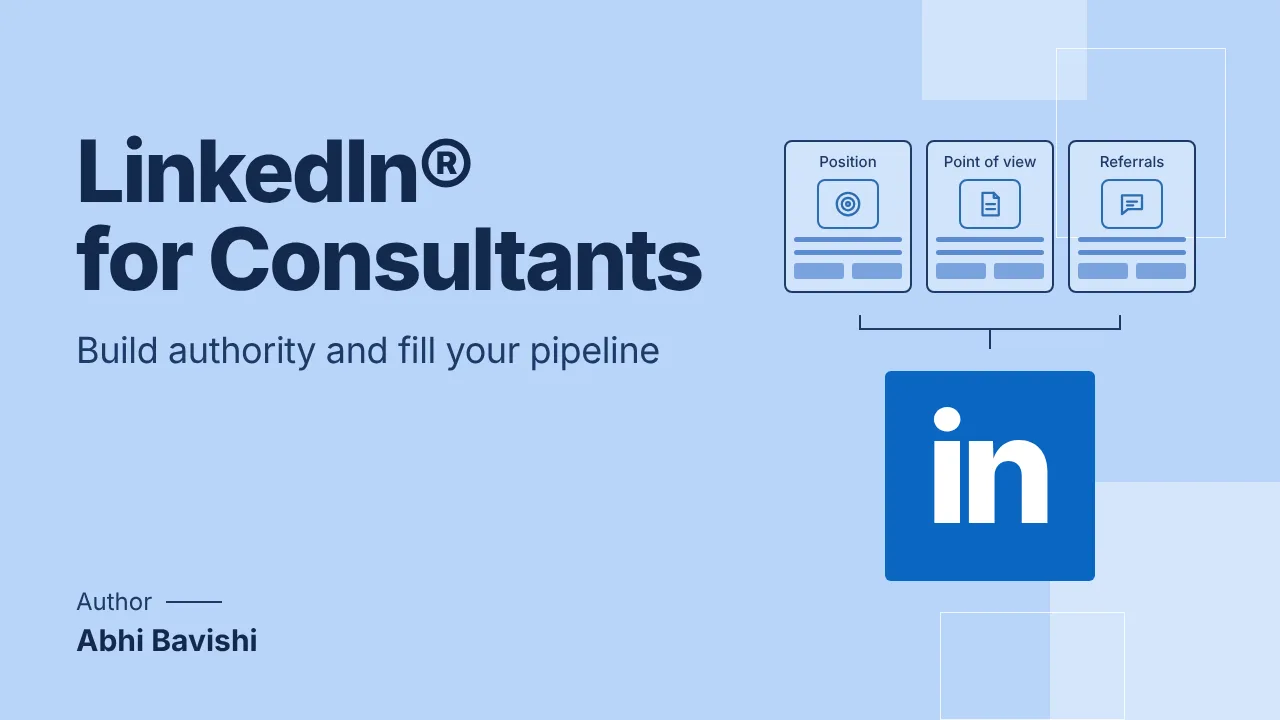
Consultants can use LinkedIn® to make their expertise easier for buyers and referral partners to recognize. Start with a clear position, explain real decisions, and publish evidence you have permission to share. Build conversations around relevant problems, then invite a suitable next step without promising a predictable pipeline.
Key takeaways
- Write for a buying decision instead of a broad professional audience.
- Show your reasoning and its limits, even when client outcomes are confidential.
- Treat case-study permission and evidence as separate checks.
- Track relevant conversations and referrals without claiming perfect attribution.
Most independent and boutique consultants already know this in theory. The problem is practical. Billable work comes first, so posting happens in bursts, the pipeline follows the same feast and famine pattern, and every post feels like a risk because the best material belongs to clients. This guide gives you a system built around those constraints, not around the habits of full-time creators.
Why consultants need a different LinkedIn® playbook
A consultant does not need to address the entire platform. Focus on buyers who own the problem you solve and the peers who hear about that problem first. A clear explanation for that audience can be more useful than broad attention from readers who will never need your work.
That changes the goal. You are not chasing reach. You are building recall and trust inside a small, high-value circle, so that when a need appears, your name is already attached to it. Three things make consulting different from other service businesses on the platform:
- Buying is slow and shared. A scoped engagement often involves several stakeholders, so your content has to survive being forwarded to someone you have never met.
- Referrals carry the weight. Much of your work arrives through people who already trust you. Content keeps you top of mind for them between projects.
- Confidentiality is a hard constraint. Your most persuasive proof sits under client agreements, so you need ways to teach and show results without exposing anyone.
Start with positioning, not posting
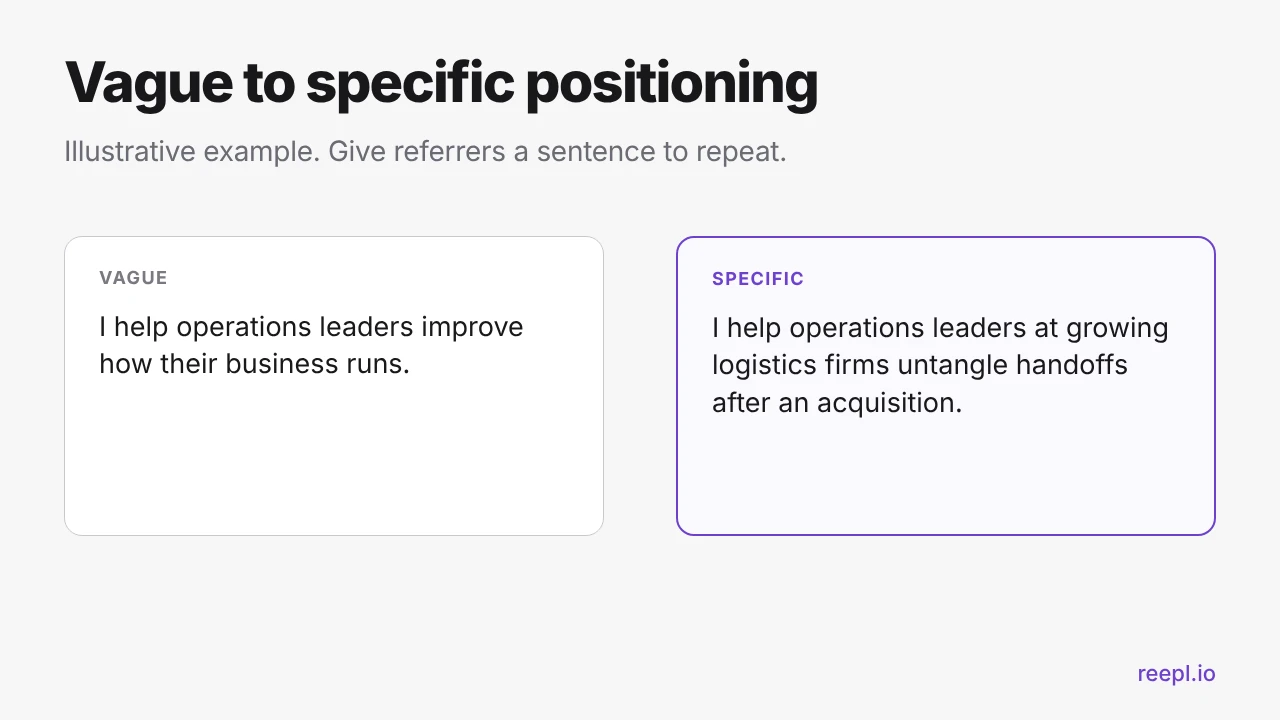
Posting more will not fix a vague position. If a reader cannot tell within a few seconds who you help and with what, they cannot refer you, because referring requires a sentence they can repeat.
Write the one-sentence position
Use this structure and fill it in with real specifics: I help [specific buyer] solve [specific problem] in [specific situation]. The situation is the part most consultants skip, and it is the part that makes you memorable. "I help operations leaders" is a category. "I help operations leaders at growing logistics firms untangle handoffs after an acquisition" is a position.
Make the profile match the position
Your profile is the landing page every post and comment sends people to. Put the position in the headline, lead the About section with the problem you solve, and use Featured for one clear way to start a conversation. If you want a head start, the free About section generator drafts a version you can rewrite in your own words.
Do this before you publish anything. Every post you write afterwards will send readers to a profile that explains why the post mattered.
Build a point of view people can repeat
Consultants are paid for judgment, so your content should show judgment. Generic tips are interchangeable. A point of view is a position someone could disagree with, which is exactly why it is memorable and why it gets forwarded.
Four post types that work for consultants
- The pattern: something you keep seeing across engagements, stated without naming anyone.
- The contrarian take: where standard advice in your field breaks down, and what you do instead.
- The decision guide: how you would choose between two options, with the questions you ask first.
- The framework: your method in three or four steps, with one honest limitation.
Openers to adapt
The first line decides whether anyone reads the rest. These are illustrative openers to adapt to your own work, not results anyone achieved:
- "The most common reason a project stalls is not budget. It is that nobody owns the decision."
- "Before I recommend anything, I ask every new client the same three questions."
- "Most advice on this topic assumes a team you do not have. Here is what I do when it is just you."
- "I turned down a project last month. Here is the signal that made me say no."
If you want more formulas, the guide to LinkedIn® hooks breaks down the structures that stop the scroll. Whatever you borrow, keep the language yours. If your posts do not yet sound like you, how to find your LinkedIn® voice is a good place to start.
Case-study posts that respect client confidentiality
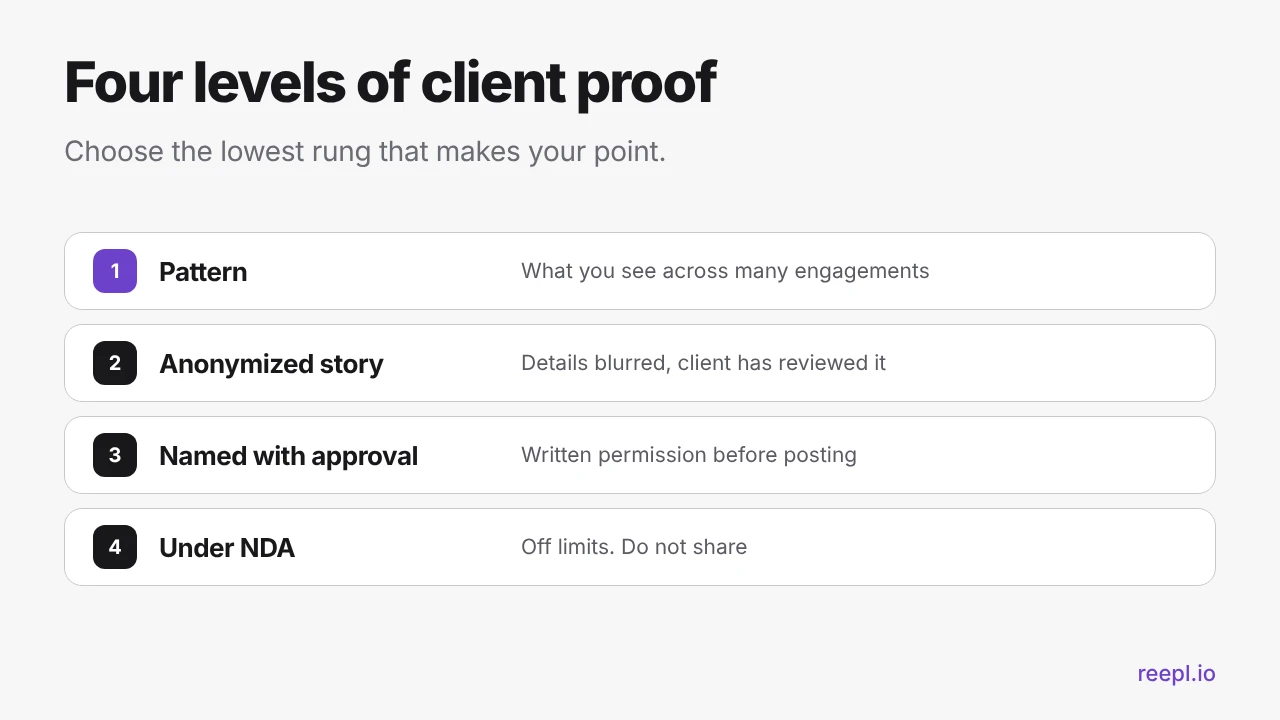
Proof is what separates a consultant who has opinions from one who gets results. It is also where careless posts cause damage. The safe approach is to treat client proof as a ladder and choose the lowest rung that still makes your point.
The rules that keep you safe
- Read your agreement first. If a contract restricts discussing the work, the answer is no, whatever the post would gain.
- Share the decision, not the data. Readers value how you reasoned. They rarely need the client's numbers, names, or internal politics.
- Blur what could identify them. Industry, size, location, and timing can each give a client away. Change or drop the details that do.
- Ask for review. For anything specific, send the draft to the client and get written approval before it goes live.
- Label what is illustrative. If a story is a simplified or blended example, say so. Never present an invented result as a real one.
A case-study post structure
A simple shape works: the situation in one line, the decision that mattered, what you changed, and what the reader can apply. Here is an illustrative example of the pattern, not a claimed result:
"A leadership team asked me to fix slow approvals. The real issue was that three people believed they owned the same decision. We wrote down who decides what, and the queue stopped being the topic of every meeting. If approvals feel slow in your business, check ownership before you check process."
Notice what is missing: no company name, no figures, no identifying detail. It still teaches something, and it still shows how you think.
A thin weekly rhythm around billable work
Consistency beats volume, and the rhythm has to survive a heavy delivery week. Aim for a routine so small that skipping it feels harder than doing it. A workable version is one post and a handful of short comment sessions per week.
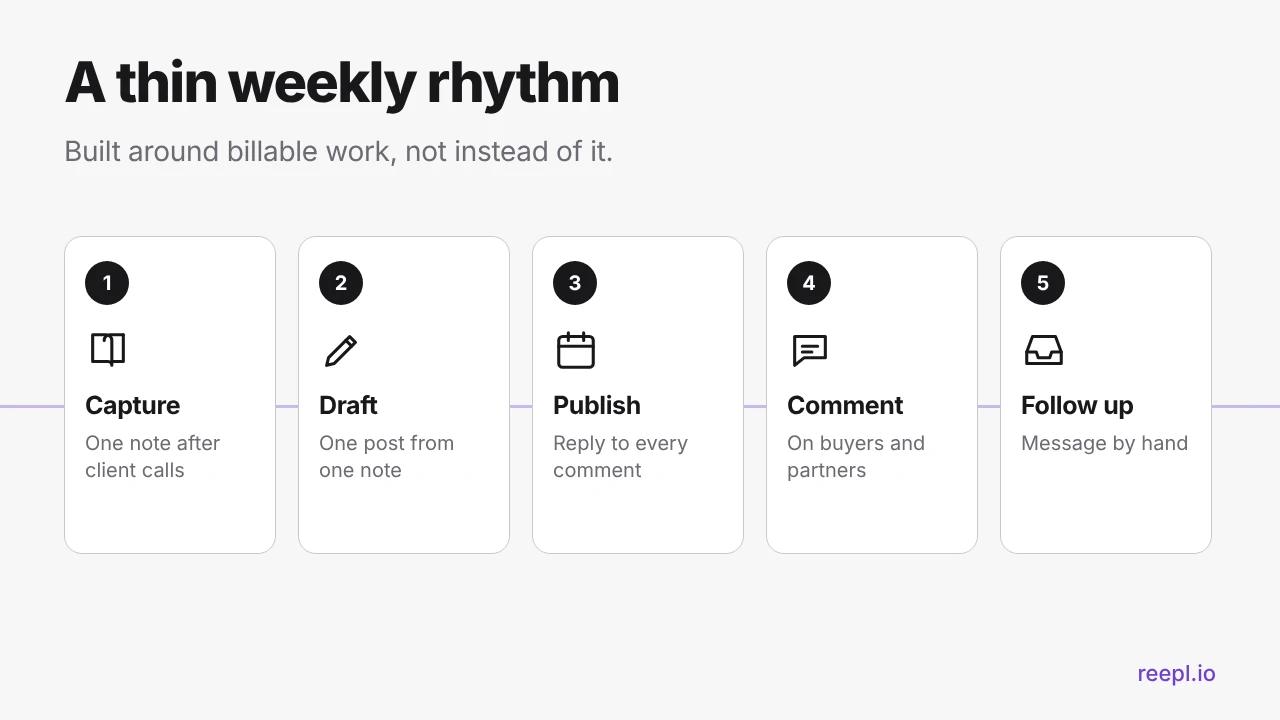
- Capture: after client calls, jot one line about a question, a surprise, or a decision. This is your idea bank.
- Draft: turn one note into one post in a single sitting.
- Publish: post at a time when your audience is likely to be at their desks, then answer every reply yourself.
- Comment: spend a short block on posts from buyers and referral partners.
- Follow up: review the week's conversations and decide who gets a personal message.
Where can Reepl help a consultant?
Reepl is an AI writing platform that puts your social media on autopilot in your own voice: it finds what to post about, drafts your posts, and keeps your calendar full, with you choosing what it does without asking.
Use Reepl to develop a public-safe note into a draft, keep a voice profile, and organize your own posts in a calendar. You choose the review settings and decide what may be scheduled. The content calendar creator can help arrange topics, but you provide the actual expertise and client permissions.
For comments and messages, Reepl drafts and you review, edit, and send. A drafting system cannot authorize disclosure of client work or determine whether an illustrative example matches your contract. Keep those checks with the person responsible for the engagement.
Comments as relationship building
Who to comment on
- Buyers: leaders in the roles and companies you serve.
- Referral partners: people who meet your ideal clients first, such as lawyers, accountants, recruiters, and other consultants with adjacent services.
- Past clients and colleagues: people who can speak about your work if you stay visible to them.
What a useful comment looks like
Add one specific thing: a short example from your experience, a respectful counterpoint, or a question that moves the conversation forward. Skip praise that could sit under any post. The full method, including how to pick posts and when to comment, is covered in our LinkedIn® comment strategy guide.
Turn conversations into calls by hand
A simple sequence
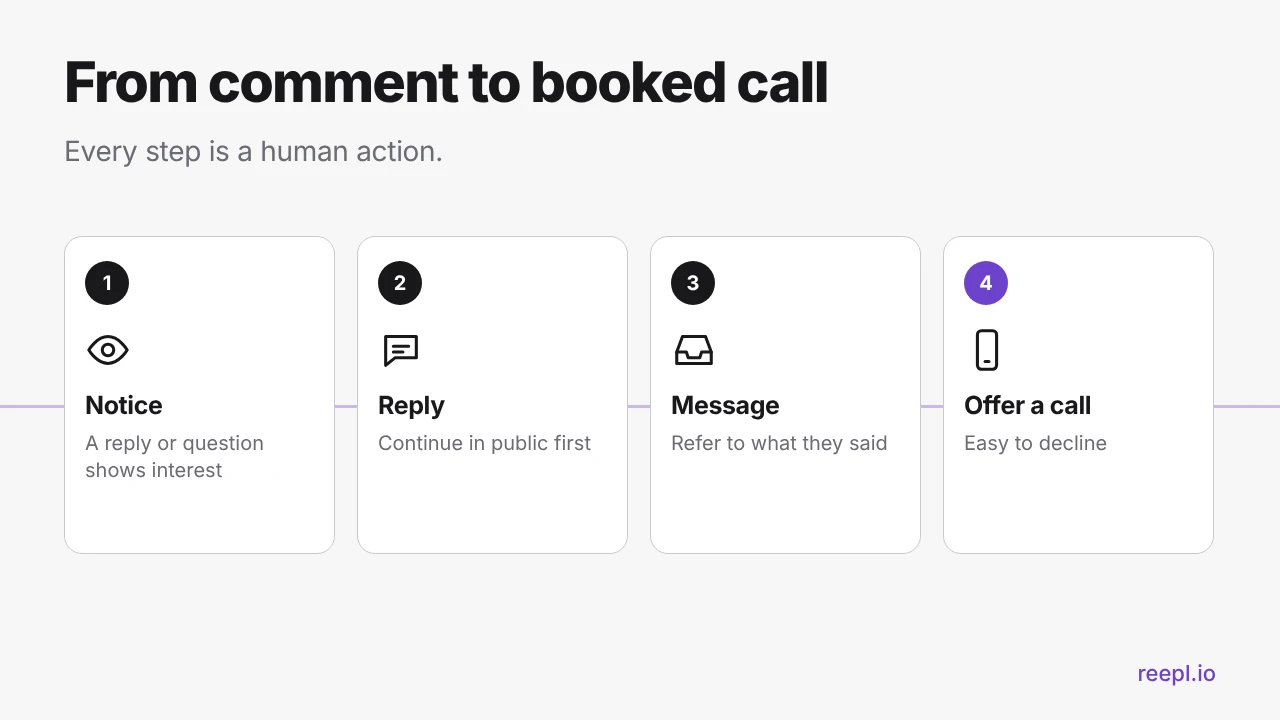
- Notice a signal. Someone replies in depth, asks a follow-up question, or mentions a problem you solve.
- Continue in public first. Answer in the thread so the exchange builds on itself.
- Move to a message when it is natural. Refer to something they actually said.
- Offer a call as an option. Make it easy to decline.
An illustrative message might read: "Your point about decision ownership stuck with me. I have some thoughts on how teams usually untangle it. Would a short call be useful, or is it better to keep this in the comments?"
Do not pitch in the first message, and do not paste the same text to everyone. Reepl can draft a message from the conversation for you to edit and send, but the decision to reach out, and the final wording, belong to you.
Measure conversations, not impressions
Impressions say little about a consulting pipeline. Track what actually moves work forward: conversations started, referrals mentioned, calls booked, and which posts those people mention when you talk. A short note after each call asking "what made you reach out?" teaches you more than any dashboard, and it tells you which topics to repeat.
How do you map content to a consulting buying decision?
Write for the decision a buyer is trying to make. An operations director considering outside help needs to recognize the problem, distinguish possible causes, evaluate approaches, and understand what an engagement would require. Repeating your credentials does not answer those questions.
Build a small decision map. For each stage, record the question, the proof you can share, and a useful next step. At problem recognition, explain observable symptoms and alternative explanations. At evaluation, compare approaches and prerequisites. Before a buying conversation, show how you scope work and where your involvement ends.
For an illustrative post-acquisition operations consultant, the map could begin with “Why do approvals slow down after teams merge?” The next post might compare unclear ownership with incompatible systems. Another could explain a discovery workshop and the information it needs. These are different questions within one commercial theme, not the same sales pitch in different formats.
The map also helps you avoid giving implementation instructions without enough context. A post can show the questions you would investigate without declaring the answer to a reader’s unknown situation. That restraint demonstrates judgment. It gives a buyer a reason to bring you the context a public post cannot hold.
| Buyer question | Useful post | Evidence boundary |
|---|---|---|
| Is this our problem? | Symptoms and plausible alternative causes. | Do not diagnose an unseen organization. |
| Which approach fits? | Decision table with tradeoffs. | State the assumptions behind the recommendation. |
| Can this consultant help? | Permissioned method example or project artifact. | Protect the client and avoid invented results. |
| What happens next? | Scope, inputs, and discovery process. | Do not imply a call guarantees a solution. |
How do you turn one consulting insight into a complete post?
The following is an illustrative writing exercise, not a reported engagement. The starting note is: “Approval delays can arise when ownership is unclear.” That note is useful but too broad. Turn it into a reader decision: “Before replacing an approval tool, establish who can decide exceptions.”
A complete draft might read: “A new approval system will not settle a disputed decision. Before choosing software, write down the normal owner, the exception owner, and the point where a decision escalates. If two teams disagree about those names, migrating the workflow may move the disagreement without resolving it. This check is useful when work waits despite everyone having access to the system. It is less useful when the bottleneck is a technical outage or a legal review that cannot be shortened.”
The post makes a claim, gives a practical check, and names exceptions. It demonstrates consulting reasoning without pretending the fictional scenario produced a measured improvement. If you have a real, approved case, add the relevant evidence and describe the scope. Do not substitute invented revenue or time savings to make the opening stronger.
A related document could show a blank decision-rights worksheet. Include columns for decision, owner, backup, required information, and escalation trigger. Explain that the worksheet records agreements; it does not create agreement by itself. That distinction makes the resource more useful than an impressive graphic with no implementation guidance.
Finish with a next step appropriate to the reader. “Check one recurring approval this week” is useful without a sales conversation. An invitation to discuss a particular situation can live in your profile or in a relevant exchange. The article should still help someone who never becomes a client.
What evidence and confidentiality checks belong before publication?
Use an evidence ledger for any post about client work. List each claim, its supporting material, permission status, and the wording approved for publication. Separate what happened from what you believe caused it. A project finishing after your workshop does not, by itself, prove the workshop caused the improvement.
The LinkedIn® Professional Community Policies prohibit false or misleading content. For consulting posts, the editorial consequence is straightforward: do not present a composite scenario as a client case, and do not imply a broader result than your evidence supports. The User Agreement also makes clear that you need the rights to content you share. Client permission and contractual confidentiality deserve their own review.
If a post includes a client endorsement, consult the FTC’s endorsement guidance for US-facing advertising. Honest quotations can still create a misleading overall impression if the surrounding copy implies typical outcomes that are not substantiated. Disclose relevant connections where required and avoid editing a quotation until its meaning changes.
LinkedIn®’s AI-assisted content guidance asks members to review and approve AI-assisted work and preserve their own expertise. Give a drafting assistant only public-safe facts. Ask it to flag missing evidence rather than fill the gap with a plausible case study. The OpenAI prompt engineering guide supports using clear instructions and relevant context; neither prompting nor style matching turns generated details into proof.
Before publishing, ask a colleague to read the post as a client might. Could the combination of industry, timing, role, and project description identify the organization? Could a buyer interpret the post as a promise of a result you have not promised in your proposal? Remove or narrow the passage if either answer is yes.
How do you evaluate pipeline contribution without overstating attribution?
Maintain a short conversation record with the buyer’s role, relevant problem, first known contact, content mentioned, and next agreed step. Keep confidential buying information in your normal secure business records, not in a public content spreadsheet. Ask how the person found you without forcing an answer into “social media.”
A referral can be the direct source while several posts helped the prospect evaluate you. Record both facts if the prospect mentions them. Do not assign the full value of a signed engagement to the last post viewed merely because the dashboard makes that easy.
Review topic usefulness as well as volume. If decision guides produce relevant questions but broad leadership posts produce mainly peer applause, that may justify more decision guides. If the questions reveal buyers misunderstanding your scope, revise the profile and introductory post. Content measurement should improve the sales conversation, not inflate a channel report.
What should you do next?
A consulting pipeline on LinkedIn® is built from a clear position, a point of view people can repeat, careful proof, a rhythm you can keep during busy weeks, and conversations you move forward yourself. None of it requires a large audience or daily posting. Start this week: write your one-sentence position, fix your headline, publish one post, and leave three thoughtful comments. When you want help drafting in your own voice, see Reepl's plans.
Turn a useful idea into a clear draft
Bring your own context, review the draft, and keep the final wording yours.