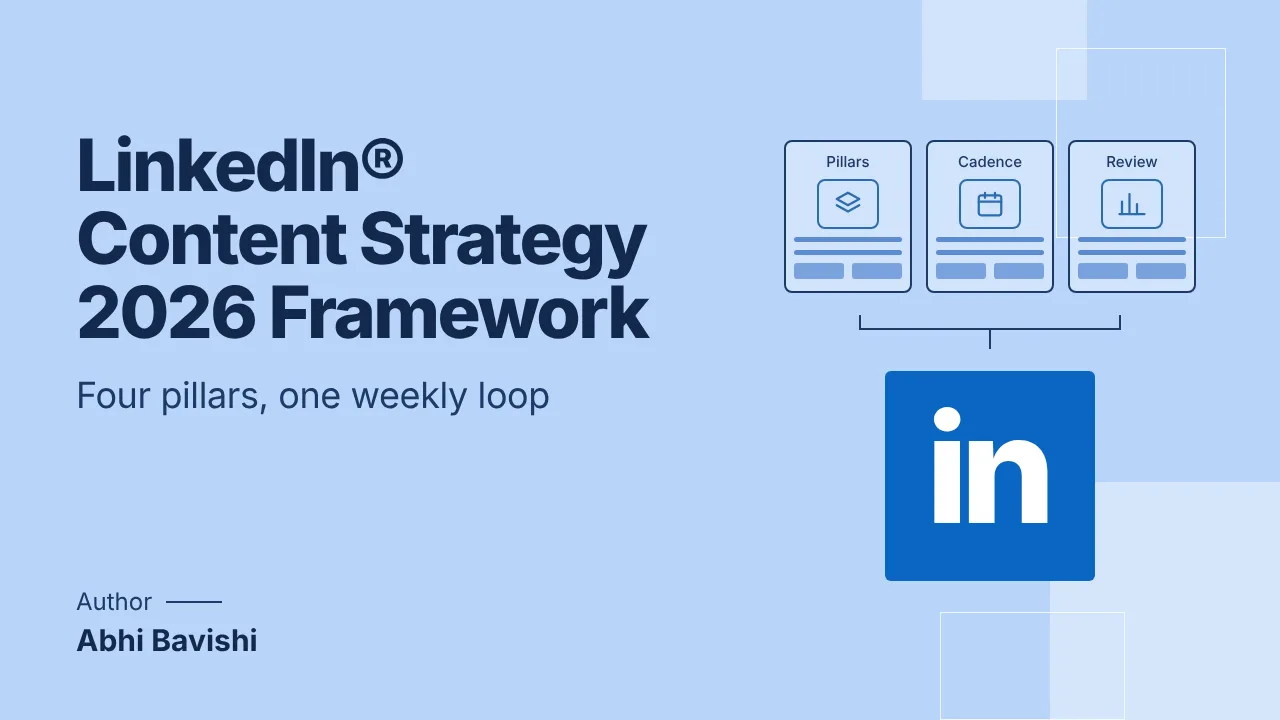
A LinkedIn® content strategy for 2026 comes down to four things: a small set of repeatable content pillars, a posting cadence you can actually sustain, one consistent voice across every post, and a weekly habit of reviewing what the algorithm rewards. Everything else, hooks, formatting, scheduling tools, exists to support those four.
Why "just post more" isn't a strategy
Average LinkedIn® reach dropped 34% in 2025, and reach is down for 98% of users compared to the year before, according to AuthoredUp's Algorithm Insights analysis of over 621,000 posts. In that environment, posting more often without a plan just produces more posts that underperform. A content strategy is what turns "I should post more" into a system that survives a bad week, a busy month, or an algorithm change.
Most people who say they have a LinkedIn® content strategy actually have a content calendar: a list of dates with blank slots. A calendar tells you when to post. A strategy tells you what to say, in what voice, and why it should work.
The four pillars of a 2026 LinkedIn® content strategy
1. Content pillars, not content ideas
A content pillar is a recurring theme you can return to indefinitely: a founder journey, a product lesson, an industry opinion, a client win. Three to five pillars is enough. Fewer than three and your feed feels one-note; more than five and you lose the recognizability that makes people follow you specifically. Every post you write should trace back to one of your pillars, not be invented from scratch each time.
2. A cadence you can sustain
The best cadence is the one you'll still be running in month six. Three focused posts a week, each with a clear pillar and a real detail, consistently beats daily posting that burns out by week three. Build the cadence around your actual capacity, then use a content calendar to hold yourself to it, not to invent it.
3. One consistent voice across every post
Voice consistency is what makes ten posts read as one person instead of ten disconnected drafts. It matters for readers, who start to recognize your pacing and phrasing, and it matters for how AI-written LinkedIn® posts hold up under scrutiny: generic AI output resets its tone with every prompt, while a voice trained on your own past writing carries the same rhythm from post to post.
4. A weekly review loop
Strategy without a feedback loop calcifies. Spend fifteen minutes a week looking at which posts, within which pillar, actually moved: comments, saves, and profile visits, not just impressions. Drop or retire what isn't working and double down on what is. A framework you never revisit isn't a strategy, it's a guess you made once.
What this looks like in practice: a worked example
Take a solo SaaS founder. Four pillars, three posts a week, is enough to run for a year without repeating yourself:
- Product lessons. A specific decision, why it was made, and what changed because of it. Not "here's our new feature," but "here's the feature I killed and why."
- Customer wins. A real outcome with a real number, told from the customer's side, not a testimonial screenshot.
- Industry opinion. A take on where the category is heading, ideally one that disagrees with the obvious consensus.
- Behind the build. The unglamorous parts: a pricing mistake, a hire that didn't work out, a Tuesday that didn't feel like progress.
Each pillar has a distinct job. Product lessons build credibility, customer wins build proof, industry opinion builds reach among people who don't know you yet, and behind-the-build builds the personal connection that makes someone actually click follow. Rotate through all four across the week rather than defaulting to whichever one is easiest to write that day, that's usually the sign a pillar has quietly taken over and the others have gone stale.
Repurposing inside the framework, not instead of it
A content strategy doesn't mean every post starts from a blank page. Existing material, a blog post, a customer call, a talk you gave, is often the fastest way to fill a pillar slot without inventing a new topic from scratch. The discipline is making sure repurposed content still gets filtered through your pillars and your voice rather than pasted in wholesale; see our guide on how to turn a blog post into a LinkedIn® post for the mechanics. Treat repurposing as a source of raw material for your pillars, not a shortcut around having them.
Build your framework in one sitting: 5 steps
- List your 3-5 pillars. Write one line for each: what it's about and why you're credible on it.
- Pick a sustainable cadence. Commit to a number of posts per week you can hit even in a bad week, and assign a pillar to each slot.
- Write down your voice, in your own words. Three sentences that describe how you sound: formal or casual, short sentences or long, first-person stories or third-person observations.
- Batch a week of drafts against the pillars. Draft with your real voice as the anchor, not a generic AI default. If you use a voice-trained tool, feed it your own past posts first.
- Schedule a 15-minute weekly review. Same day, same time, every week. This is the step most strategies skip, and the reason most of them quietly die.
What the LinkedIn® algorithm rewards in 2026 (and how it should shape your strategy)
LinkedIn®'s ranking works in three stages, quality filtering, a small engagement test with an initial audience, then broader network ranking based on how that test performs, per Hootsuite's breakdown of the LinkedIn® algorithm. A few implications for how you plan content:
- Length has a sweet spot. 800-1,000 characters performs best on average, per AuthoredUp's dataset, long enough to make a point, short enough to hold attention.
- Saves and instant reposts are the strongest reach signals in 2025's data, ahead of likes or comments, per the same AuthoredUp analysis. Write posts worth saving, not just skimming.
- External links in the post body reduce reach, according to Hootsuite's own engagement experiment. Put the link in the first comment instead if you need to share one.
- Timing still matters for that initial test window. Hootsuite's research points to Tuesday and Wednesday mornings, 8-9 AM, as strong average windows, though your own audience's habits should override any general rule. A post time finder can help you check against your own posting history.
None of this replaces the four pillars above. It's the environment your strategy has to perform in, not a substitute for having one.
Common mistakes that break a content strategy
- No pillars, just a topic list. Without pillars, every post is a cold start, and your feed never builds a recognizable identity.
- Cadence set by ambition, not capacity. Committing to daily posting in week one is the single most common reason a strategy dies by week four.
- Generic AI voice. A tool that hasn't learned your actual writing produces posts that sound like anyone, which defeats the point of building a recognizable voice.
- Treating the scheduling tool as the strategy. A calendar app tells you when to post. It has no opinion on what your pillars are or whether your voice is consistent.
- Never reviewing what worked. Skipping the weekly review means repeating the same mistakes indefinitely instead of correcting course after two or three posts.
- Copying someone else's pillars wholesale. A pillar only works if you're actually credible on it. Borrowing a competitor's content angles without the underlying experience to back them up reads as hollow within a few posts.
Where Reepl fits into this framework
Reepl is built around the same four pillars this framework describes, not as a replacement for them. Voice profiles train on your own past LinkedIn® posts and writing samples, so drafts carry your actual pacing and phrasing instead of a generic AI default, the consistency piece of the framework. The built-in content calendar creator turns your pillars and cadence into an actual weekly plan instead of a list of good intentions. Templates give you a repeatable starting point for each pillar so a batch-writing session doesn't start from a blank page every time.
Reepl drafts. You review and send. There's no automated posting, commenting, or messaging involved. That's a different approach from template-heavy tools like Supergrow or broad-and-shallow schedulers like Hootsuite, both of which optimize for volume over voice fidelity. If you're building this framework as a solo founder specifically, the underlying approach doesn't change, only the pillars you'll choose. See how the framework plays out for that audience in our guide to LinkedIn® for solo founders.
The strategy is the system, not the posts
A LinkedIn® content strategy that works in 2026 isn't a longer content calendar or a smarter AI prompt. It's four pillars you can name from memory, a cadence that survives a busy week, a voice that stays recognizable post after post, and fifteen minutes a week spent looking honestly at what worked. Get those four right and the algorithm mechanics become a tailwind instead of a mystery.
Build Your LinkedIn® Content Strategy With Reepl
Voice profiles trained on your own posts, plus a content calendar and templates, so your strategy stays consistent every week.