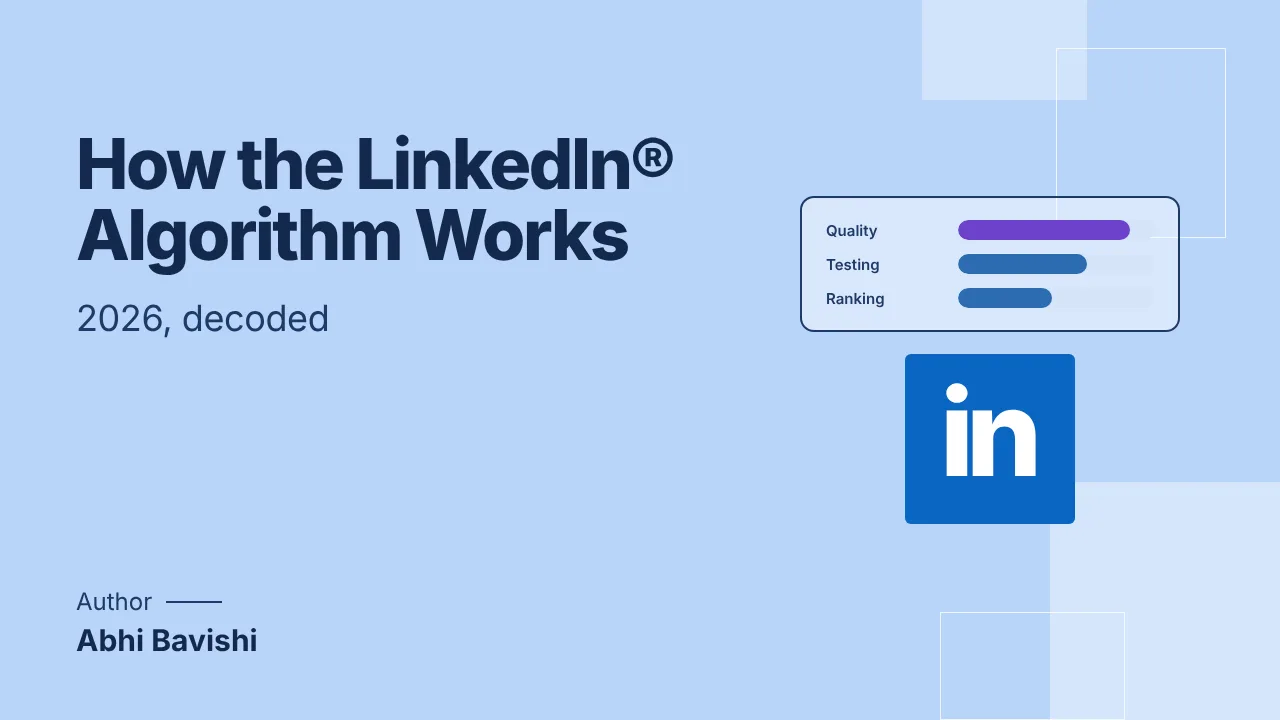
The LinkedIn® algorithm works in three stages: an automated quality filter screens every post for spam and policy violations, a small test audience determines whether it earns a wider reach, and posts that perform well get pushed further through repeated ranking passes across the network. Comments, saves, and reposts count for more than reactions.
The three-stage model LinkedIn® actually runs
"The algorithm" isn't a single formula. According to Hootsuite's breakdown of how LinkedIn® ranks content, the platform runs every post through three distinct stages before deciding how far it travels.
Stage one: the quality filter
The moment you hit publish, an automated classifier checks the post for spam signals, policy violations, and low-quality patterns (excessive hashtags, engagement-bait phrasing, broken links). Posts that fail this filter never reach a meaningful audience, regardless of who wrote them or how good the idea is.
Stage two: the engagement test
Posts that clear the filter go to a small slice of your network first, often a fraction of your total connections and followers. LinkedIn® watches what that test group does in the first hour or two: do they comment, save, or reshare it, or scroll past. This is the stage most creators mean when they talk about the "golden hour."
Stage three: network ranking
Posts that perform well in the test window get ranked again, this time against a broader slice of the network, and the cycle repeats. A post that keeps earning genuine engagement, not just views, can keep climbing for days. One that goes quiet after the first test rarely recovers.
Why reach felt like it collapsed in 2025 (and carried into 2026)
If your numbers look worse than they used to, you're not imagining it. AuthoredUp's Algorithm Insights study, which analyzed 621,833 LinkedIn® posts, found that average reach dropped 34% in 2025 compared with the year before. The same study found reach down for 98% of users year-over-year, meaning the drop wasn't isolated to a few underperforming accounts. It was close to universal.
That kind of platform-wide decline usually points to one thing: more people posting, competing for the same amount of attention and the same test-group ranking slots. The fix isn't to post more into a shrinking pool of attention. It's to make each individual post more likely to survive stage two.
The ranking signals that matter most right now
Saves and instant reposts outrank likes
Per the same AuthoredUp research, saves and instant reposts are the strongest reach drivers on LinkedIn® in 2025. A save tells the algorithm someone found the post worth returning to. An instant reshare tells it someone found the post worth vouching for publicly. Both carry more ranking weight than a reaction, which costs the reader nothing and signals very little back to the algorithm.
Comments outweigh reactions in the engagement test
The stage-two test is built to measure conversation, not applause. A post that earns a handful of substantive comments, especially ones that start a reply thread, clears the test far more reliably than one that racks up hundreds of quiet likes. Writing something that invites a real opinion, not just "agree?", is one of the more controllable levers you have as a writer.
External links in the body suppress reach
Hootsuite's own engagement experiment found that posts with an external link in the body get less reach and engagement than posts without one. LinkedIn® is trying to keep people on the platform, and a post that sends readers away in the first line works against that goal. Put the link in the first comment instead.
Optimal post length in 2026
The era of the 3,000-character LinkedIn® essay is fading. AuthoredUp's research found that posts are getting shorter overall, with 800 to 1,000 characters emerging as the sweet spot for reach in the current algorithm. That's roughly the length of the direct-answer paragraph at the top of this article: enough room for one real idea and one real example, not enough to bury either in throat-clearing.
Timing still matters: the golden hour and best posting windows
Because stage two is a time-boxed test, when you post still affects whether you clear it. Hootsuite's 2025 data places the best average posting window at 8 to 9 AM on Tuesdays and Wednesdays, though "average" is doing a lot of work in that sentence. Your specific audience's active hours matter more than a generic calendar slot. If you want a number tuned to your own connections instead of a platform-wide average, Reepl's free LinkedIn® best time to post calculator estimates it from your own posting history.
Common LinkedIn® algorithm myths in 2026
Myth: more hashtags means more reach
Hashtags help a handful of people browsing a specific tag find your post. They do nothing for the quality filter or the engagement test, and piling on five or six unrelated hashtags reads as exactly the kind of pattern the spam classifier is built to flag. One or two relevant tags is plenty.
Myth: tagging people boosts distribution
Tagging someone notifies them; it doesn't change how the algorithm scores the post itself. If the people you tag don't engage, tagging them adds no ranking signal, and tagging people who have nothing to do with the post reads as spam behavior to both readers and the classifier.
Myth: posting every day is required to stay visible
There's no daily-posting requirement built into the ranking model. What actually happens is more mundane: accounts that post often also tend to be the ones that have found a format and a topic that reliably clears the engagement test, so frequency correlates with results without causing them directly. Two posts a week that each earn real comments will outperform seven posts a week that don't.
Myth: editing a post after publishing hurts reach
Editing a post shortly after publishing to fix a typo doesn't meaningfully change its ranking. What does hurt is republishing the same content repeatedly or deleting and reposting to "reset" a slow start; that pattern looks like spam behavior rather than a normal edit.
Why this matters more for founders and solo creators
If you're posting as an individual rather than a brand page, the stakes of clearing (or failing) the engagement test are higher. A brand page can absorb a few quiet posts inside a broader marketing budget. A founder building a personal audience is relying on each post to compound into pipeline, and a string of posts that stall in stage two can look, from the outside, like the strategy isn't working when it's really a handful of fixable mechanics: the wrong length, a link in the wrong place, or an ending that doesn't invite a reply.
This is also where a lot of founders default to posting inconsistently, which compounds the problem the algorithm is already testing for. Reviewing a draft against the specific signals above, comment-worthy ending, no body link, right length, right window, before you publish is a habit that pays off faster than any amount of guessing at "what the algorithm wants" in the abstract.
How to work with the algorithm instead of fighting it
- Write for a comment, not a like. End with a specific question or a stance someone would want to push back on, not a generic "thoughts?"
- Keep the link out of the post body. Drop it in the first comment if you need to send people somewhere else.
- Aim for 800 to 1,000 characters on most posts, and save the longer format for stories that genuinely need the room.
- Post inside your own golden hour, not a generic best-practice time slot, and stay available to reply to early comments while the test window is still open.
- Check the draft before you publish. Reepl's free LinkedIn® post analyzer scores a draft's engagement potential against these same signals before it goes live.
What doesn't work anymore: automation and comment pods
LinkedIn®'s August 2025 update specifically reduced the visibility of automated comments, the kind produced by bot-style engagement tools and comment pods. That update didn't touch AI-assisted writing. It targeted automated posting and commenting where no human reviews or sends the output. The distinction matters more in 2026 than it did a year ago: tools like Taplio that lean on scheduled automation sit on the wrong side of that line, while a human-in-the-loop workflow, where AI drafts and a person clicks send, doesn't.
That's also why AI-written content that reads as generic keeps losing ground. It's not that the algorithm has a dedicated "AI detector." It's that generic AI output tends to skip the exact signals covered above: it hedges instead of taking a stance, it rarely invites a real comment, and it reads the same from one post to the next. See how voice-trained AI produces posts that still clear the engagement test, and how to spot the signs when your own drafts sound like AI before you publish them.
The bottom line
The 2026 algorithm rewards the same underlying behavior it always has: content that makes a real person want to comment, save, or reshare it within the first hour or two. Reach dropped for almost everyone in 2025 because more people were competing for the same test-group attention, not because the rules quietly changed. Write for a specific reader, keep the link out of the body, post in your own best window, and check your instincts with a free analyzer or time-finder before you publish, rather than after reach has already stalled.
Score Your Post Before You Publish
Voice-trained AI drafts, plus a free post analyzer to check engagement potential against the signals that matter in 2026.