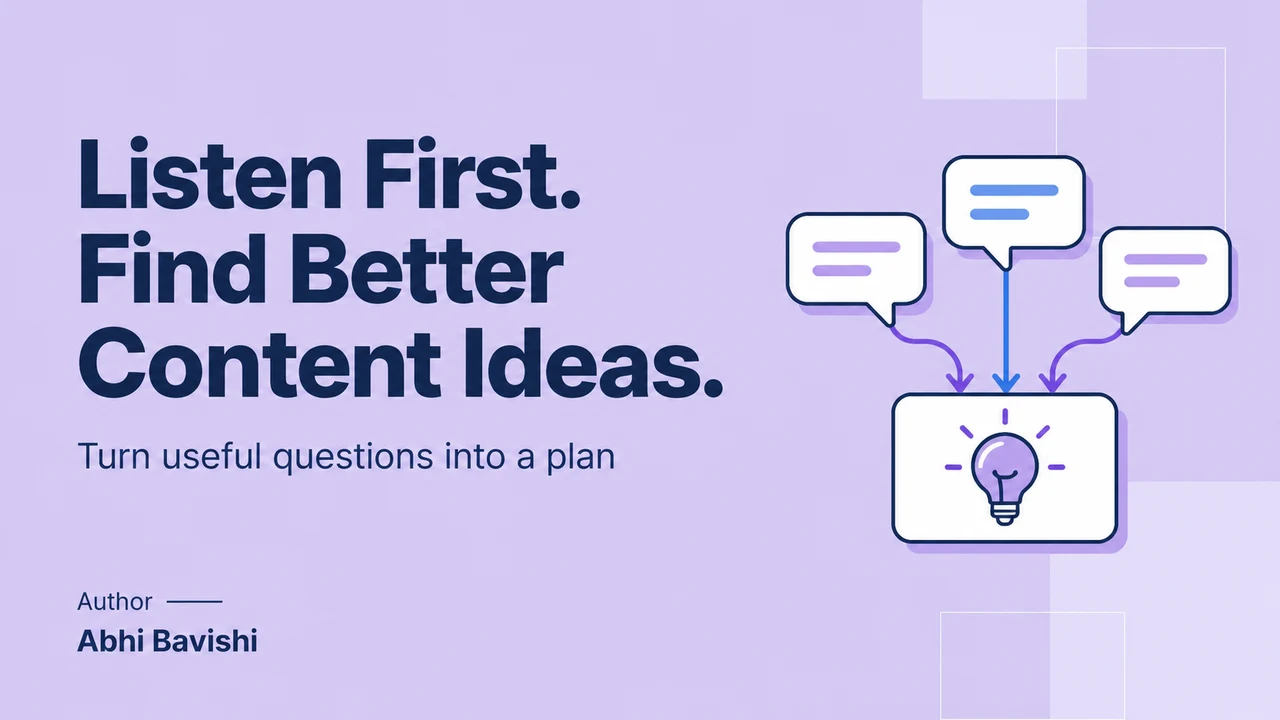
Turn social listening into useful content ideas by collecting specific audience questions, checking their context, and adding an answer you can support. Group related questions around a decision your reader faces. Then write one practical post, preserve the source links, and judge success by the conversations it helps you start.
Key takeaways
- Listen for decisions and recurring confusion, not just popular keywords.
- Keep a source link and context beside every promising observation.
- Treat public conversations as clues, not a representative customer survey.
- Add your experience, an example, or a practical decision rule before drafting.
- Review the questions a post generates to choose your next useful topic.
What is social listening for content ideas?
Social listening is the practice of examining public conversations to understand what people care about, ask, and struggle to resolve. For content planning, the useful output is a reader problem you can help solve, rather than a list of trending subjects.
Sprout Social's explanation of social listening distinguishes the broader interpretation of conversations from tracking individual mentions. That distinction matters when you sit down to write: a mention tells you something happened, while interpretation helps you decide whether it deserves a post.
A founder discussing onboarding delays might be expressing frustration, requesting advice, or criticizing a vendor. Those are different writing opportunities. Read the surrounding discussion before turning one sentence into an apparent demand for your expertise.
Start with a decision your audience makes. A consultant might listen for questions about selecting a research method, getting stakeholder approval, or deciding whether a project is ready to launch. Each decision gives you a narrower and more useful starting point than “leadership” or “growth.”
The goal is to discover language and uncertainty you might otherwise miss. You still need judgment about the answer. A widely repeated claim can be wrong, and a quiet question can be commercially important for the people you serve.
Where should you listen without building an endless feed?
Choose a small set of sources that expose different parts of the same problem. Public communities reveal questions, specialist publications provide developments, and your own permissioned customer notes show the language people use when making decisions.
Google Alerts lets you receive notifications when new matching results appear in Google Search. Use it for narrow phrases, product categories, or named developments. An alert is a discovery mechanism, so open the result and inspect the original source before using it.
Reddit's search documentation describes ways to refine searches and find relevant discussions. Start in communities where your intended readers already discuss the problem, then read their rules and existing answers before considering participation.
RSS feeds from specialist publishers can add useful context without requiring constant browsing. Pair them with a few public discussions rather than subscribing to every publication in your industry. The point is to improve your decisions, not increase the number of unread items.
| Source | Useful question | What it cannot establish |
|---|---|---|
| Public community discussion | What is confusing people here? | What all customers think |
| Specialist publication | What changed in this field? | Whether your audience cares |
| Search interest tool | Is relative search interest changing? | Exact buyer demand |
| Customer notes you can use | What blocked this specific decision? | Market prevalence |
Google Trends explains that its data is sampled and normalized. A higher relative score is not a count of potential customers. Use the tool to investigate changes in attention, then verify the underlying story elsewhere.
Give your first listening pass a fixed time budget, such as 30 minutes. That is a suggested working constraint, not a benchmark. If you finish with one well-understood question and its evidence, the session has done its job.
Which signals deserve a place in your content queue?
A useful content signal combines audience relevance, an unresolved question, and an answer you can responsibly contribute. Popularity can help you discover a discussion, but it should not make the publishing decision for you.
Save the full context alongside your observation. Include the source, date, audience, question, existing answers, and what remains unclear. You should be able to return a week later and understand why the item mattered without reconstructing the entire conversation.
Use these questions when reviewing a candidate:
- Who is trying to make a decision, and what is stopping them?
- Does the discussion describe the audience you actually help?
- What have other people already explained well?
- Can you add evidence, experience, or a practical example?
- What could make your interpretation misleading?
Avoid scoring systems that pretend to be precise. A simple “write,” “investigate,” or “archive” decision is often enough. If you cannot explain the missing answer in a sentence, move the item into investigation rather than forcing a draft.
A competitor announcement might deserve attention when it changes a buying decision. A heated argument might deserve none if you have no useful expertise. You can acknowledge an important development without manufacturing an opinion about every popular discussion.
Keep contrary evidence in the same note. If one community complains about a workflow while another reports that it works well, the disagreement may be the real topic. Write about the conditions that explain the difference instead of claiming universal failure.
How do you turn a conversation into an original angle?
Turn the observation into a specific reader question, then answer it using something beyond the original conversation. Your contribution might be a decision tree, a worked example, a caution from experience, or a comparison of realistic options.
The transformation should be visible in your notes. “People are discussing onboarding” is a topic. “How should a founder decide which onboarding steps to remove?” is a question. “Remove steps that collect information nobody uses before the first useful outcome” is a potential answer to investigate.
Use this compact brief before asking anyone, including an AI writer, to draft:
| Brief field | What to write |
|---|---|
| Reader | The person making the decision |
| Trigger | The situation that makes the question urgent |
| Question | One question in the reader's language |
| Answer | Your provisional recommendation |
| Evidence | Source links and relevant experience |
| Boundary | When the recommendation does not apply |
| Next step | One action the reader can take |
The boundary is especially valuable. Advice about reducing onboarding steps may be wrong when a step is legally required or prevents a serious error. Naming that limit makes the post more useful and gives you a clearer reason to choose one example over another.
If you use AI, provide the brief and the source excerpts you are entitled to use. Ask for a draft that distinguishes documented facts from your recommendation. Review every factual claim and replace generic phrasing with language you would actually use.
Do not turn another person's distinctive wording into your own discovery. Reddiquette encourages attention to original sources and community norms. Link to public discussions when appropriate, avoid exposing unnecessary personal details, and ask permission before using private material.

What does a worked listening example look like?
Consider an illustrative consultant who helps small software teams improve customer onboarding. The following discussion themes and draft are invented to demonstrate the method. They are not customer research, a measured trend, or a claim about real public posts.
The consultant notices three questions: whether to require a setup call, how much information to collect at signup, and why people abandon a checklist. Instead of drafting three unrelated posts, the consultant identifies a shared decision: what must happen before a customer gets value.
The initial angle is too broad: “Five ways to improve onboarding.” It could have been written without listening to anyone. The revised angle addresses the shared uncertainty: “Which onboarding steps should happen before the first useful result?”
The consultant writes a small example using a fictional scheduling product. Creating an account is necessary to save appointments. Adding a company logo is optional. Confirming a time zone prevents mistakes. Importing the entire contact list can wait until a customer understands the basic workflow.
A draft might begin: “Before you remove an onboarding step, ask what breaks if it happens later. In a scheduling product, a missing logo is inconvenient. A wrong time zone can ruin the first appointment.”
The body explains how to classify required, optional, and deferrable steps. The closing question asks readers which step their team struggles to classify. That invites useful detail without claiming that the example proves a universal rule.
Notice what the consultant has added: a decision rule and a concrete demonstration. The public conversations supplied the question, but they did not supply the entire post. This is the difference between research informing your thinking and simply repackaging someone else's work.
Before publishing, the consultant checks that the example contains no customer identifiers and labels it illustrative. They also record what evidence would change the recommendation, such as regulatory requirements or a workflow where importing contacts is the first useful result.
How can you build a weekly listening routine?
Separate collecting, deciding, and writing into short sessions. If you draft immediately after every interesting item, the loudest conversation can take over your calendar. A review step gives quieter but more useful questions a fair chance.
For a first week, try a 30-minute collection session, a 20-minute review, and a separate drafting block. These are planning suggestions. Adjust them to your workload, and stop collecting when the evidence is sufficient for the decisions you need to make.
Use a repeatable sequence:
- Collect a few relevant observations with their source links.
- Group observations by the decision behind them.
- Select one question you can answer with evidence or experience.
- Draft the answer with an example and an explicit limitation.
- Record the follow-up questions after publishing.
Keep the queue small enough to review in one sitting. Archive duplicate observations once you have preserved their useful context. Repeated mentions can increase your confidence that a question deserves investigation, but they do not establish how common the problem is across a market.
Add a review date to time-sensitive topics. A product announcement or policy discussion may become obsolete before your scheduled publishing slot. Reopen the primary source before publication, especially when the recommendation depends on the current version of a feature or rule.

Where can Reepl help with the listening workflow?
Reepl is an AI writing platform that puts your social media on autopilot in your own voice: it finds what to post about, drafts your posts, and keeps your calendar full, with you choosing what it does without asking.
Signals supports a workflow built around sources and topics you choose. Use the items you find as inputs to a listening brief, then check the original source and decide what you can contribute. Finding a discussion does not verify its claims or make it appropriate to publish.
Keep the editorial decision in your own hands. A useful starting point is one audience question, one source-backed answer, and one practical example. You can complete that process with a notebook as well; the quality comes from the reasoning you add.
How do you know whether listening improved your posts?
Look for better questions and more relevant conversations, alongside whatever business outcome your publishing supports. A post that attracts fewer reactions but clarifies a serious buying concern may be more useful than a broad opinion that gets casual agreement.
Maintain a simple review note: the original question, what you published, what readers asked next, and whether the answer needed correction. Keep observations separate from conclusions. One promising reply is evidence of that conversation, not proof that an entire content strategy works.
Use the next review to refine the brief rather than simply repeat a successful headline. If readers misunderstand the same step, explain it more clearly. If the discussion exposes an exception, write the follow-up. Listening becomes useful when it changes the quality of your answer.
Continue with our guides to using Reddit observations for customer research and adapting a useful idea for each platform.
Put your next idea into words
Draft in your voice, review the details, and choose what to publish.