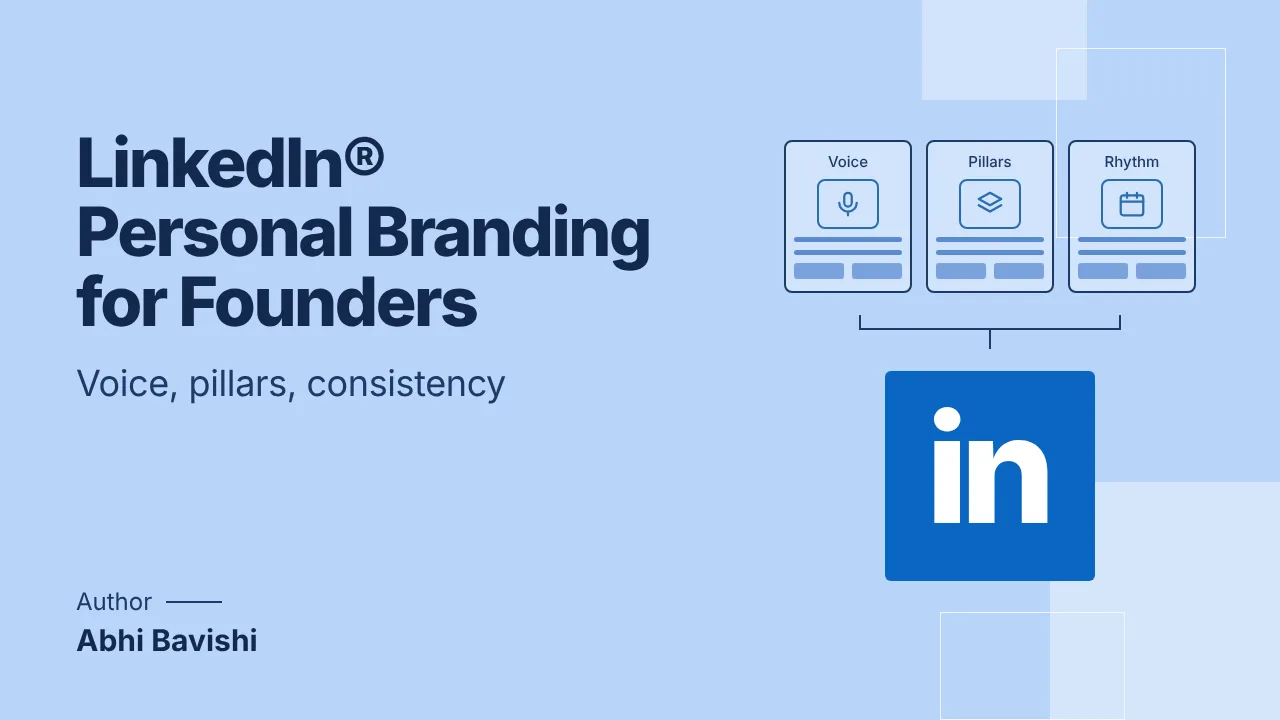
LinkedIn® personal branding for founders means building a recognizable point of view under your own name, not your company page, so the people who eventually buy from you, hire you, or invest in you already trust you before the first call. It rests on a consistent voice, a profile that backs up your claims, and a small set of topics you return to on purpose.
Most founders get this backwards. They treat their LinkedIn® profile like a static resume and their posts like a company newsletter, then wonder why neither one moves a deal forward. Personal branding done right is closer to a compounding asset: every post, comment, and profile update either reinforces the same recognizable voice or dilutes it.
What personal branding actually means on LinkedIn®
A personal brand is not a slogan or a bio line. It is the pattern people notice after seeing your name enough times: the topics you always have an opinion on, the way you explain things, and the results you can point to. For founders specifically, that pattern needs to answer one question fast, why should a stranger trust this person's judgment on the thing they're building?
This is different from influencer-style personal branding, which optimizes for reach and reaction volume. Founder branding optimizes for a much smaller, higher-intent audience, future customers, candidates, investors, and partners, who are reading closely even when they never comment. A post that gets 40 reactions but reaches three people who later book a call has done its job. A post that gets 4,000 reactions and zero pipeline has not.
Why your LinkedIn® profile is the real landing page
Founders spend hours on post copy and skip the profile that every one of those posts links back to. That is backwards. Anyone who clicks through from a post, a comment, or a mutual connection lands on your profile first, not your company's website. If the headline is a job title and the About section is a paragraph of buzzwords, the trust a good post just built evaporates in the next five seconds.
Headline: say what you help with, not just your title
"Founder & CEO at [Company]" tells a reader nothing they can't get from your job title. A stronger headline names who you help and how, in plain language. If writing that from scratch feels harder than it should, Reepl's free LinkedIn® Headline Generator gives you a fast first draft to edit into your own words.
About section: proof, not a resume
The About section is where a skeptical reader decides whether to keep reading your posts or move on. It should read like a short, specific case for why you're credible on your topic, not a chronological list of past roles. Reepl's free About Section Generator for LinkedIn® is a useful starting point if you're staring at a blank box.
The four building blocks of a founder's personal brand
Strip away the tactics and a durable founder personal brand comes down to four things, in this order of importance.
1. A consistent voice
Voice is the specific words, rhythm, and level of directness that make a post recognizably yours even with the name blocked out. Most AI-assisted posting fails here, generic prompting produces generic voice, and readers can tell within a sentence or two (see can AI write LinkedIn® posts that sound human for the specific signals that give generic AI writing away). This is the single biggest lever founders underinvest in, because it's invisible until it's missing.
2. Three or four recurring content pillars
Pick a small number of topics you're willing to post about repeatedly, for example: lessons from building the product, a specific industry problem you understand better than most, behind-the-scenes founder decisions, and customer outcomes. Three or four pillars is enough range to avoid repetition and narrow enough that regular readers know what to expect from you.
3. Consistency over virality
One viral post does more for your ego than your brand. A personal brand compounds from showing up on a predictable cadence, weekly at minimum, so the same audience sees your name enough times to start recognizing the pattern. Chasing a single high-reach post at the expense of a sustainable rhythm is a common way founders burn out and quietly stop posting within a month.
4. A profile that matches the content
Every one of the first three only works if the profile someone lands on afterward backs it up. Headline, About section, and featured content all need to point at the same story the posts are telling.
How the LinkedIn® algorithm actually rewards personal brands
LinkedIn®'s ranking system runs new posts through three stages, an initial quality filter, a small-audience engagement test, and then a wider network-ranking pass based on how that test performed, according to Hootsuite's breakdown of the LinkedIn® algorithm. A recognizable personal brand helps at every stage of that funnel: people who already know your name are more likely to engage fast during the test window, which is exactly the signal that pushes a post into wider distribution.
This matters more now than it did a year ago. Average LinkedIn® reach dropped 34% in 2025, and reach is down for 98% of users compared to the year before, according to AuthoredUp's Algorithm Insights study of over 620,000 posts. In a lower-reach environment, a small, loyal, high-engagement audience is worth more than a large, indifferent one, which is exactly what a personal brand builds over the accounts that skip it.
Timing still has a real effect on top of that. The best-performing window in Hootsuite's 2025 data was 8-9 AM on Tuesdays and Wednesdays, worth testing as a default before optimizing further.
A simple weekly system founders can actually keep
The founders who sustain a personal brand for years, not weeks, tend to run a version of this loop:
- Once a week: capture 3-5 raw ideas from the week, a decision you made, a customer conversation, a mistake you caught. Rough notes are enough.
- Draft in one sitting: turn those notes into posts against your three or four pillars, in your own voice, rather than starting from a blank page each time.
- Review before sending: a short pass to sharpen the hook, check any fact or number, and make sure it still sounds like you, not a template.
- Post on a fixed cadence: pick a schedule you can hold for a year, not a month, and treat consistency as the metric that matters most early on.
The bottleneck for most founders isn't ideas, it's turning raw notes into a finished draft without losing an evening to it.
Where AI helps, and where it still needs you
This is where a voice-trained AI tool changes the math. Reepl trains a voice profile on your own past LinkedIn® posts and writing samples, so drafts start closer to your actual voice instead of a generic AI tone. Reepl also runs a free Profile Analyzer for LinkedIn® that scores your headline, About section, and overall profile so you know exactly what to fix before you invest in more posts pointing back to it.
What AI shouldn't do is publish on your behalf. Reepl's workflow is human-in-the-loop by design, it drafts the post, comment, or message, and you review and send it. There's no automated posting, auto-commenting, or auto-DMing from a bot account. That distinction matters for a personal brand specifically, because a brand is built on the assumption that the words are actually yours. Tools built around fully automated posting or engagement work against the trust a personal brand depends on.
Compared to broader analytics or scheduling tools like Shield, which covers LinkedIn® analytics but no content generation, or template-based writers like Supergrow and formatting-only tools like AuthoredUp, Reepl's voice-profile approach is built specifically for the "sounds like a person, not a brand account" problem that personal branding requires.
Why a consistent voice compounds beyond the post itself
There's a second reason a consistent, recognizable voice pays off beyond how any single post performs. Branded mentions correlate 0.67 with appearances in AI Overviews, and the top 25% of brands by mention volume receive 10x or more AI Overview citations than everyone else, according to Ahrefs Brand Radar. A founder whose name shows up consistently, in a consistent voice, across LinkedIn® posts, comments, and their own site, builds exactly the kind of recognizable mention pattern that AI systems increasingly use to decide who to cite. A personal brand that changes tone every week never builds that pattern, no matter how often it posts.
Common mistakes that flatten a founder's personal brand
- Posting only company news. Product launches and hiring announcements read as marketing, not a personal point of view. Save those for the company page and use your personal profile for perspective.
- Switching topics every week. Range without a pattern reads as noise. Readers need to know what you're reliably good at talking about.
- Publishing generic AI output unedited. A prompt with no personal detail produces a post that could have been written by anyone, which is the opposite of a personal brand.
- Ignoring the profile. A strong post with a generic headline and an empty About section wastes the trust the post just built.
- Quitting after a quiet month. Personal brands compound slowly. The founders who stick around a fixed cadence for six months consistently outperform the ones chasing one viral post.
None of these are hard to fix individually. The founders who build a durable LinkedIn® presence are usually the ones who fix all four building blocks at once, voice, pillars, consistency, and profile, rather than optimizing one and neglecting the rest.
Build Your LinkedIn® Voice with Reepl
Voice profiles trained on your own past posts, so AI drafts sound like you, not a template.