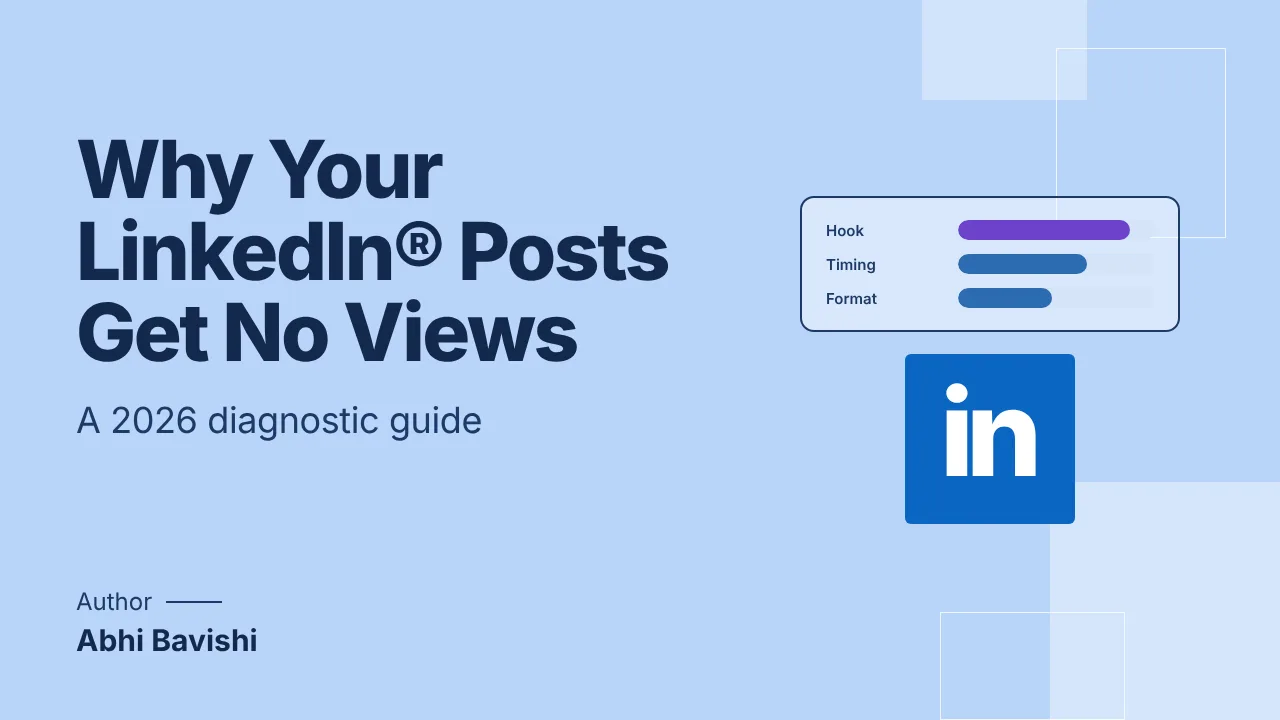
The most common reasons a LinkedIn® post gets no views in 2026: an external link in the post body, publishing outside your audience's active hours, weak engagement in the first hour, or spam-like patterns like hashtag stacking. Reach is down for most accounts industry-wide, so a single flat post is not always a personal failure. Run through the checklist below to find which cause applies to your post.
If a post used to work and suddenly does not, the instinct is to blame the algorithm, or worse, assume LinkedIn® is punishing you personally. Usually it is neither. It is one or two specific, checkable things. This guide walks through the seven most common causes, ranked by how often creators run into them, a checklist to test each one, and what to actually do if your reach dropped hard overnight.
Reach is down industry-wide, not just for you
Before diagnosing your specific post, it helps to know the baseline. AuthoredUp's analysis of over 620,000 posts found that average LinkedIn® reach dropped 34% in 2025, and reach was down for 98% of accounts compared to the year before. If your numbers softened across the board and not just on one post, you are looking at a platform-wide shift, not a personal penalty.
That context matters because it changes the question. "Why did my reach drop?" is a different problem from "why did this one post flatline while my others are fine?" The first is a platform trend you adjust to. The second is almost always one of the seven causes below.
The 7 reasons LinkedIn® suppresses a post
LinkedIn® does not publish exact suppression triggers, so this list is ranked by how often practitioners and analytics tools report running into each one, not by an official percentage. Test them in order.
1. An external link in the post body
This is the single most common self-inflicted cause. LinkedIn® wants to keep people on the platform, and a link that sends readers elsewhere works against that. Hootsuite ran a controlled engagement experiment and confirmed that posts with external links in the body get measurably less engagement and reach than the same post without one.
The fix is not to stop sharing resources, it is to move the link. Put it in the first comment instead of the caption, or, if the link has to be in the post itself, expect a reach penalty and budget for it.
2. You posted outside your audience's active hours
Hootsuite's research puts the aggregate best time to post on LinkedIn® at 8 to 9 AM on Tuesdays and Wednesdays. That is a useful starting point, but it is an average across a huge, mixed audience. It is not necessarily when your specific followers are online. A B2B audience in one time zone behaves differently from a creator audience spread across three continents.
If you post at 11 PM your time because that is when you have energy to write, you are very likely publishing into a quiet feed. Check when your own audience is actually active rather than copying a generic best-time chart.
3. Weak engagement in the first hour
Hootsuite describes LinkedIn®'s ranking process as a three-step model: quality filtering, then engagement testing on a small slice of your audience, then a decision on whether to expand distribution to your wider network. That middle step is the one that decides most outcomes. If the small initial sample does not engage, LinkedIn® has little reason to push the post further.
Practitioners often call this early window the "golden hour," though LinkedIn® has never published an exact length for it. What matters is not the precise minute count, it is that the first wave of engagement functions as a signal the algorithm uses before deciding how far to distribute the post.
4. Spam-like patterns
Stacking a long list of hashtags, tagging people who are not connections hoping for a notification bump, or posting the same link repeatedly across multiple posts all read as manipulation attempts rather than genuine content. None of these are officially documented as automatic suppression triggers, but they correlate with lower reach often enough that most practitioners treat them as a real risk and avoid them.
5. Your SSI score dropped
LinkedIn®'s Social Selling Index tracks how consistently you build a professional brand, find the right people, engage with insights, and build relationships. It is not a direct ranking input LinkedIn® has confirmed for the feed algorithm, but a falling SSI usually reflects the same underlying pattern that hurts reach: less consistent posting, less genuine engagement given to others, a thinner network.
6. A recent algorithm update
LinkedIn® adjusts its ranking model regularly, and updates do not come with an announcement or changelog for creators. If your entire niche or format saw a reach shift at the same time, that is a strong signal it was an update, not something you did. This is the case where comparing notes with other creators in your space is genuinely useful.
7. Your content pillars shifted and your audience disengaged
If you have been posting reliably about one topic and then switch subjects for a stretch, the audience that followed you for the original topic quietly stops engaging, and the algorithm reads that drop as declining relevance. This is less a single-post problem and more a drift that compounds over weeks. It is also the easiest one to prevent with a defined set of content pillars you return to consistently.
How to test each cause: a quick checklist
- Open the flat post. Is there a link in the caption itself, not the first comment? If yes, that is cause #1.
- Check your posting time against when your own audience is typically active, not a generic best-time chart. If you posted well outside that window, that is cause #2.
- Look at engagement in the first hour after publishing versus your usual posts. If it started slow and stayed slow, that points to cause #3.
- Count the hashtags and check for tags on non-connections. More than a small handful, or tags on people who do not follow you, points to cause #4.
- Check your SSI score in LinkedIn®'s Sales Navigator or profile dashboard. A recent drop supports cause #5.
- Ask two or three peers in your niche if their reach shifted around the same date. A shared drop points to cause #6.
- Look back four to six weeks. If your topics have wandered from what originally grew your following, that is cause #7.
Paste the post itself into the free Post Analyzer for LinkedIn® to get a structural read on length, formatting, and common reach-limiting patterns before you go through the manual checklist above.
What to do if your reach dropped hard, overnight
A sudden, sharp drop, well beyond the 34% industry average, is worth treating differently from a single flat post. Here is a practical recovery approach.
A recovery approach for the week after a drop
- Days 1-2: Do not delete the flat post. Deleting does not reset any flag and can read as an additional inconsistency signal. Let it sit.
- Days 2-4: Post normally, on your usual pillar, at your usual time. Resist the urge to overcorrect with an off-brand "viral bait" post, it usually performs worse and confuses the audience you have built.
- Days 3-5: Spend extra time actually engaging, commenting thoughtfully on other people's posts in your niche, not just posting your own. Genuine engagement given out is one of the more reliable ways to rebuild signal.
- Days 5-7: Review whether the drop was isolated to you or shared across your niche (cause #6). If it was shared, stop treating it as a personal problem and simply keep a consistent cadence.
LinkedIn® does not publish an official recovery timeline, so treat any specific day count you see elsewhere as a rough community estimate, not a guarantee. The consistent pattern practitioners report is that a single flat post, on its own, tends to have limited lasting effect on future posts, while a string of low-quality or off-pillar posts compounds the problem.
When to post a "reset" post
Rather than trying to force a viral swing, a reset post works best when it goes back to the format and topic that grew your audience in the first place, a story, a specific lesson, or a clear opinion in your usual voice. The goal is to re-establish the pattern the algorithm and your audience both recognize, not to chase a completely different format hoping something sticks.
How to prevent this from happening again
Define content pillars and stay consistent
Cause #7 above, drifting off-topic, is one of the few causes fully in your control. Pick three to five recurring themes and keep returning to them. This does not mean every post looks the same, it means the audience always knows roughly what they are getting from you, which keeps engagement (and the algorithm's read on relevance) stable.
Reepl's scheduling and content-planning workflow is built around this: you draft in your own voice, on your own pillars, and Reepl helps you plan a consistent cadence instead of posting reactively. Reepl never posts, comments, or messages on its own, you draft, review, and click send every time.
Monitor before you need to diagnose
Waiting until a post flatlines to start checking your numbers means you are always reacting. Tools like AuthoredUp and Shield track analytics over time so trends are visible before a single bad post feels like a crisis. Reepl's Best Time to Post finder and Post Analyzer give you two of the cheapest habits to build: check your actual audience's active hours periodically, and run a new post through a structural check before it goes out, rather than after it has already gone quiet.
Most "no views" posts trace back to one of the seven causes above, and most of them are fixable within a week. If you want a second opinion on a specific post rather than working through the list manually, the free Post Analyzer is the fastest way to check it.
Check a post before it goes quiet
Reepl scores your draft for common reach-limiting patterns and helps you plan a consistent posting cadence in your own voice. You always review and send.