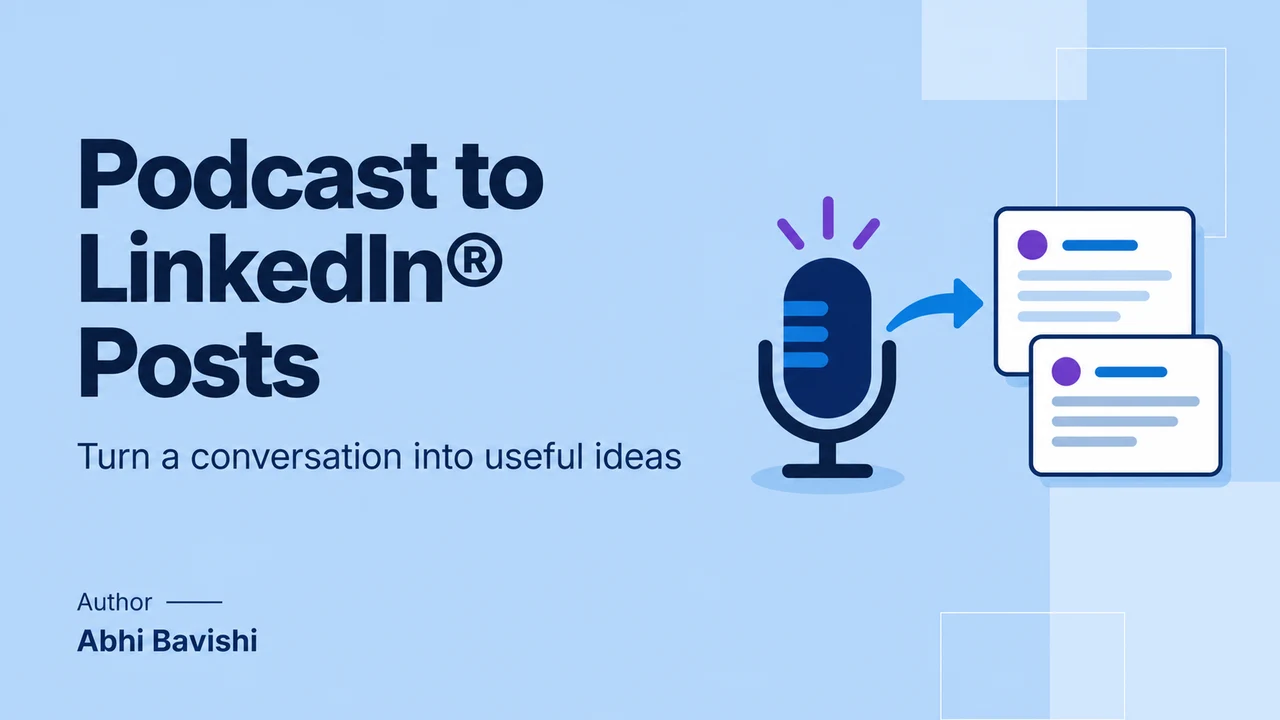
Turn a podcast episode into five distinct LinkedIn® posts by finding one story, one argument, one lesson, one framework, and one unresolved question. Check each idea against the recording, preserve the speaker’s qualifications, and write every post to stand alone. Review attribution and permissions before arranging the drafts into a sequence.
Key takeaways
- Start with a checked transcript and timestamps, not an episode title or an AI summary.
- Give each post a different reader benefit instead of rewriting the same takeaway five times.
- Separate the guest’s statements from your interpretation, especially when writing in first person.
- Keep conditions, uncertainty, and exceptions that affect the meaning of the original discussion.
- Publish only as many posts as the episode supports; five is an editorial target, not a quota.
What should you collect before writing?
Collect the recording, a usable transcript, the episode’s public source page, and the speaker details. W3C’s transcript guidance shows how to identify speakers and distinguish added clarifications from recorded words.
A source ledger is a working record that connects every proposed post to the passage supporting it. Keep that record beside your drafts so revisions do not gradually drift away from the conversation.
Read the transcript once for the overall argument. Then listen to the passages you might reuse, including the conversation immediately before and after them.
Transcription can mishear a product name, lose a negative, or give one speaker’s words to another.
For each candidate passage, save the timestamp, speaker, exact wording, relevant qualification, and intended use. Record whether you are quoting, paraphrasing, or adding your own analysis.
A paraphrase changes wording while preserving meaning. GOV.UK’s transcription guidance distinguishes verbatim transcripts from summaries, which convey themes rather than exact words.
If you hosted the episode, check your guest agreement and any promises about editing or promotion. If you are a guest, check what the producer permits you to reuse.
If you are discussing someone else’s episode, use your own commentary, credit the source, and check permission before reusing substantial excerpts or media. Attribution and permission answer different questions.
Plan one session for source review and another for drafting. A short, clear interview may fit into an hour of editorial work; technical conversations or unclear reuse rights can take longer.
Treat that as a planning allowance, not a productivity promise.
How do you find five genuinely different angles?
Assign five different jobs before writing hooks. The story shows a decision unfolding.
The argument challenges an assumption. The lesson explains a correction.
The framework gives readers a procedure. The question opens a specific uncertainty that remains unresolved.
| Post type | Material to find | Reader benefit | Common failure |
|---|---|---|---|
| Story | A situation, decision, and consequence | Recognize a familiar problem | Inventing a dramatic outcome |
| Argument | A claim with reasoning and limits | Reconsider an assumption | Making the claim absolute |
| Lesson | A mistake and a better next move | Avoid a similar mistake | Turning one case into proof |
| Framework | Steps or a repeatable decision | Apply the idea | Attributing your structure to the guest |
| Question | A genuine tradeoff | Compare experiences | Asking for agreement |
Each post needs a different purpose. If every draft ends with “write down the decision,” the angles probably overlap.
Change the underlying reader task before changing the opening sentence.
Our newsletter repurposing guide covers a related process for written source material. Here, the unit of work is narrower: one verified conversation becoming five independent posts on the same platform.

What does a usable source excerpt look like?
The following is a fictional podcast excerpt, created only to demonstrate the method. The show, speakers, timestamps, and events are illustrative.
No real recording was analyzed. All five finished posts below discuss this fictional example explicitly, so they cannot be mistaken for reported experience.
Fictional episode: “When project reviews become approval queues.”
Host, 08:10: What changed in your team’s weekly review?
Guest, 08:18: Our design team brought every open question to Friday’s meeting. People arrived with screenshots, but often nobody had written down the decision they needed. We spent the meeting discovering the question.
Guest, 09:02: We tried a shorter agenda first. That did not address the missing decision. Then we asked the person bringing a topic to write three things: the decision, the owner, and what would happen if we waited.
Host, 09:48: Did that replace the meeting?
Guest, 09:53: No. Some topics moved into written discussion. We kept the meeting for disagreements where people had different assumptions. We did not measure time saved, so I would not put a number on it.
Guest, 10:35: This was an internal design team. A regulated approval process may need a different record. And urgency can be real. Sometimes waiting creates a bigger problem than a rough decision.
The usable material is specific: screenshots without a decision, an unsuccessful shorter agenda, a three-part note, and a distinction between written discussion and live disagreement. There is no measured productivity gain, no universal meeting rule, and no evidence about other teams.
What do the five finished posts look like?
These examples are complete posts, including the context needed to understand them independently. Use their structures with your own verified source.
Do not replace “fictional” with a real guest’s name unless the underlying details actually match.
1. The story post: show the failed first fix
A shorter agenda can leave the real meeting problem untouched.
Consider a fictional design team that brings screenshots to its Friday review. Everyone can see the work. Nobody has stated the decision.
The team shortens the agenda. The conversation still starts with people trying to discover what they are being asked to decide.
The next change happens before the meeting: each topic needs a decision, an owner, and a note about what happens if the team waits.
Some topics move into written discussion. Others stay in the meeting because people disagree about the assumptions.
There is no measured time saving in this example. The useful change is that the question becomes visible before everyone gathers to answer it.
Before shortening your next review, check whether each agenda item names an actual decision.
The story centers on the order of events. Its restraint matters: the fictional source supports a change in preparation, not a claim that the team transformed its performance.
2. The argument post: challenge a narrow assumption
Meeting length is an incomplete diagnosis of meeting quality.
In a fictional podcast scenario, a design team shortens its review agenda and still struggles. The missing ingredient is a written decision for each topic.
That example suggests a useful distinction: a scheduling problem and a decision problem may need different fixes.
A scheduling problem might call for fewer attendees or less time. A decision problem might require a named owner, clear alternatives, or agreement on what is being decided.
This does not make long meetings good. It gives you another question to ask before cutting them.
Look at the last review that felt unproductive. Could everyone have written the same sentence describing the decision?
If the answers differ, start there. A shorter calendar invitation cannot resolve an undefined question on its own.
This post advances an interpretation. In a real adaptation, introduce it as your reading of the discussion unless the guest made that same argument directly.
3. The lesson post: make the correction usable
An agenda topic can name the work without naming the decision.
“Review onboarding screens” tells a team what to look at. It leaves open what the team should resolve.
In a fictional design-team example, that gap survives an attempt to shorten the agenda. The team then asks people to state the decision before bringing a topic to review.
A more useful agenda item might read: “Choose whether account setup happens before or after the product tour.”
That sentence is an illustrative rewrite, not a detail from the fictional conversation. It shows the distinction in practice.
You can still bring screenshots and background. The decision sentence gives that material a purpose.
Try rewriting one item on your next agenda. If you cannot name the choice yet, label the session as exploration and give it an appropriate outcome, such as identifying the options.
The new onboarding detail is clearly labeled as an addition. That boundary lets you teach with fresh examples without quietly expanding what the source said.
4. The framework post: offer a short procedure
Before a project review, try a three-line decision note.
This procedure adapts a fictional podcast example about an internal design team:
- Decision: What choice needs to be made?
- Owner: Who is responsible for moving it forward?
- Delay: What happens if the choice waits?
Then choose the conversation format. Written discussion may be enough when the question is clear and the relevant context is available. A live meeting may help when people are reasoning from different assumptions.
The note does not replace a formal approval record. It also does not establish that a decision is safe merely because someone wants it quickly.
Use it as a preparation check for one ordinary internal review. Afterward, ask whether the note clarified the conversation or left a missing piece.
Keep the fields that help your team decide. Add the record your actual process requires.
The three fields come from the excerpt. The application guidance is editorial advice.
Preserve that distinction when a real speaker supplies only part of your framework.
5. The question post: invite a concrete comparison
When does an unresolved project decision deserve a meeting?
A fictional design-team scenario offers one dividing line: move some topics into written discussion, but meet when people disagree about their assumptions.
That leaves a practical tension. Written discussion can reveal an assumption slowly. A meeting can expose it quickly, but it can also gather people before anyone has prepared the question.
One possible trigger is a written exchange where participants keep answering different questions. Another is a deadline where waiting has a clear consequence.
These are starting points for judgment, not universal rules. Team size, the stakes, and approval requirements change the answer.
For an ordinary internal project, what signal makes you move a discussion from writing into a meeting?
A specific example would be useful: what remained unresolved, and what did the live conversation make possible?
The question introduces the tradeoff before asking readers to contribute. Someone can answer without hearing the episode or agreeing with its premise.
How should you check and sequence the drafts?
Review meaning first, voice second, and scheduling last. Polishing a sentence before checking its source can make an unsupported claim harder to notice because it already sounds finished.
Use this review order:
- Open the source passage beside each draft and check the speaker, claim, qualification, and any number.
- Mark every added example or interpretation. Attribute it to yourself or label it illustrative.
- Check first-person language. Never turn a guest’s experience into something you appear to have done.
- Add the real episode title, speaker credit, and source link where readers can identify the material.
- Review required permissions and any guest approval before scheduling.
- Read all five openings and endings together to spot repeated promises.
For voice, read the draft aloud and remove expressions you would never use. The guide to teaching AI your writing style provides a fuller method for keeping assisted drafts consistent.
A possible sequence is story, lesson, argument, framework, then question, with unrelated posts between them. That is an editorial choice, not an algorithm rule.
Publish the question earlier if reader examples would improve the framework. Pause the sequence if the discussion reveals an error or a missing qualification.
Evaluate each post against its purpose. Did the framework prompt useful application questions?
Did the argument produce substantive disagreement? Did the source link help interested readers find the episode?
Keep those observations separate from broad claims about what format “works.” One batch cannot establish a universal result.
Review each resulting claim against the recording. A drafting assistant does not remove the need to verify source material or secure any required reuse permissions.
Choose one episode and build its source ledger before drafting. If you find only three strong angles, publish three strong posts and keep the remaining space for another idea.

Put your next idea into words
Draft in your voice, review the details, and choose what to publish.